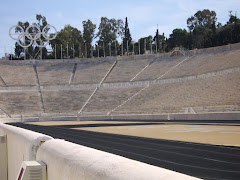
While on sabbatical in Munich last summer, it was fun to stumble upon a new Olympic film with the title "
Berlin 36."
Of course, at the time it seemed there was no hope of screening this film any time soon (
trailer here) -- I speak/read no German, and the art-house "look" to the preview did not hint of mainstream release (it was later revealed the film opened in Germany in September 2009).
With thanks to the P.R. team for AJFF, I viewed "Berlin 36" at home and look forward to viewing the big screen version at the Festival Premiere event tomorrow evening.
The festival's other films, including some sports-themed titles (especially the sumo-scale "
A Matter Of Size" regarding the Japanese sport), are on my to-do list for the final days before heading to Vancouver (be sure to check out the
AJFF's complete schedule).
But back to a review of "Berlin 36" ...
"Berlin 36" portrays the true story of
Gretel Bergmann, a Jewish high jumper from Laupheim, Germany, who was on track to win the gold in the
1936 Berlin Olympic Games until a range of political moves involving the Nazi Party, German track officials, the I.O.C., U.S. Olympic Committee and others led to Bergmann's undeserved dismissal from the German track team only weeks before the XIth Olympiad Opening Ceremony.
The curious twist to the already sad story of Olympic-level anti-Semitism is that the German team replaced Bergmann with a "female" high jumper who was, um, "equiped" for competition.
Contrary to the
review by The Sunday Paper in Atlanta, whose critic incorrectly identified the "female" athlete as "
transvestite," the real-life competitor named
Dora Ratjen was a
hermaphrodite (distinctly different from transvestite in that s/he may have had both boy and girl parts under her/his track suit). Ratjen's 4th place finish at the Berlin Games went down in Olympic history among the first cases for the need for
gender testing in sport.
UPDATE ADDED Jan. 13, 2010: I stand corrected -- in the previous paragraph I got it wrong. The correction: The Sunday Paper correctly reported that Dora Ratjen was transvestite, not hermaphrodite, according to comments made by Kaspar Heidelbach, the director of "Berlin 36," during the Q&A session on opening night of the AJFF. "I have seen the [Ratjen's] medical file," said Heidelbach, when responding to audience questions. At an AJFF post-premiere dessert event, Heidelbach further clarified that he tracked down Ratjen's medical records [confirming transvestite status, rather than hermaphrodite] via a former East German official who located the files in Moscow. Therefore, Ratjen apparently had boy parts under his track suit.
"Berlin 36" does a fairly good job at showcasing the behind-the-scenes workings of Germany's preparation for the 1936 Olympics. It was interesting to view the film maker's take of the Olympic City in the opening scenes and during the climactic buildup to the actual competition in the Berlin Olympic Stadium (these scenes were reminiscent of pre-Games/during-Games of Paris 1924 as portrayed in "
Chariots Of Fire" and in the classic Olympic caper "
Charlie Chan at the Olympics").
Where "Berlin 36" left me hanging was some of the obviously "made up facts" that turned the real-life drama faced by Bergmann into "historic fiction" and farce.
In a phone interview tonight with Ms. Bergmann -- a New York resident of more than 70 years, for decades using the name Margaret Lambert (now age 95) -- I asked her to clarify a few things in "Berlin 36" and learned a lot from the conversation.
"I first learned they were planning a film [about my life] about three years ago," said Lambert. She explained that the filmmakers asked for her input during the production, and she met several members of the "Berlin 36" cast and crew, including
Karoline Herfurth, the actress who portrays Bergmann (some might recognize Herfurth from her part in "
The Reader").
"There were some things [about "Berlin 36"] I felt should be changed," she added. "But we came to an agreement."
The elements Lambert mentioned for change included the recommendation that the filmmakers use a pseudonym for Ratjen, which they did. But in spite of Lambert's input, the script was not altered from fiction to fact when it came to the "friendship" between the Jew and she-male athlete.
"We were roommates -- that was fact," said Lambert. "But we were never that friendly [as portrayed later in the film]. We only ever talked about sports and high jump, but nothing personal whatsoever."
Certainly, by the conclusion of "Berlin 36" the Bergmann-Lambert story was completely off the tracks.
"We did think it was odd that she [Ratjen] was shy and would not shower with the other girls," said Lambert of the film's portrayal of her teammate and bathing. "But I did not learn that he, or she, was a man until I read about it in a magazine at the dentist office ... in 1968!
"I laughed out loud and thought 'oh, there she is, my roommate' and everyone else in the dentist's waiting room thought I was crazy!"
Lambert went on to state that overall she is very happy about how "Berlin 36" turned out, but she thought some of the made-for-big-screen drama was "stupid" or "silly" but she understood why the filmmakers had to do what they did "for effect" and she was "O.K. with it" because, Lambert said with a chuckle, "no one would watch an hour-and-a-half movie only about high jumping."
Lambert also mentioned she was impressed with
Herfurth's preparation for the role of the Olympian-in-training Bergmann.
"That girl trained for three months," said Lambert.
I do recommend that anyone should see "Berlin 36" at its multiple screenings during the Atlanta Jewish Film Festival or when it comes to a theatre near you. Though off-track from fact in later scenes, it does do justice to Lambert-Bergmann's place in Olympic track and field history while offering insight and answers to that often-asked question, "why do they have gender testing in the Olympics?"
---------------------------------------------------
It's not every day one gets to interview a 1936 should-have-been Olympian, so in addition to discussing "Berlin 36" I also asked Lambert her perspective on other Olympic topics.
I had seen in biographies of Lambert that she moved to the U.S. in 1937, and she proclaimed she would never return to Germany but later did. So I asked for some more specifics on her decision to go home in recent years.
"The first time I went back it was to Frankfurt, and then a couple of days in my hometown," said Lambert. "I was very nervous. But I'm glad I went. I learned that people there still feel very guilty about what happened, and you could not blame them for what their parents and grandparents did."
When asked her perspective on the tragic events at the Munich 1972 Olympics, and the extent to which she may have drawn a connection to Berlin 1936, Lambert said, "I was very upset during Munich and thought they should have immediately closed the Games. But I don't think I drew any connection between Berlin and Munich -- what happened in Munich was just horrible."
I also asked Lambert about her trek to the USA in 1937, and whether she made the journey in an era when Zeppelins were the common Germany-to-North America Trans-Atlantic option.
"I came over on a ship later in 1937, after the
Hindenburg," said Lambert, correctly noting that lighter-than-air travel quickly ended after the May 1937 explosion in New Jersey ended the Zeppelin travel era. Of the Hindenburg tragedy, Lambert added, "I was sorry people died but very happy the Nazi symbol [the Hindenburg] was destroyed."
On the topic of "did you go on to compete in other sports after the high jump?" Lambert explained, that when she left Germany, she was only allowed to take $4 with her to America, so it was a tough start upon arriving in the USA.
"I played tennis and golf working at a summer camp," Lambert said. "And I hit a home run the first time I was up to bat in baseball."
Of the Fosbury Flop that now dominates high jump, Lambert said, "I would never have learned to do that."
Our conversation also touched on the South African woman who won gold at the 2009 World Championships in Athletics, which took place at the Berlin Olympic Stadium. Though neither Lambert nor I could recall Ms.
Caster Semenya's name, we both remembered the
gender issues brought up during the Berlin track event.
Both Lambert and I wondered the extent to which Semenya's future competitions may inspire interest in "Berlin 36" and the extent to which the film might inspire further conversation about Semenya.
"When I saw her [Semenya] on TV, I instantly thought she was a man," said Lambert (and so did I, frankly). But Lambert did not draw parallels to the 1936 gender issues. Instead, Lambert noted her take on modern Olympians.
"I don't think the Olympics are what they used to be," said Lambert. "We did it for the love of sport, and now they do it for the money."

 Too bad Marlon Brando isn't around for the Vancouver 2010 Winter Games, as the Olympic City apparently has a new streetcar named "FLEXITY" set to open -- and operate free for several weeks -- connecting downtown Vancouver visitors with just about everything on the waterfront.

 Excitement is growing as there are just 29 days to the Vancouver 2010 Olympic opening ceremonies.


 Posts
Posts