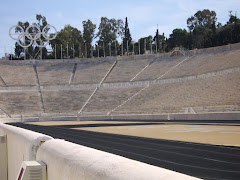
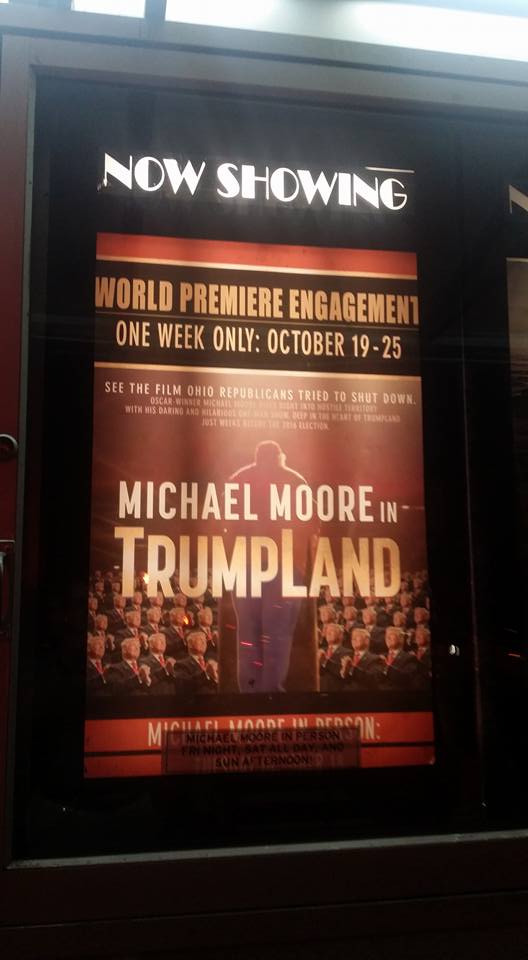
The title: "Michael Moore In Trumpland."
 |
| Image via Dog Eat Dog Films |
The venue: IFC Center in Greenwich Village.
I first learned about Moore's latest work through the Oscar-winning filmmaker's Facebook page, a favorable criticism in The New York Times and a rave review in New Yorker magazine.
Informed by these appraisals, expectations were high but in check.
Moore is one of my all-time favorites -- it's tough to beat the documentary power of the Pets or Meat scenes in "Roger & Me" or the emotional wallop of the Flint, Mich., kindergarten shooting in "Bowling For Columbine."
One of the last films my mother and I watched together before her ALZ diagnosis was "Fahrenheit 9/11" and during a shared trip to Washington in early 2007 we both screamed/jeered in the direction of The White House, inspired by and much like the film's distraught military mother, Lila Lipscomb, who lost her son in the Iraq War.
Moore's autobiography (specifically his narration of the audiobook version) is a highlight from several road trips to and from Oklahoma. I'd be delighted if Moore would turn his documentary lens in the direction of the Olympic movement like other great (and sports-minded) documentarians Leni Riefenstahl and Bud Greenspan.
So, when the couple beside me at IFC Center mentioned they "heard Michael might actually be here" it was exciting. Would he show up?
There was barely time to build anticipation for only a minute later ... there he was! From my seventh row and center seat, I had a clear view of Moore's introduction by the theatre's manager.

Moore spoke to the audience for about 10 minutes, pausing only to make sure his mobile phone live stream to a theatre in his home state of Michigan was still on the line. The IFC manager held Moore's phone aloft while Moore described the short journey taken to complete his "Trumpland" project.
My eight minute audio recording of his remarks includes a few gems:
"By the end of Thursday, over 100 theatres in 100 cities called us wanting this film in their theatres, so we're gonna make it happen," said Moore. Here's hoping this film will be available in wide release by this coming Friday.
This enthusiastic response was the result of "a zero-inch ad" in The New York Times, indicative that only publicity and buzz is taking this film for a rocket ship ride.

"To paraphrase Barack Obama, I think one of the things that will save the cinema is if we all have more fierce sense of urgency about it," said Moore. "I really learned a lot in these two weeks about what you can do. No, you are not going to see a lot of car chases or a lot of production value, but this great art form ... especially with documentary, there is nothing wrong with being entertained and to laugh while we are learning."
Moore then explained the timing of the project.
Moore then explained the timing of the project.
"I did something I had not done before, which is to film myself in a one-man show I wrote. I spent time writing it much of this year."
Moore went on to explain his team secured funding then a performance venue in an Ohio town only to learn the right-minded political machine voted them out of the community. By dumb luck or divine intervention, the team eventually found a new venue in nearby Clinton County and got things moving again, eventually booking "about 750 people" for the live audience.
"Probably about a hundred, 150 of them are leaning toward Trump," said Moore. "Another couple hundred were people who were thinking of not voting or voting third party."
Additional insights are included in the brief video I captured during Moore's unscripted remarks:
But what of the film itself? Would it live up to the hype spreading online?
"Let us know what you think of the movie," wrote one of my cousins, in response to my elated Facebook posts from Moore's appearance.
 |
| Image via Dog Eat Dog Films |
For this viewer and writer, "Michael Moore In Trumpland" may not be Moore's best work, or his most popular (though opening week stats indicate it's rising like a bullet in cinema stats for documentaries). But I do think it is Moore's most timely, and though its rushed assembly leaves a few rough edges, this film is a crowd pleaser bound to earn a lot of thoughtful discussion and accolades.
As noted in the aforementioned New York Times review, "Trumpland" is not so much about the real estate tycoon turned presidential candidate. Rather, the name is derived from the Ohio farmland awash in pro-Trump signage as Moore's crew arrived in The Buckeye State.
What's missing from the new film are the fun soundtrack elements, stock footage and quirky visual setups that typically bring chuckles across Moore's work. There's no cartoon describing "A Brief History of the United States."
But that's OK! Instead of these elements, Moore cleverly establishes a rapport with the Ohio audience, quickly admitting that -- in spite of several floor-to-ceiling photos of a youthful Hillary Clinton as the main stage decorations -- he is not a Hillary fan, but rather a die-hard supporter of Bernie Sanders who had to come to terms with a different candidate earning his party's nomination (like most of, say, the audience members, regardless of their party).
In place of the grin-worthy video clips, Moore sets up two big laughs by introducing the audience members sent to the segregated balcony attendees. On one half of the upper floors, Hispanics are walled in by cardboard bricks, while to their right are several Americans of Middle Eastern descent who have their own "security drone" hovering in the rafters as an eye-in-the-sky protector of all other audience members.
I don't want to spoil one of the most poignant moments of the film, so let's just say a very surprising Hillary supporter makes a cameo appearance that left my New York theatre audience, and the Ohio attendees in the film, audibly gasping (perhaps worth the entire price of admission). From here Moore goes to work building a case, much like that faux-brick wall upstairs, reasoning why more voters should give Mrs. Clinton serious consideration before Nov. 8. Moore makes this case very succinctly and without put downs nor yelling about her opponents. And his crescendo that calls out many of Hillary's worst "crimes" again and again is hysterical.
 |
| Image via Dog Eat Dog Films |
Like many of Moore's other documentaries, "Trumpland" is a thinking persons' film; it's not for everyone, but like "Bowling For Columbine" or "Sicko" and "Where To Invade Next" it is perhaps intended for everyone and should be entertaining and informative for anyone with the same open mind they profess to possess.
I found myself disagreeing with Moore more often during this film than some of his previous work, but "Trumpland" earned my respect for its ability to inform without insulting its opposition. Perhaps Moore does not write as sharply as Aaron Sorkin in "The American President" or "The West Wing" but Michael does play in the same ballpark as, say, Sorkin's monologue for "Newsroom."
I found myself disagreeing with Moore more often during this film than some of his previous work, but "Trumpland" earned my respect for its ability to inform without insulting its opposition. Perhaps Moore does not write as sharply as Aaron Sorkin in "The American President" or "The West Wing" but Michael does play in the same ballpark as, say, Sorkin's monologue for "Newsroom."
Should folks see "Michael Moore In Trumpland" soon, before the election? Absolutely! And I hope they savor and enjoy it, but more importantly, talk about it with friends, co-workers or anyone planning to vote.
After the film I asked the theatre manager to share Moore's publicist details, and submitted a phone interview request. No response so far, but I'm ready with a few questions should that welcome call arrive.
Photos by Nicholas Wolaver unless otherwise captioned for Dog Eat Dog Films.

.jpg)
.jpg)
.jpg)


 Posts
Posts