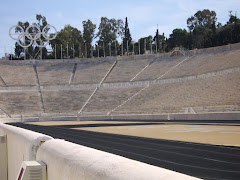
A few months ago while pondering art, a news item crossed my desk regarding the first major exhibition in years for
Jean-Michel Basquiat.
My eyes and ears perked up for the potential opportunity to experience more works by the artist who rose to prominence during the 1980's.
The attention-grabbing article stated the
Foundation Louis Vuitton in Paris would present 120 Basquiat works in one venue during late autumn to mid-January.
C'est magnifique!
In consideration of a potential trip to the City of Lights, I recalled my first encounter with Basquiat's craft, which took place in 2016 at The Broad, downtown LA's outstanding modern art assemblage (the museum was created by a married couple whose family name and art collection each rhyme with
mother lode).
At The Broad, Basquiat's grand "
Untitled" head canvas transfixed me, though I had no idea nor context that it was part of a series.
 |
| "Big Snow" via ArtNet.com |
A few months later (spring 2017), at the gift shop for the Pompidou Center in Paris, another Basquiat quietly entered my experience, this time with the a five-ringed connection as the painter's work titled "Big Snow" referenced the 1984 Olympic Games, possibly on a TV in his studio while he worked on the piece. On this canvas (right), Basquiat also referenced Jesse Owens at the Berlin 1936 Games.
Closer to home, in September I was reminded there's also a
vivid Basquiat in the permanent collection of the High Museum of Art, perhaps the best acquisition our Atlanta-museum-that-could actually did purchase.
I don't often splurge on "art travel," but a few weeks after reading the initial exhibition headlines, in late October my Moscow-based girlfriend Valentina mentioned she also read about other showstopping exhibitions taking place in Paris -- specifically, a blue and pink
Picasso exhibition at Museum D'Orsay, and a Pompidou presentation of
Cubism -- and this art trifecta emerged as the tipping point to meet in France.
An art weekend in Paris, just before Christmas, with my Russian girlfriend?

Twist our arms!
As it turned out, during our four-day art adventure (Nov. 30 to Dec. 4) we trekked to Foundation Louis Vuitton
deux fois as the museum closed for one of those
big weekend protests that made headlines worldwide.
"Sorry, folks -- museum's closed!"
Bummed at our denied access upon our first arrival on a Saturday, we vowed to return and snapped a daytime selfie (left) with the exhibition's promo poster, noting the illustrated figure held aloft something resembling an Olympic torch.
We later learned this image is part of a much larger 1984 work titled "Grillo" featuring likenesses for African gods of war.
Also learned (weeks later) Basquiat
did create at least
three Olympic-themed works, included at the base of this post, not seen at Foundation Louis Vuitton but "out there" to be experienced in person on a future art sojourn.
I was relieved and so pleased when we finally got in our two hours of Basquiat on a Monday evening, as the exhibition was not too crowded, enabling a leisurely pace to explore not one but
four levels of the museum in which the Basquiat paintings hung in near-chronological order.
The image atop this blog post shows the view we experienced upon entering the exhibition. According to the Foundation
press release, this "exceptional trilogy of big
Heads from 1981-1983" accompanied a "presentation of works ... on the theme of the street, used as a studio, source of inspiration, living body."
Street art was the vibe.
Amazing street art.
I found this gateway into Basquiat the most compelling of the exhibition sections spanning almost 10 galleries. In the first rooms, the work titled "Brett as a Negro" (above right) drew me in as it features acrylic applied almost like finger paint to 100 mint-green subway tiles.
This graffiti-like head left me wondering
did the private collection owner pry these tiles from a New York metro station wall?
The exhibition's intro section also featured social commentary via the stern gaze of law enforcement portrayed in "La Hara" and "Irony of a Negro Policeman," both from 1981.
On level two we discovered the exhibition's only obvious five-ringed connection with the mostly red canvas "
Cassius Clay" on view steps from a much larger "St. Joe Louis Surrounded by Snakes" and facing an installation of nearly three dozen more faces/heads drawn by Basquiat.
We also learned more about his proficiency with oilstick and collage.
The second gallery featured some of the brightest colors, and the canvases started getting bigger and bolder, punctuated by "Boy and Dog in a Johnnypump" (left) on loan from a foundation in Greenwich, Conn.
That was a fast graduation from street to fine art!
Though the bright colors and larger works provided surprises and intrigue, I found myself less moved by some of the artist's homages to musical heroes, notably Charlie Parker.
Instead the showcase of Basquiat's collaboration with Andy Warhol provided the most new-to-my-growing-Basquiat-knowledge and fandom. The vast and complex word-infused works made me dizzy in the best way.
No "Big Snow" on view? No big deal.
The monumental "Unbreakable" (right) seemed to showcase greatest hits of so many favorite painters I now believe Basquiat also studied and admired.
It's tragic the twentysomething artist's life ended too soon -- God only knows what more brilliance could emerge had more time and growth sans drug addiction and other demons been possible.
Through wall text, and later in the exhibition's
thorough catalogue (a must-read for any Basquiat fan -- an excellent read on the long flight home), we learned the artist's final months included the loss and mourning of multiple mentors and friends, making the last work on view "
Riding With Death" even more somber.
Nevertheless, we left the museum exhilarated and hungry for more Basquiat
tout de suite. The exhibition closes 21 January, but will reside in fond memories for a lifetime.
Photos by Nicholas Wolaver except credited image of "Big Snow" and the three Olympic images below, none of which appeared in the museum exhibition.


.JPG)


 Posts
Posts