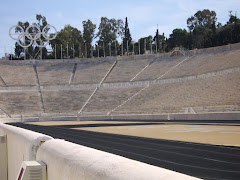
As noted last month through posts about this and that, some January work travel provided sightseeing options in Philadelphia, "the city that loves you back."

The trip got me to thinking about one of Philly's top arts patrons, Albert C. Barnes (1872-1951), the physician/chemist and educator who left behind an art collection/school in suburban Merion, Pa.
Sadly for Barnes, his estate and school alumni/friends eventually learned Philadelphia is also "the city that f*cks you back."
 The school in this case is The Barnes Foundation, which kindly provided me a review ticket to visit its astounding collection (amassed by Albert), an experience I enjoyed and appreciated at the organization's new Central Philly address.
Several highlights are listed below with a recommendation to visit this important art institution, now more a museum than its original school designation.
It's not easy to write about the visit without acknowledging the troubling way The Barnes came to my attention, adding a dash of reluctance to an otherwise positive review.

The gist of the story is this: In his lifetime, liberal-minded Barnes collected and shared his art in a manner that flipped the bird to Philadelphia's more conservative society and art establishment, and in his will, Barnes left his collection with specific preferences on how his legacy was to be preserved (providing another middle finger pointed from the afterlife).
Decades after his death, an array of unscrupulous characters systematically circumvented Barnes' written wishes, returning the finger with one hand while "stealing" $25 billion in art with the other.
Biggest of the establishment "villains" (as portrayed in "The Art of the Steal") are folks named Richard H. Glanton, Bernard C. Watson, Ray Perelman, the leader of the Pew Charitable Trusts and the Annenbergs, not to mention several city and state elected officials and one dim bulb (or complicit?) judge.
Juxtaposed with the "bad guys" viewers may be impressed to see Julian Bond, whose father was friends with Barnes, speaking up for what he believed was unjust in the Barnes debacle.
I'll let the full film available here present its case -- the silence from "the establishment" is noisy:
Barnes was a guy who hung out with big thinkers including Salvador Dali and Albert Einstein.

So my 2016 visit to The Barnes was informed by the prism of images and perspectives showcased through "The Art of the Steal" lens.
This is to say that each room at The Barnes provided me a jubilant response "this is amazing!" to the art and how it is mounted, quickly followed by the internal reminder "this is not how I, or any fellow guest, was supposed to experience this" because, according to the documentary film, "Barnes was not interested in mass experience -- he was interested in quality experience" and the facility, as originally envisioned, was "not a museum but an educational institution" set to teach art as Barnes wanted it taught.

I also looked for some sign the audioguides featured Barnes' personal POV on any one or hand-grouped section of works, and there were no signs this was ever discussed (but then, if audioguide technology existed in Barnes' day, he might have been opposed to this less personal and less interactive way to learn about art).
Moving on, here's what's to love about the collection: Views of hundreds of works, including dozens by Renoir (181), Cezanne (69), Matisse (59), Picasso (46), Rousseau (18), Modigliani (16) and many more by Degas (11), van Gogh (7), Seurat (6) and others.
Personal favorites included:
-- Numerous religious icons painted on wood, attributed to self-taught artist Jose Aragon of early 1800's Spanish New Mexico (biggest surprise and coolest new-to-me artist in the collection)
 -- The colors in Picasso's 1906 canvas "Nude In Profile"
-- Seurat's 78"x98" "Models" inclusive of the artist's work showcased in "Ferris Bueller's Day Off"
-- Modigliani's "Reclining Nude from the Back" (a showstopper in the room where it's displayed)
-- A creepy-cool mid-1500's copy of "Temptation of Saint Anthony" attributed to Hieronymus Bosch
-- "The Departure of the Six-Meter Boats," a brightly-painted 1936 nautical scene by Raoul Dufy (the closest-to-Olympic work I could find)
-- Gustave Courbet's naughty "Woman With White Stockings" (the canvas most likely to make the conservative establishment blush)
-- Astounding Rousseau canvases including "Woman Walking in an Exotic Forest," "Scouts Attacked by a Tiger" and "Unpleasant Surprise" (with its title that sort of drove home the whole Barnes Foundation back story of 1990 to 2005).

Will I return? Probably. Is a visit recommended? Absolutely!
Two artist cousins -- both painters -- resided in Philadelphia and visited The Barnes more than 20 years prior to "the unpleasantness" that started in the 1990's. On a recent call, they said it was really special to get a guided tour of the art and learn about it in Barnes' or his disciples' words. I'm glad The Barnes is accessible now, but wish there had not been such a bumpy road with so much questionable maneuvering to make it possible.
Images of artwork and Albert C. Barnes via The Barnes Foundation; Matisse "The Dance" image via EverettPotter.com; exterior image via JoLee Magazine; museum interior via The New York Times; movie poster via IMDB.
March 1, 2016 Footnote/Update: As a follow up to clarify her response, the P.R. manager emailed the following information which may be helpful for those interested in The Barnes' education initiatives:
"... the classes do indeed follow the Barnes historical teaching approach. Barnes classes remain focused on experiential education, 'learning by doing' - directly experiencing works of art, participating in class discussions, reading key works of philosophy and the traditions of art by looking objectively at the use of light, line, color and space. Barnes felt that through this educational method, students would improve their critical thinking skills, as well as their ability to learn and succeed in general, and become more productive participants in a democratic society. This method remains central to the Barnes education method."


.jpg)


 Posts
Posts