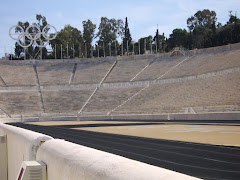
Showing posts with label Santiago Calatrava. Show all posts

Sunday, October 11, 2015

Review: One World Observatory Inspires More Awe Than New Tower It Calls Home

In mid-September I took a late-summer vacation to New York, including a couple of days in Manhattan, which is always fun!

Free time in the city at last afforded me an afternoon to pay my respects at the 9/11 Memorial and to get an up-close look at the new One World Trade Center tower, the new P.A.T.H. rail station (with its fantastic Santiago Calatrava top "opening soon") and other points of interest near the banks of the Hudson River.

With thanks to my friend Amy and her Mode.com team, we also enjoyed a nighttime peek at the incredible progress in the business district.

This post includes a review of One World Observatory -- Manhattan's newest attraction likely to remain a top memory for any tourist who visits it -- and some reflection on New York visits spanning 21 years.

For this writer, visiting the 9/11 Memorial and new tower was not as somber as anticipated. Rather, the experiences provided many moments of reflection on two decades of living since my first visit to Lower Manhattan (during college) and later as a short-term resident house-sitting for a friend who lived near the George Washington Bridge.

At that time, I jogged or walked the bridge a few mornings and more afternoons, often gazing south to the pair of World Trade Center towers with curiosity.

During these initial New York adventures, I visited the original World Trade Center first during spring 1994, and again in October 1996 just after the New York Yankees' World Series victory parade through downtown.

On the first WTC stop with my friend (then studying at New York University), we only trekked through the lobby before heading to the subway station -- it was a rainy and cold evening after visiting the Statue of Liberty and Ellis Island, so we decided ascending to Windows On The World would yield no views of the island at night.

Though it was sunny on the second visit two years later, and I did take one of the World Trade Center express elevators to a half-way point (the "free" part of the tower experience, as I recall), I got cold feet about continuing to the top as I felt under-dressed in jeans and a sweatshirt worn to the parade.

Another vague memory of the original WTC was its immense plaza with a bronze globe sculpture I learned, only years later, was"The Sphere" by Fritz Koenig.

Until September 11, 2001, my only other WTC reference point was the 1978 extended-for-TV version of the film "King Kong" starring Jessica Lange and Jeff Bridges (an elementary school classmate had a "King Kong" lunchbox for which I pined many times). 

One World Observatory brought back these recollections while forging many new and spectacular memories. I highly recommend the experience.

There's not much to write home about with regards to the building itself -- many other writers (and people in general, including some who work in the building) share my disdain for the milquetoast, soulless architecture and missed opportunities the tower portrays. Just because it's big does not make it "great" design.

There's also not much to say about the One World Observatory queue process (lined up on the tower's west side), ticketing process (save time online in advance) nor the lower level atrium through which visitors experience a world map of visitor stats, exhibits on this site history, a faux-granite tunnel and other features designed to ease the patient wait in line for an elevator.

If there's no rain, I recommend getting up close to the building and looking directly up, and also be ready to see your "spot" on the world visitor map (it cleverly pops up a few seconds after they scan your ticket). 

The real excitement begins by finally entering the lift cars with room for about a dozen guests and floor-to-ceiling LCD monitors on the exterior "windows."

These aptly-named "Sky Pod Elevators" are reminiscent of Roald Dahl's "Great Glass Elevator" owned by Willy Wonka.

Wonderment awaits!

Smart visitors will have their video lenses ready as the doors close -- during the 102 level ascent of fewer than 60 seconds, passengers witness several years of Manhattan urban development (a few years per second from 1500 A.D. to present day). Downtown's skyline takes shape before your eyes in a spectacular manner. I enjoyed most the "views" of the Empire State Building and Brooklyn Bridge assembly, and requested an extra ascent just to capture it again.

The Sky Pod LCD animation is on par with the outstanding train experience at Universal Studios' Wizarding World of Harry Potter.

Upon exiting the elevators, visitors enter yet another dark corridor. As ears pop during another brief video presentation on a 50-foot horizontal panel, guests may be wondering "where's the view we paid to see?"

At last, the payoff in the form of ... Surprise! In a curtain-like motion the panel wall rises to unveil -- to the gleeful gasps of many -- a clear glass wall and vistas of Brooklyn, Long Island and beyond!

I felt lucky my visit took place on a sunny, cloudless afternoon, and spent more than an hour slowly gazing upon the Statue of Liberty, Hudson and East Rivers, the traffic on the bridges, the Lower Manhattan towers below, the 9/11 Memorial site (much further and directly below) and all of Midtown.

But before enjoying the limitless options to "See Forever" (the venue tag line), there was one more pause featuring demonstrations of a hand-held rental device named the One World Explorer which helps identify every landmark on the horizon with touchscreen bells and whistles. Thought I did not purchase this experience, a fellow visitor who did shared its coolness and handiness, and she seemed to be happy with her purchase.
www.OpenBuildings.com
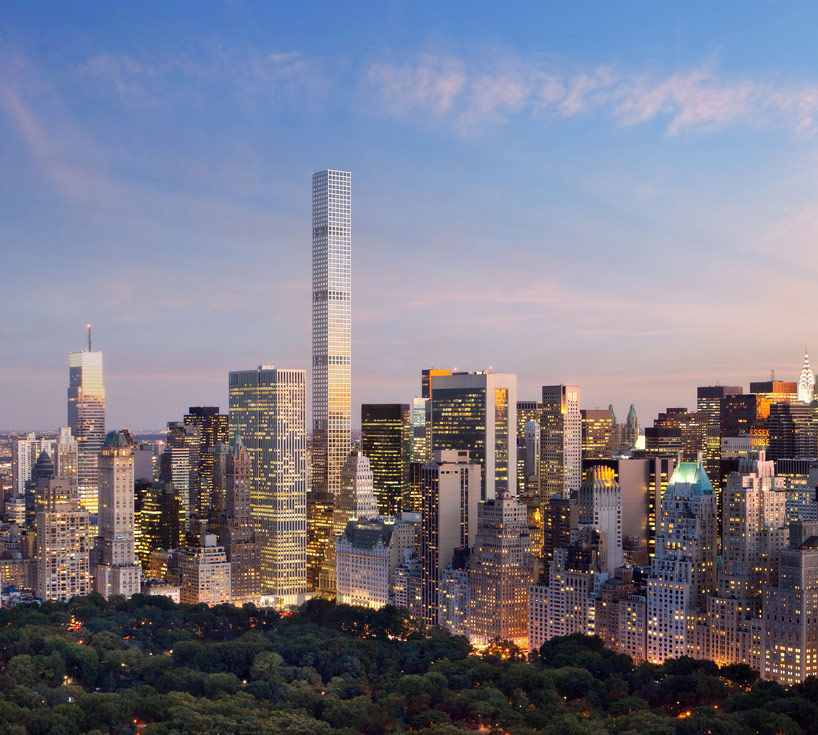
Sadly, the one building for which I sought immediate Explorer details is still under construction and not yet programmed into the device -- 432 Park Avenue, which topped out one year ago today, is the new "world's tallest residential building" (also taller than the Empire State Building) and another Manhattan sight to behold.

I noticed other Observatory visitors lingered for 90-plus minutes like me, soaking in every view, each passing aircraft and the earth's curves in all directions. My camera quickly filled with dozens of images.

It was fun to see the 15-story yellow painting installed near Hell's Kitchen to welcome the Pope with his likeness waving to the south, clearly visible several miles away (see photo below featuring Empire State Building to play "Where's Waldo -- His Holiness Edition").

I also enjoyed looking north to the George Washington Bridge and reflecting on all the change -- for the world and yours truly -- since those autumn walks in 1996. I thought of how the city might have evolved had the International Olympic Committee chosen New York over London to host the 2012 Olympics (as frustrating as it was to stand in the rain at Rockefeller Center and learn Manhattan's bid loss on 6 July 2005, they made the right choice).

With my brain finished wandering the "Capital of the World" cityscape, I noticed the option to stand upon the "Sky Portal" featuring a 14-foot "glass floor views" (real-time video projections) of the busy streets below. This may be a thrill for many or an "also ran" for those who previously stood upon the real glass floors of the SkyDeck hanging out the side of Chicago's Willis Tower.

Noticeably absent from One World Observatory: those coin-operated binoculars and telescopes so popular at the Empire State Building. I guess the new tower's glass skin might skew the lens views, or maybe the attraction management realized no one carries spare change these days.

Is the One World Observatory worth the price of admission? Yes! Just try to book in advance to save time in line, and wish and hope and pray for a clear day so you may see Forever.

Photos by Nicholas Wolaver except lunchbox image via Ebay and The Sphere image via this great blog post.


Monday, March 7, 2011

Milwaukee Art Museum Gets It Wright

Frank Lloyd Wright's good works are part of my memory since teenage years, but a 1994 exhibit at the Museum of Modern Art marked the first time the architect's fame and accomplishments "stuck" with me.


Wright's city plan for Baghdad intrigued me for its inclusion of an Olympic stadium in Iraq, though I cannot confirm whether the New York exhibit showcased that Wright design, or if the Olympic/Wright connection came to my attention later.


In the 17 years since experiencing that MOMA exhibit, however, each visit to a Wright destination either earned comparison to the Manhattan display, which set a very high bar for architectural exhibitions, or brought back memory of lessons learned in that temporary assembly of Wright drawings, models and materials.


Now showing at the Milwaukee Art Museum, the new exhibition "Frank Lloyd Wright: Organic Architecture for the 21st Century" gets it right, and sets another high bar for future exhibitions.


Students, fans or anyone curious about Frank Lloyd Wright will find the MAM show enjoyable, entertaining and informative, including a broad overview of Wright's career (covering most of the basics and big milestones in his work) and many surprises for those more familiar with Wright projects across the U.S. (the exhibit focuses on stateside projects).


Thanks are in order for the MAM media relations team, which arranged tickets for this blogger and a guest to visit the museum on March 5.


"Frank Lloyd Wright: Organic Architecture for the 21st Century" begins with a large room filled with enormous architectural models created at Taliesin or Taliesin West, Wright's homes and working studios in Spring Green, Wis., and Scottsdale, Ariz., respectively.


From the towering model of "The Illinois" -- a soaring design for a mile-high skyscraper in Chicago -- to panoramic three-dimensional displays of "Broadacre City" and "The Living City," Wright's visionary take on the possibilities for architecture on a citywide level, attendees are treated to handmade models and hand-drawn ideas that mostly lived only in Wright's mind, and on rare sheets of drafting paper. Only one or two designs in the room -- the Price Tower built in Bartlesville, Okla., and a synagogue in Pennsylvania -- made it from dream or proposal stage to construction.


The most unusual and surprising (and unbuilt) designs of the exhibition include rare, full-color renderings for the Rogers Lacy Hotel in Dallas (sigh for what could have been ...) and the Gordon Strong Automobile Objective, a scenic overlook and destination (rooftop for a massive planetarium) intended for Sugarloaf Mountain, Md., which shares spiral design elements that later appeared in the Guggenheim Museum's spiral atrium.


Following what I describe as the futuristic/unbuilt "room of dreams," the exhibit looks at a range of residential projects and designs for families. Attendees are treated to views of Usonian, Cloverleaf Quadruple and other private residences, showcased around several elements from Taliesin. My girlfriend and I tuned into some rare home movies from Wright's home before studying the designs for Falling Water, which is on our target list for the next Wright experience to share.


The best surprise in the "residential" sections of the exhibition: Large renderings for the unbuilt Raul Bailleres House, a beachfront property that would have included tiered infinity pools and waterfalls in Acapulco, Mexico, displayed beside a spectacular "Seacliff" house intended for waterfront property near San Francisco.


We later learned that the Bailleres House, with many updates and redesigns for other clients, now stands in Maui, Hawaii, as the "Marilyn's House" built in the 1980s (my girlfriend and I visited that beautiful site, which overlooks Haleakala Mountain, last year).


A cottage designed for bestselling author Ayn Rand was a nice surprise in the exhibition. Another delight was learning the back story related to the drawing.


We also enjoyed several drawings of the Frederick C. Bogk House, a Milwaukee home built on Terrace Drive near Lake Michigan. We delighted in driving from MAM to this residence, only a mile from the museum, on the same afternoon, and if time permits, we suggest any MAM visitors also make time to experience the Wright-designed Greek Orthodox Church in suburban Wauwatosa, Wis. (spectacular).


The Greek temple is one of a handful of iconic places of worship highlighted in the exhibition. The standout, of course, is Unity Temple of Oak Park, Ill., and MAM installed a shadow box-style model of the temple sanctuary.


Numerous office and government buildings -- some built, some only proposed -- come to life in more large illustrations and models, such as a large model of the S.C. Johnson headquarters of Racine, Wis. We enjoyed learning about Wright designs for Marin County, Calif., and the Lenkurt Electric Co.


There were only a handful of "holes" in the exhibition. We noted that both the Guggenheim Museum and Ennis House noticeably missing. I suspect the Guggenheim has its own stronghold on Wright artifacts, which the Manhattan institution may or may not be willing to share. In the case of Ennis House, and nearby Hollyhock House (also in Los Angeles, and also missing from the MAM exhibition), maybe its imperilled status factored for MAM exclusion.


But then, there are hundreds of Wright structures from which to choose, and MAM covered the right bases with great detail. Anyone can read more in the Frank Lloyd Wright Field Guide or other publications available in the exhibition gift shop.


For those who visit MAM, be sure to enjoy the lakefront dining experience at Cafe Calatrava in the lower level -- the cauliflower soup is magnificent, and the architecture-inspired menu (honoring the Wright show as much as the famed Spanish architect who created MAM's expansion 10 years ago) is great for fueling or refueling for a day at the museum.


Illustrations via MAM:
-- Lenkurt Electric Company, San Carlos, CA, 1955, © 2010 Frank Lloyd Wright Foundation, Scottsdale, AZ
-- Rogers Lacy Hotel, Dallas, TX, 1946, © 2010 Frank Lloyd Wright Foundation, Scottsdale, AZ

Monday, July 28, 2008

Lao-tzu For You


"A journey of a thousand miles begins with a single step," was the quote that came to mind at the Atlanta airport yesterday (this thought sent me scrambling online to find its author, Lao-tzu -- who knew?). Given the long history behind this quote, at this moment, wondering the stage at which the word 'miles' was added to the translation.

The journey of more than ten thousand miles from Georgia to China at last is underway! Touched down in Milwaukee on Sunday for a day of last-minute pre-Games prep, visit with girlfriend and family, an overdue haircut and a free lunch courtesy of Milwaukee's cool Downtown Employees Appreciation Week (we have got to get one of these in Atlanta!). On the flight here via the BEST Care In The Air, had the pleasure of meeting Jeff Compton, a CEO from Calhoun, Ga., who was heading to Wisconsin for a week of presentations (good luck to him!).

Milwaukee has a curious mix of Olympic connections. The Pettit National Ice Center west of downtown is a great home for U.S. speedskaters (though not likely any will be in Beijing). Downtown's historic Hilton Hotel is fabulously affordable (and an Olympic lodging sponsor). And the magnificent Milwaukee Art Museum was designed by Spain's Santiago Calatrava (it's my understanding he's behind many of Barcelona's and Athens' key Olympic venue designs, and according to reference sites, today is his 57th birthday). Milwaukee would be an outstanding satellite venue for Chicago 2016 thanks to perfect (summer) weather and proximity north on Lake Michigan.

Also learning the how-to's of Flip Camera use (perhaps the coolest camera of all time!) and will post videos once more editing practice is complete. Dog tired, but jazzed that in just 12 hours the next leg (MKE to Detroit) will be complete before the long leg to Tokyo and Beijing.

Blog Archive

Powered By Blogger
Web Analytics