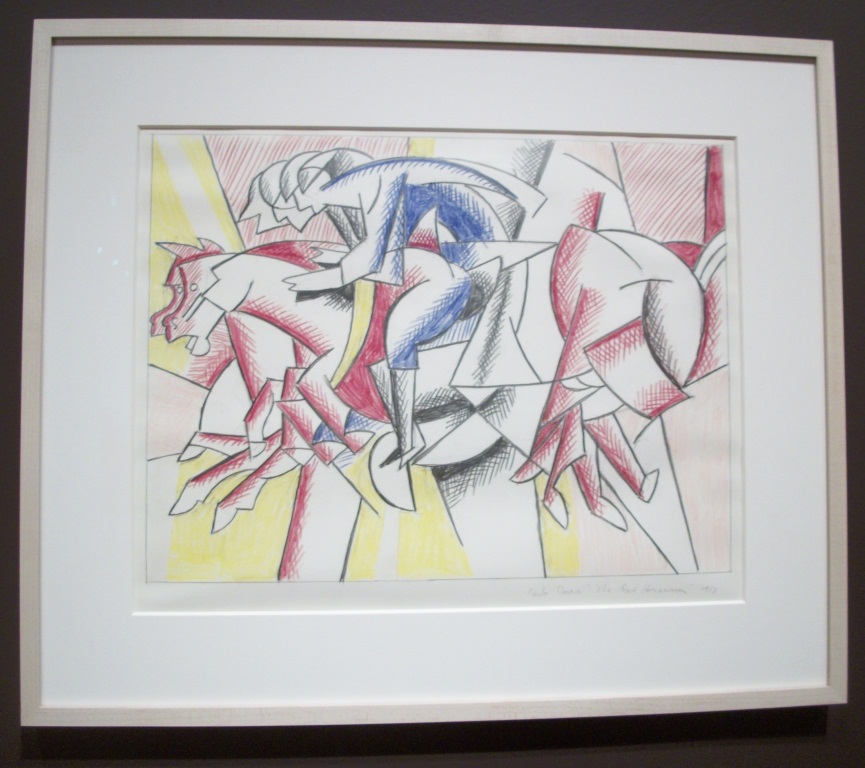
During the 1990s, a friend introduced me to the official Cultural Olympiad poster series for the Games of the XXIIIrd Olympiad at Los Angeles, including an iconic equestrian-themed work I purchased (one of my first Ebay finds). And during a college spring break trip to New York, another friend pointed out a massive Roy Lichtenstein mural in the lobby of a Manhattan building -- loved it!
These two events, and later reading Lichtenstein's 1997
obituary in the New York Times (which I vividly recall, as his distinct work jumped off the page during morning reading at my first full-time P.R. job in Atlanta), form my earliest introductions to an artist now among my all-time favorites.
My apartment includes that early Ebay purchase of "The Red Horseman" poster from LA84, as well as a large poster from the Museum Ludwig Köln featuring a Lichtenstein titled "Landscape with Figures and Rainbow," and small snapshot photos of other works in museums visited through the years.
You can imagine my delight to learn of the Chicago Art Institute exhibition "
Roy Lichtenstein: A Retrospective" opening in May. After patiently waiting to return to The Windy City last week, I at last experienced the exhibition with my girlfriend. Borrowing from the show's souvenir button design (inspired by "I [heart] N.Y." T-shirts) ... I [dot] Lichtenstein.
With thanks to the Chicago Art Institute public relations team for the media pass, what follows are an array of afterthoughts from two visits to the exhibition, first on June 16 then a return June 24 (yes, the exhibition is worth multiple visits). The
press release for the exhibition provides a good overview, as does this
museum video on the installation process.
"Roy Lichtenstein: A Retrospective" includes more than 160 works by the American artist. The entry arcade is flanked by two large works portraying architectural features, among the many building blocks and areas of study Lichtenstein explored during more than 50 years of painting.
We delighted in the cheerful Disney-inspired "Look Mickey" in vivid red, blue and yellow, with thousands of hand-painted dots that are part of so many of the works (we learned how the artist employed stencil and toothbrush to apply these points of paint on later images). And before diving into many advertising- and cartoon-inspired canvases in the second gallery, the exhibition provides a handful of compare and contrast works showing early Lichtenstein creations (most are not easily recognizable as Lichtenstein) juxtaposed with 1990s "Brushstroke" works -- with just a few paintings, visitors can see the huge leap Lichtenstein made from what was popular in art circles to his own brand of pop art.
Around the first corner, and around every turn in this exhibition, are wonderful surprises. Eyes meet the Lichtenstein everyone knows -- comic strip couples embrace while jet fighters and submarine commanders unleash attacks. The first big corner in this exhibition reveals themes of Early Pop (including common items from detergents to sneakers and jewelry), Black and White (with larger than life golf ball, tire, radio and desk calendar canvases -- don't miss the Magnifying Glass) and the first glimpse of War and Romance themes.
The most intriguing surprise early in the exhibition: ceramic busts and coffee cups (we liked how the stacked coffee mugs were just a few steps from the brown and yellow "Cup of Coffee" painting). The 18"x 45" "Hot Dog With Mustard" sort of jumps out as much as "The Ring (Engagement)" as the first Lichtenstein explosion in the exhibition (the red and black facets moving outward like the blasts of "Whaam!" in the next room).
Returning to the Black and White section, we marveled at the advertising-inspired "Large Jewels" as another of the early surprises to enjoy. So much to love in this exhibition -- we spent almost an hour in only the first two rooms!
The big guns are out in the room of comic war and romance paintings. The best treats: the aforementioned "Whaam!" facing a U-boat commander screaming in "Torpedo ... LOS!" as well as "Bratatat!" and "Takka Takka." I was humming
Lionel Richie tunes upon spotting "Cold Shoulder" (with an eerie, forlorn message of Hello ... in a caption bubble almost crying off the canvas) and "We Rose Up Slowly" with its couple kissing like Brook Shields and her partner in "
Endless Love" movie scenes.
"Roy Lichtenstein: A Retrospective" rounds the bend to unveil several more explosions and brushstrokes, with some curious three-dimensional works of porcelain enamel on steel. Several private collection works are shown here and in the landscapes series in the next gallery. Most impressive are the "Perforated Seascape #1" (as visitors cross the room this 3D work comes alive in vivid red, white and blue) and two
Rolux-infused paintings titled "Seascape" and "Pink Seascape" (amazing and so surprisingly Roy).
Rounding another bend takes your breath away. It is amazing to see "Landscape with Figures and Rainbow" -- the real one rather than my apartment poster -- on loan from Germany measuring an enormous 8' x 10' (awesome!); the room features Lichtenstein's amazing history of art celebrating his take on Henri Matisse, Pablo Picasso, Morris Louis and others. We spent the most time evaluating the sculptures in this section, as well as the 120" x 102" canvas "Laocoön" inspired by a major European sculpture (blending brushstrokes, dots and more colors than any other painting in the room).
Modern works, Mirrors, numerous studies (including the study for my favorite "The Red Horseman" and my girlfriend's favorite "Alka Seltzer" in pencil and crayon), angular/geometric shapes classified as Perfect/Imperfect and Artist's Studio works build the exhibition's third crescendo with a room of Nudes (with the floor-to-ceiling "Nudes with Beach Ball" drawing a lot of attention. The concluding gallery unveils the surprise of Lichtenstein's landscapes (many with Asian themes) and a return to the brushstrokes. Amazing. And the enormous scale of the landscapes offers an unintended "Where's Waldo" game to find the tiny philosopher or boat captain in a couple of the monumental works.
Obviously, we loved "Roy Lichtenstein: A Retrospective" and highly recommend a visit while its in the Chicago Art Institute through Sept. 3, at the National Gallery of Art in Washington Oct. 14 to Jan. 13, then in London and Paris throughout next year. I also recommend the exhibition catalogue with 368 pages and full color images of hundreds of Lichtenstein and related works. I don't typically use/recommend museum audio guides, but this exhibition's audio tour includes so many archived Roy Lichtenstein interviews it is a must-listen for the first-timer or longtime fan.
One thing that struck me, reading the catalogue and other museum writings through the exhibition, is the absence of reference to
Ben-Day dots, often used to describe some of Lichtenstein's artistic process. My hunt through the catalogue continues, but I am curious to know whether the curators purposely avoided use of the Ben-Day reference, which also is absent from the audio guide. Was there a copyright issue of the word Ben-Day? What was the point of ommiting Ben-Day descriptions? It's not even on the dot-edu link for the exhibition.
Whether or not the dot answer is determined, the "Roy Lichtenstein: A Retrospective" exhibition is outstanding. Period.
Photos by Nicholas Wolaver except the LA84 poster from this link




 Posts