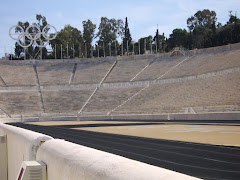
It's been nine years since my initial visit to Rio de Janeiro.
Reflecting on my first day back in Brazil's coastal metropolis, I sure hope summer 2016 will be only the second of many joyous returns to Rio.
The morning began on Delta Air Lines flight DL21 somewhere over the Amazon rain forest. Early rays of the dawn showcased the earth's curve and jungle-wrapped reservoirs 35,000 feet below our aircraft.
By our 8:30 a.m. landing, I was a little tired and anxious but overwhelmed with relief -- so happy to finally be in the Olympic City.
The five-ringed journey to Rio in some ways began in 2009. I was one of the stunned Chicago 2016 Olympic bid volunteers in Daley Plaza when the Windy City lost the first-round of voting, and had a lot invested in a Chicago win.
At the time, I did not think conversion to "Rio fan" status was possible.
But by 2010 and especially at Brazil House during the 2012 London Olympics -- where a showcase of Rio's plan was on view -- I could not help getting excited.
The deep pile of event tickets on my hotel desk proves I may have gotten too excited (yes, definitely over-spent on tickets).
As our plane pulled up to the gate, there was a subtle difference from the arrival at Beijing or London -- perhaps for austerity reasons, given Brazil's troubled national economy of recent months -- there were no "welcome to Rio" Olympic signs affixed to the terminal. And on what seemed to be a half-mile walk from the plane to the customs and baggage claim hall, only one floor-to-ceiling advertisement for Olympic sponsor Samsung came into view. No big deal, just one of those things.
Limited edition pins; only 300 made.
I was biting my nails as my carry-on bag full of pins (40 pounds of them) got special attention in the "nothing to declare" screening area. But with a smile and brief explanation of Olympic pin collecting history, not to mention luck the guard had seen enough with my top-most box of trading materials, I was free to go, breathing easy my 300 blogger pins made it through (whew!).
Exiting customs into the main airport lobby, there was a sea of Brazilian media staked out to photograph and interview arriving athletes.
It was only later in the day I learned Usain Bolt and the Jamaica Olympic Team touched down about an hour after my flight.
Since my rolling suitcase is a Team Canada-branded bag from Beijing 2008, one curious reporter from Fox Sports started a Periscope interview, asking me about my Olympic plans and my take on Rio's preparations -- quite a welcome back to Brazil!
Swiss House under construction in Rio
The taxi ride through the city went right by the Mare favela neighborhood, graffiti, and school recently featured on Vox. Closer to our destination, the Hotel Vermont in Ipanema -- where we were "Feeling The Bern" and enjoying the Democratic National Convention via CNN International by evening -- our route took us by the incomplete Swiss House under construction.
I spent the afternoon strolling around the Ipanema neighborhood, eventually spotting a group of USA House volunteers donning badges -- everyone in the group was Brazilian, so my guess is that they had wrapped up a training session.
At dinner in a neighborhood steakhouse, another group of Team USA workers sat near me and they confirmed the venue for U.S. hospitality "is still a work in progress but will be ready soon."
The day's only frustration: My domestic mobile provider, Sprint, did not give me complete instructions to activate my phone in Rio (I have a 30-step list of actions to take, but the most critical -- the first step -- was left off their list). But I am optimistic tomorrow will yield a solution at the Rio Media Center or a nearby mobile phone shop. Fingers crossed.
My only regret of the day was being ill-prepared to trade pins with the handful of Rio 2016 volunteers who are highly visible in their bright yellow shirts.
But the best part of the day was meeting people who, in spite of my language barrier, were extremely friendly and accommodating.
I also ran into former U.S.O.C. communications director Bob Condron, a fellow member of the International Society of Olympic Historians (ISOH, a client), who was at the airport to meet his wife.
Condron helped me learn about the U.S. Olympic Committee internship program WAY back in 1989, and it was so cool to share brief stories of our journeys since Oklahoma City to Rio.
Can hardly wait to learn which other old friends, and new ones, will cross paths in the Olympic city.
Funniest conversation was at at an Ipanema pharmacy (think Walgreen's of Brazil); as I hunted for Dr. Scholl's shoe inserts a friendly store employee asked to help, and our only means of communication was via hand-drawn illustrations of shoes.
We shared a good laugh about it, and my feet felt like dancing on the walk back from dinner.
It's going to be an amazing Olympics.
Images via the Rio 2016 homepage via Rio2016.org, Brazil post office archive, with other photos by Nicholas Wolaver
As noted last month through posts about this and that, some January work travel provided sightseeing options in Philadelphia, "the city that loves you back."
The trip got me to thinking about one of Philly's top arts patrons, Albert C. Barnes (1872-1951), the physician/chemist and educator who left behind an art collection/school in suburban Merion, Pa.
Sadly for Barnes, his estate and school alumni/friends eventually learned Philadelphia is also "the city that f*cks you back."
The school in this case is The Barnes Foundation, which kindly provided me a review ticket to visit its astounding collection (amassed by Albert), an experience I enjoyed and appreciated at the organization's new Central Philly address.
Several highlights are listed below with a recommendation to visit this important art institution, now more a museum than its original school designation.
It's not easy to write about the visit without acknowledging the troubling way The Barnes came to my attention, adding a dash of reluctance to an otherwise positive review.
Like many (but perhaps too few) of the destination's guests, I learned about Barnes and his eye for early 1900's masterpieces through the 2009 documentary film "The Art of the Steal," which heavily favors the underdog "Friends of the Barnes Foundation" since most, if not all, of the key players that reshaped the institution declined to tell their side of the story on camera or at all.
The gist of the story is this: In his lifetime, liberal-minded Barnes collected and shared his art in a manner that flipped the bird to Philadelphia's more conservative society and art establishment, and in his will, Barnes left his collection with specific preferences on how his legacy was to be preserved (providing another middle finger pointed from the afterlife).
Decades after his death, an array of unscrupulous characters systematically circumvented Barnes' written wishes, returning the finger with one hand while "stealing" $25 billion in art with the other.
Juxtaposed with the "bad guys" viewers may be impressed to see Julian Bond, whose father was friends with Barnes, speaking up for what he believed was unjust in the Barnes debacle.
I'll let the full film available here present its case -- the silence from "the establishment" is noisy:
Barnes was a guy who hung out with big thinkers including Salvador Dali and Albert Einstein.
Henri Matisse, who painted a special mural "The Dance" inside Barnes' home, stating "The Barnes Foundation is the only sane place to see art in America" as commentary not only on Barnes' against-the-grain presentation of art, but also (I think) out of disdain for the "business of art" dictating the norms of most museums (I personally agree with some criticism for the way art is presented in this day and age).
So my 2016 visit to The Barnes was informed by the prism of images and perspectives showcased through "The Art of the Steal" lens.
This is to say that each room at The Barnes provided me a jubilant response "this is amazing!" to the art and how it is mounted, quickly followed by the internal reminder "this is not how I, or any fellow guest, was supposed to experience this" because, according to the documentary film, "Barnes was not interested in mass experience -- he was interested in quality experience" and the facility, as originally envisioned, was "not a museum but an educational institution" set to teach art as Barnes wanted it taught.
I asked the P.R. representative the extent to which The Barnes still instructs guests as it did during its pre-relocation era and she did not seem to know what I was talking about [March 1, 2016: See footnote]. A quick search of The Barnes' website does yield some hints that classes are available featuring content/lessons written by Barnes and his contemporaries who knew his wishes.
I also looked for some sign the audioguides featured Barnes' personal POV on any one or hand-grouped section of works, and there were no signs this was ever discussed (but then, if audioguide technology existed in Barnes' day, he might have been opposed to this less personal and less interactive way to learn about art).
Moving on, here's what's to love about the collection: Views of hundreds of works, including dozens by Renoir (181), Cezanne (69), Matisse (59), Picasso (46), Rousseau (18), Modigliani (16) and many more by Degas (11), van Gogh (7), Seurat (6) and others.
Personal favorites included:
-- Numerous religious icons painted on wood, attributed to self-taught artist Jose Aragon of early 1800's Spanish New Mexico (biggest surprise and coolest new-to-me artist in the collection)
-- Gustave Courbet's naughty "Woman With White Stockings" (the canvas most likely to make the conservative establishment blush)
-- Astounding Rousseau canvases including "Woman Walking in an Exotic Forest," "Scouts Attacked by a Tiger" and "Unpleasant Surprise" (with its title that sort of drove home the whole Barnes Foundation back story of 1990 to 2005).
I spent nearly four hours exploring The Barnes and wished there had been more time -- it was a relief to find that in most, if not every, gallery, great pains were taken to recreate as authentic-to-the-original location experience to the extent modern architecture and lighting will allow.
Will I return? Probably. Is a visit recommended? Absolutely!
Two artist cousins -- both painters -- resided in Philadelphia and visited The Barnes more than 20 years prior to "the unpleasantness" that started in the 1990's. On a recent call, they said it was really special to get a guided tour of the art and learn about it in Barnes' or his disciples' words. I'm glad The Barnes is accessible now, but wish there had not been such a bumpy road with so much questionable maneuvering to make it possible.
Images of artwork and Albert C. Barnes via The Barnes Foundation; Matisse "The Dance" image via EverettPotter.com; exterior image via JoLee Magazine; museum interior via The New York Times; movie poster via IMDB. March 1, 2016 Footnote/Update: As a follow up to clarify her response, the P.R. manager emailed the following information which may be helpful for those interested in The Barnes' education initiatives:
"... the classes do indeed follow the Barnes historical teaching approach. Barnes classes remain focused on experiential education, 'learning by doing' - directly experiencing works of art, participating in class discussions, reading key works of philosophy and the traditions of art by looking objectively at the use of light, line, color and space. Barnes felt that through this educational method, students would improve their critical thinking skills, as well as their ability to learn and succeed in general, and become more productive participants in a democratic society. This method remains central to the Barnes education method."
In mid-January, on a business trip to Pennsylvania, I tacked on an extra day or two for museum exploration around Philadelphia.
What a treat it was to visit the Brandywine River Museum of Art in Chadds Ford, Pa., home to an extensive collection of paintings by N.C., Andrew and Jamie Wyeth, additional Wyeth family painters and other artists.
With thanks to the museum P.R. department for a media ticket, I was treated to views of several dozen N.C. Wyeth canvases known since childhood via the pages of adventure books "Treasure Island" and "Kidnapped" or "Robin Hood."
Though renovations are underway this winter, their permanent collection items on view were impressive, starting with a large room dedicated to the most senior Wyeth, N.C.
The third floor gallery features several of the artist's earliest work including his breakthrough commissions and follow up material that vividly captured literature enjoyed by millions. Over here, pirates! Over there, shipwrecks! Around each corner seemed a new yet familiar surprise awaiting discovery.
Many of these large, colorful illustrations remind me of the Dallas-based artist Bart Forbes -- a painter and illustrator known for his Olympic art commissions and paintings created for the U.S. Postal Service (my introduction to Forbes, when I was a teenager, included comparing his sports portraits to some of Wyeth's illustrations and paintings of literary characters).
One canvas that was new to my eyes was N.C. Wyeth's "Death of Edwin" with a young man drawing his last breath atop some hay. This jumped off the canvas for me as it reminded me of a favorite painting by Andrew, one of N.C.'s sons.
My expectations were elevated for the next gallery, which is dedicated to Andrew, an artist who I met briefly while working with with the P.R. account team for the High Museum of Art expansion.
The museum's new-in-2005 galleries in a Renzo Piano-designed building were filled with Wyeths, creating one of my all-time favorite exhibitions. Upon arrival at Brandywine, I was curious which of the Atlanta exhibition works would be on view.
It made me very happy to spot Andrew's work titled "Spring" featuring a hillside covered with dead, damp grass and just two remaining patches of snow, with one pile of powder sporting the likeness of "Old Man Winter" gazing skyward.
Having just seen "Death of Edwin" in the previous gallery, for the first time I noticed Andrew's possible homage to his father's illustration via the melting snowman (my guess is this comparison is commonly drawn but it was new to me).
I also enjoyed learning about the people and location depicted in the large Andrew Wyeth canvas titled "Snow Hill" featuring a May Pole-like structure and several adults enjoying winter play.
My best guess was the men and women included the artist's siblings, but this thinking was quickly corrected by a helpful staff member who explained the dancers instead include the artist's models and one "blank space" perhaps as a placeholder for Andrew's other source of inspiration, his father.
The hilltop setting is only steps from the current Brandywine site.
Gallery three included a handful of works by Jamie Wyeth -- the third generation of American painters -- and works by other Wyeths including Andrew's sisters.
The museum also presented a temporary exhibition titled "Natural Selections: Andrew Wyeth Plant Studies" -- my favorite in this room was the sycamore-inspired "Summer Freshet Study" which reminded me of spring in my parents' backyard in Edmond, Okla., where they planted four sycamores that are now enormous (for this writer, Wyeth is the best sycamore painter anywhere).
The Brandywine staff shared that the 2005 partnership with the High is getting recharged later this year as the museums are teaming up for a new exhibition titled "Rural Modern: American Art Beyond The City" on view initially at the Brandywine from Oct. 29 to Jan. 22, 2017 (the dates for the High exhibition remain "to be announced").
I hope to return to Chadds Ford during the spring or summer when the Brandywine offers tours of both N.C. and Andrew's studios and several other indoor and outdoor experiences.
When visitors find themselves near the Brandywine campus, I recommend a stop at the nearby eatery Hank's Place just across the highway. This place is hopping with great food and conversation (Andrew Wyeth himself dined there, according to the Philadelphia Inquirer).
Images include items from the Brandywine River Museum website and/or photos in the museum by Nicholas Wolaver. Image of "Spring" by Andrew Wyeth via this site.
A public relations executive by day, small-time eBayer by night and weekends, lifetime member of the International Society of Olympic Historians (ISOH) and full-time Olympic enthusiast who also looks at "BoingBoing-style" unusual news with interest. Please e-mail me at olympiada@yahoo.com or if you can't get enough try my Facebook page http://www.facebook.com/people/Nicholas_Wolaver/713593008


 Posts
Posts