Sunday, January 20, 2019

Foundation Louis Vuitton Basks in Bright Spotlight of its Major Jean-Michel Basquiat Exhibition

A few months ago while pondering art, a news item crossed my desk regarding the first major exhibition in years for Jean-Michel Basquiat.

My eyes and ears perked up for the potential opportunity to experience more works by the artist who rose to prominence during the 1980's.

The attention-grabbing article stated the Foundation Louis Vuitton in Paris would present 120 Basquiat works in one venue during late autumn to mid-January.

C'est magnifique!

In consideration of a potential trip to the City of Lights, I recalled my first encounter with Basquiat's craft, which took place in 2016 at The Broad, downtown LA's outstanding modern art assemblage (the museum was created by a married couple whose family name and art collection each rhyme with mother lode).

At The Broad, Basquiat's grand "Untitled" head canvas transfixed me, though I had no idea nor context that it was part of a series.

"Big Snow" via ArtNet.com
A few months later (spring 2017), at the gift shop for the Pompidou Center in Paris, another Basquiat quietly entered my experience, this time with the a five-ringed connection as the painter's work titled "Big Snow" referenced the 1984 Olympic Games, possibly on a TV in his studio while he worked on the piece. On this canvas (right), Basquiat also referenced Jesse Owens at the Berlin 1936 Games.

Closer to home, in September I was reminded there's also a vivid Basquiat in the permanent collection of the High Museum of Art, perhaps the best acquisition our Atlanta-museum-that-could actually did purchase.

I don't often splurge on "art travel," but a few weeks after reading the initial exhibition headlines, in late October my Moscow-based girlfriend Valentina mentioned she also read about other showstopping exhibitions taking place in Paris -- specifically, a blue and pink Picasso exhibition at Museum D'Orsay, and a Pompidou presentation of Cubism -- and this art trifecta emerged as the tipping point to meet in France.

An art weekend in Paris, just before Christmas, with my Russian girlfriend?

Twist our arms!

As it turned out, during our four-day art adventure (Nov. 30 to Dec. 4) we trekked to Foundation Louis Vuitton deux fois as the museum closed for one of those big weekend protests that made headlines worldwide.

"Sorry, folks -- museum's closed!"

Bummed at our denied access upon our first arrival on a Saturday, we vowed to return and snapped a daytime selfie (left) with the exhibition's promo poster, noting the illustrated figure held aloft something resembling an Olympic torch.

We later learned this image is part of a much larger 1984 work titled "Grillo" featuring likenesses for African gods of war.

Also learned (weeks later) Basquiat did create at least three Olympic-themed works, included at the base of this post, not seen at Foundation Louis Vuitton but "out there" to be experienced in person on a future art sojourn.

I was relieved and so pleased when we finally got in our two hours of Basquiat on a Monday evening, as the exhibition was not too crowded, enabling a leisurely pace to explore not one but four levels of the museum in which the Basquiat paintings hung in near-chronological order.

The image atop this blog post shows the view we experienced upon entering the exhibition. According to the Foundation press release, this "exceptional trilogy of big Heads from 1981-1983" accompanied a "presentation of works ... on the theme of the street, used as a studio, source of inspiration, living body."

Street art was the vibe. Amazing street art.

I found this gateway into Basquiat the most compelling of the exhibition sections spanning almost 10 galleries. In the first rooms, the work titled "Brett as a Negro" (above right) drew me in as it features acrylic applied almost like finger paint to 100 mint-green subway tiles.

This graffiti-like head left me wondering did the private collection owner pry these tiles from a New York metro station wall?

The exhibition's intro section also featured social commentary via the stern gaze of law enforcement portrayed in "La Hara" and "Irony of a Negro Policeman," both from 1981.

On level two we discovered the exhibition's only obvious five-ringed connection with the mostly red canvas "Cassius Clay" on view steps from a much larger "St. Joe Louis Surrounded by Snakes" and facing an installation of nearly three dozen more faces/heads drawn by Basquiat.

We also learned more about his proficiency with oilstick and collage.

The second gallery featured some of the brightest colors, and the canvases started getting bigger and bolder, punctuated by "Boy and Dog in a Johnnypump" (left) on loan from a foundation in Greenwich, Conn.

That was a fast graduation from street to fine art!

Though the bright colors and larger works provided surprises and intrigue, I found myself less moved by some of the artist's homages to musical heroes, notably Charlie Parker.

Instead the showcase of Basquiat's collaboration with Andy Warhol provided the most new-to-my-growing-Basquiat-knowledge and fandom. The vast and complex word-infused works made me dizzy in the best way.

No "Big Snow" on view? No big deal.

The monumental "Unbreakable" (right) seemed to showcase greatest hits of so many favorite painters I now believe Basquiat also studied and admired.

It's tragic the twentysomething artist's life ended too soon -- God only knows what more brilliance could emerge had more time and growth sans drug addiction and other demons been possible.

Through wall text, and later in the exhibition's thorough catalogue (a must-read for any Basquiat fan -- an excellent read on the long flight home), we learned the artist's final months included the loss and mourning of multiple mentors and friends, making the last work on view "Riding With Death" even more somber.

Nevertheless, we left the museum exhilarated and hungry for more Basquiat tout de suite. The exhibition closes 21 January, but will reside in fond memories for a lifetime.

Photos by Nicholas Wolaver except credited image of "Big Snow" and the three Olympic images below, none of which appeared in the museum exhibition.


Thursday, January 10, 2019

Average Joes Need Reply

The World Olympians Association is looking for a few good women and men -- anyone not an Olympian -- to participate in an online health survey. The organization is spreading the word, which reached me via Facebook on 10 January.

I spent about 20 minutes reading about and then completing the online questionnaire in which respondents get quizzed about their health and work backgrounds before posting answers about gait, joints, weekly physical activities and levels of anxiety or depression. Though the survey is served up for adults over 40, there were no survey questions about age.

Anyone interested can read all about it in the WOA letter pasted below then click on the survey link provided. A password (health2018) is needed (curious the password is so last year). When general public participants make it to the end, they may select to opt in for a potential prize and/or to view the final survey results when published.

There's a version for Olympians, too: https://olympians.org/olympians/health/.

Survey says: Give this WOA study a whirl, and post a comment with your thoughts on the Q&A they provide.


Tuesday, October 30, 2018

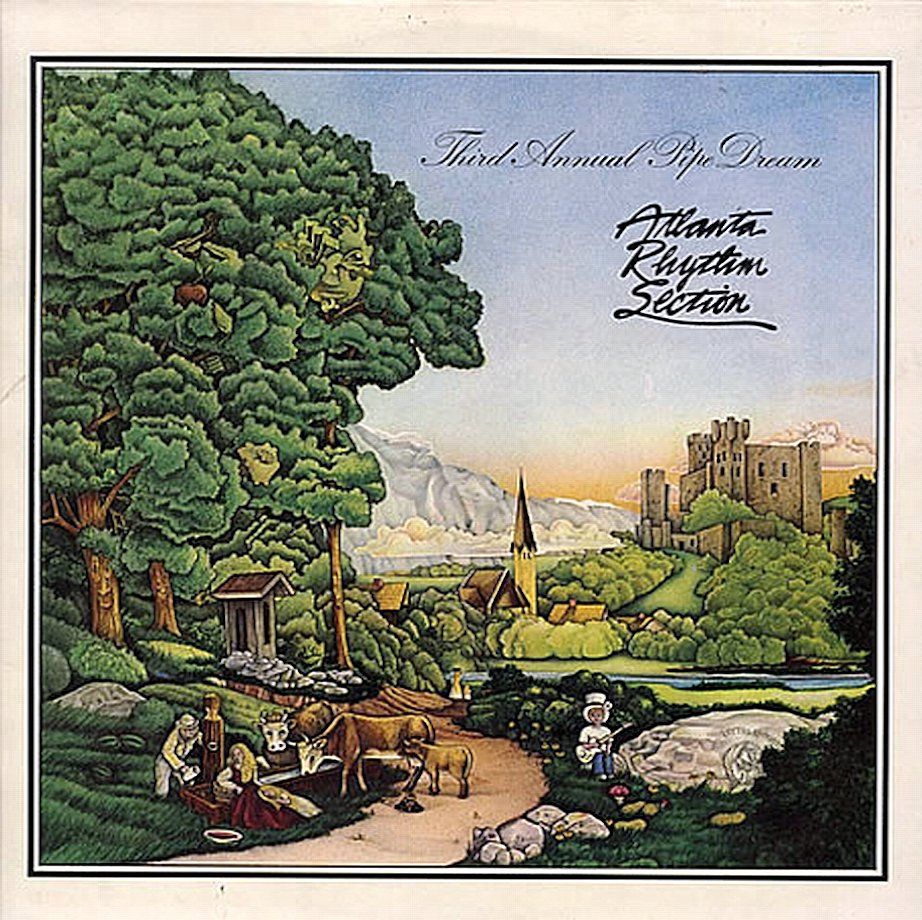
New Book Inspires 'Spooky' Memories of Southern Rock Band (and Client) Atlanta Rhythm Section

Just in time for Halloween, last week I found a "Spooky" treat sans trick via my email inbox.

The P.R. team for Schiffer Publishing reached out to offer a review copy of the new book "The Atlanta Rhythm Section: The Authorized History" by Willie Moseley.

Yes, please!

I don't think the publicist knew that in 1999 ARS was one of my first clients at The Headline Group. 

Along with "Spooky" (penned by the band's longtime manager and our main contact, Buddy Buie), during that springtime project I also came to appreciate ARS' Southern rock classics including "So Into You" and "Doraville" ("a touch of country in the city") as well as "Imaginary Lover" and "Champagne Jam."

Our motto while publicizing the band's CD titled "Eufaula" -- named for the historic town near the Alabama/Georgia state line -- was "Do It Or Die." 

We nearly did just that during a severe thunderstorm with too-close-for-comfort lightning that crept up during a live and lakeside Internet event with the band.

If only the online audience had known we were chatting with them from a state park men's room while hunkered down during the cloudburst (the band's front man Ronnie Hammond was a good sport about this and many other interviews we secured). 

I found "The Authorized History" of ARS to be a quick read and it will be a fun text for longtime fans. Much of the book features the band's slow but steady rise to prominence during the early 1970s, peaking with some spectacular concerts during which the band shared top billing with Heart, Genesis, Foreigner, Tom Petty and the Heartbreakers and Jefferson Starship.

Interesting to learn that ARS presented the first rock (or any) concert at Georgia Tech's Grant Field, a venue that most recently hosted The Rolling Stones in 2015. 

Pouring over Moseley's writing, I knew there'd be a five-ringed payoff, and sure enough there is, on page 204.

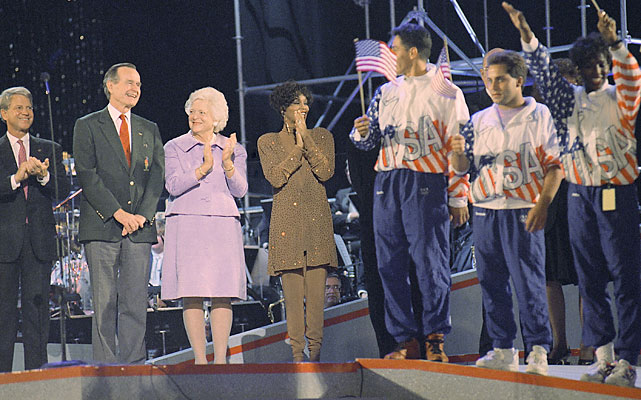
"Another memorable concert -- for the entire band -- happened [when] the Olympic Flag Jam, a grandiose event, was held at the Georgia Dome in Atlanta on September 17, 1992, to boost the upcoming 1996 Centennial Olympic Games that were scheduled for Atlanta.

The Olympic flag was officially transferred from Barcelona, Spain, the site of the previous Olympiad. Overseen by Dick Clark and Whitney Houston, the event was attended by President George H.W. Bush and his wife."

The text goes on to describe the celebratory event as including Houston, Santana, Travis Tritt, Tricia Yearwood, Alabama, Garth Brooks, TLC and James Brown, and sports personalities including Richard Petty and Atlanta-based Olympian Edwin Moses, who autographed a set of bass strings belonging to an ARS member. 

"My most vivid memory of playing at 'flag jam' was looking in the audience and seeing Coretta Scott King dancing along to us playing 'Champagne Jam,'" said Steve Stone, ARS bass and backing vocalist, according to the Moseley text. 

The event marked ARS' second live performance for a sitting president, a follow up to their September 25, 1978, gig at The White House hosted by fellow a fellow Georgia native, President Jimmy Carter. Interesting to read about "the first rock band to play on the south lawn" at 1600 Pennsylvania Ave. and how the after party unfolded without much interference by Secret Service personnel.

It was gratifying to find mention of Buie's obituary in The New York Times which I personally pitched to the newspaper upon learning of Buddy's passing three years ago.

But, unfortunately, the book did not delve into much about the work our team from The Headline Group did in spring 1999, save mention of a spring picnic at which food from The Varsity was a treat and a noise complaint brought things to an early close (I was there!).

But I'm not gonna let it bother me tonight.

Photos via ARS, Schiffer Publishing and SI.com featuring AP photo by Scott Applewhite

Wednesday, October 24, 2018

Taking in 'Paul Simon: The Life' by Robert Hilburn

Last month in New Jersey, I stumbled upon a new audio book in the public library near my summer 2018 address.

Robert Hilburn's thorough biography titled "Paul Simon: The Life" sort of jumped off the shelf and into the CD player for the drive back toward Atlanta. 

To my chagrin, this authorized biography of the 12-time Grammy Award winner remained off my radar since its mid-May release.

Later found myself wishing I had known of and read it during the summer spent near Newark, where Simon entered the world 77 years ago this month.

The book is a page-turner as it's fun to learn the back story to so many of Simon's works during October, Major League Baseball's post-season for a sport which Simon aspired to play professionally while growing up in Queens, N.Y.

Whether you're a lifelong fan or only discovering Simon's music, this is a great read. 

There's two five-ringed connections in the text.

First, there is reference to a song titled "Western Movies" by a 1950s band named The Olympics, which I learned is a band also known for the song "Good Lovin'" (later a No. 1 hit for The Rascals).

Apparently Simon enjoyed The Olympics' version more as it is cited as the inspiration for one of his pre-Simon & Garfunkel tunes scribed not long after the duo performed together in a middle school musical.

Second, the Simon & Garfunkel song "Citizen of the Planet" was hand-picked by Olympic broadcasting's Dick Ebersol to run during NBC's closing credits of the Athens 2004 Olympic broadcast. 

"Paul Simon: The Life" is dense in its detailed descriptions of Simon's family upbringing and youthful neighborhood interactions. Often teased about his height, the future husband to Princess Leia actress Carrie Fisher stood up for himself when kids picked on his outfit of choice (cargo shorts) on a hot summer day. 

Readers learn that standing up for himself, smart and methodical planning and an incredible work ethic are each common themes throughout Simon's life.

To earn pocket change as an aspiring musician, Paul logged innumerable hours playing as a house-guitarist of sorts for labels in Manhattan, along the way picking up industry tips to guide his own career. For instance, he gained the rare-to-his-peers insight to maintain copyright ownership to all of his creations, which no doubt paid off in countless ways through six decades of performing.

As a 20-year public relations executive, I found it fascinating that Simon shrugged off the aid of publicists during the early years of his career, but somehow by the time "Graceland" entered the charts he had the moxie to hire an issues management P.R. firm as his world music recordings included sessions that some predicted would draw flak over connections to Apartheid-era South Africa.

The same award-winning music and sessions, for which Simon engaged numerous African and other international musicians, earned him the Zulu name Vutlendela or "the one who opens the way" in honor of all the connections he helped establish for world music.

Simon's crisis counselor also accompanied the singer when he stood up to a group of South African protesters who reneged on a settlement during an embarrassing-for-Simon press conference in 1992. The incident is tied to Simon's adult son by his first marriage, Harper, and a lesson he wanted to teach him.

Decades earlier, a preschool Harper also played a part in Paul's lyrics for "50 Ways To Leave Your Lover," for which "snappy rhymes grew out of a good-natured rhyming exercise Simon had" with his son.

Hilburn's research is packed with quotes from interviews with the likes of Lorne Michaels, Burt Bacharach, David Geffen, Quincy Jones, Clive Davis, Charles Grodin, Dick Ebersol, Carrie Fisher, Philip Glass, Randy Newman, Linda Ronstadt, Steve Martin, Wynton Marsalis, Steve Van Zandt, Sting and Chuck Close.

Surprising photos in the book include Simon in an embrace with Fisher, baseball legend Mickey Mantle with Simon during the video shoot for "Me and Julio Down by the Schoolyard," and a candid snapshot Michaels captured as Simon autographed a speeding ticket received during his drive to Memphis, Tenn., for their intentionally fanfare-free first visit to Elvis' home.

The book also provided a fun reminder of Simon's cameo as a music executive in Woody Allen's "Annie Hall."

Big awwwww for the description of Paul's love at first sight introduction to Edie Brickell when he crashed her appearance on "Saturday Night Live" (Simon's deep connections to the show's run from Season One to present also get their due).

Of course the reading (and listening to the audio book) made me sentimental about the two Paul Simon concerts I was lucky enough to attend, including the first one in 2011 that included an impromptu high-five from the artist as this blogger snapped an arm-extended selfie on the front row.

And all those wonderful songs, and the vivid lyrics, play in the readers' head as the context and scenes of Simon's world unfurl on the book's pages.

And the moon rose over an open field
And I'm empty and I'm aching and I don't know why
Counting the cars on the New Jersey Turnpike
They've all come to look for America

Photos via Simon & Schuster, United Artists, Twitter.com/PaulSimonMusic 

Saturday, October 20, 2018

Family Secrets Revealed Sans 'One Moment In Time' in Kevin Macdonald's Latest Documentary 'Whitney'

The first time I watched a film by British director Kevin Macdonald, the cinema was only steps from the Sydney Opera House.

It was summer 2000, on the eve of the Australian Olympiad, and the story on the silver screen was "One Day In September," the Oscar-winning documentary about the terrorist attack in the 1972 Munich Olympic Village. It was such a great film, I watched again twice before returning stateside.

Macdonald packed 94 minutes with deep history and surprising interviews all in the five-ringed context. 

So, when news arrived that "Whitney" -- billed as a family-authorized Whitney Houston documentary -- got assembled with Macdonald's skilled craftsmanship, my curiosity piqued and I started counting the days to its July 6 release. 

How would the director weave in Houston's Olympic anthem "One Moment In Time," I wondered. 

And would the film billed as "an intimate, unflinching portrait" at last reveal both when and how the singer/actress met her husband Bobby Brown? 

In "Whitney" (now available streaming and on DVD) Macdonald does deliver the goods on Houston in many interesting and revealing ways -- it is so well done, I've already watched it thrice. 

As in "One Day In September" there's no way around the tragic ending, and Macdonald treats the subject's troubling spiral head-on sans varnish. There's great, surprising interviews, and amazing footage of Houston's best performances around the world, starting with her showstopping national TV debut, many of which were new for this longtime fan. 

For more about what "Whitney" does include, please jump ahead seven paragraphs. 

Though Carl Lewis taking an L.A. Olympic victory lap appears in a montage of 80's nostalgia, much to my disappointment, "Whitney" does not include reference to "One Moment In Time," Houston's Seoul Olympic anthem and her seventh single to reach No. 1 on Billboard's chart for Hot Adult Contemporary songs. 

In fact, many of the singer's late-80s/early 90s hits are glossed over while the filmmaker focused on Houston's personal life of this period, highlighting tours and TV appearances during which she defended herself from an Al Sharpton-led movement labeling her "Whitey" Houston (ever the publicity hound, Sharpton makes a later appearance, at 180 degrees, praising the singer on the day of her funeral). 

The film segues to the common narrative that Houston met and flirted with her future husband Brown during the Soul Train Awards, skipping what I believe to be the real narrative, that Brown met Houston while filming the video and recording for the anti-drug PSA "Stop The Madness" (a close look at the credit roll reveals that Houston and Brown, as part of the band New Edition, willingly participated). 

For a peek check the video time stamps of 1:44 (Houston solo), 3:01 (Brown on front row in gray jacket) and 5:06 (end credits listing The New Edition and Whitney Houston as lead vocals).

I am dying to ask Macdonald and his team whether this "Stop The Madness" clip ever met their eyes, and if so, did they ask about it during their interview with Brown or others they captured on film for "Whitney."

Would also love to ask him about the "One Moment In Time" omission. No response to my requests/queries to the Roadside Attractions PR team, so far. 

"Whitney" opens with Houston's own voiceover -- from an early-career publicity interview -- with a vivid description of her recurring dream in which the singer runs across a fiercely swinging bridge while chased by an unknown giant.

"That's the devil chasing you," according to Houston's mother, Cissy, later introduced as a backup singer for Aretha Franklin turned matriarch of the East Orange, N.J., home where Whitney and two brothers grew up blocks from racially-divided Newark. 

Viewers also meet Whitney's father, aunts (including Dion Warwick and her sister, Dee Dee, sometimes tapped as a babysitter when Cissy traveled in pursuit of her own singing career) and other players of Whitney's youth and early career. 

Devoted churchgoers, the Houstons were affectionately named "The Cosbys" of their neighborhood by one Macdonald interviewee, but viewers learn soon enough that choices of infidelity, greed, drug use and other human behaviors all factored as Whitney's star gently rose then took off like a rocket to the moon. 

There are many poignant moments, including mother-daughter scenes in which Cissy imparted wisdom and affection for Whitney. 

And there are professional milestones presented with the perspectives of agents, producers, stylists, friends and ex-boyfriends, and several light-hearted moments showing Whitney at her most playful and upbeat self. One "get" that I suspect Macdonald wanted was an interview with Robyn Crawford, Whitney's closest confidant from high school to the late 1990s, when a wedge (Brown) created a rift too great to overcome. 

Macdonald delves into several darker influences (bullying, racism, drug-using relatives, homophobia) that, all combined, may explain the sharp turns Whitney took around the apex of her success, arguably the months after "The Bodyguard" and the worldwide tour that brought her to meet Nelson Mandela, who dried her tears at their introduction (her performance in Johannesburg stood out for this blogger).

Her private homes, including her childhood abode, an early fame custom-built mansion in a New Jersey forest, and later residence with Brown in Alpharetta, Ga., provide some insightful peeks. 

Atlanta's cameo in the film is anything but flattering, but the panoramic drone views of summer in Midtown are spectacular. 

Interviews with Brown, L.A. Reid and others who deny discussion or knowledge of Houston's drug use left some audience members dumbfounded. 

And much of "Whitney" and the milestones of her addiction are where the film is just plain sad, punctuated by an interview with the personal assistant who found Whitney a Beverly Hilton bathtub. Not a dry eye in the theatre. 

There are also many gut-wrenching revelations into the world and demise of Houston's daughter, Bobbi Kristina. 

But the big reasons to watch "Whitney" are her astounding live performances as a teenager, energetic and new-to-fame twentysomething and those early 1990s moments in time. 

The backstory about her Super Bowl performance of "The Star-Spangled Banner" is inspiring. 

And her work on "The Bodyguard" is interesting (Macdonald only really touches on this, her first film, and her final film "Sparkle," leaving out "Waiting to Exhale" and "The Preacher's Wife" for unknown reasons -- maybe time as "Whitney" clocks in at exactly two hours). 

I was hoping the DVD would include extended interviews with Kevin Costner, her production company leader Debra Martin Chase, or her film agent Nicole David, who seemed to be the only person interested and actively trying to save Whitney from herself and the demons of her addictions. 

Loved the original albeit haunting music by Adam Wiltzie that scores some of the most sorrowful moments of Whitney's life. 

It's not clear whether Macdonald's latest work will earn the same acclaim as "One Day In September." It would be interesting to see the filmmaker tackle another topic with five-ringed connections. 

My suggestion to Macdonald: Enter the Olympic ring again, this time with heavyweight sports documentary filmmakers like Leni Reifenstahl and Bud Greenspan who captured entire Olympiads of competition for the ages. Macdonald as the official O-film director for a "Tokyo Olympiad" sequel in 2020, anyone? Yes, please.

For the longtime Whitney Houston fan or a younger viewer discovering her music, "Whitney" is an excellent and rounded view a life filled with many big moments in time. 

Images via Roadside Attractions, Arista, HeyUGuys.com

Friday, September 28, 2018

High Museum Fist Bumps with Artist Glenn Kaino and Olympian/Human Rights Icon Tommie Smith

AFP


Next month marks 50 years since Mexico City hosted the Games of the XIXth Olympiad.

In step with this five-ringed milestone, on Sept. 29 the High Museum of Art in Atlanta opens a new human rights- and Olympic-centric exhibition to remain on view through early February.

For an LA-based conceptual artist and one of history's most iconic Olympic gold medalists, the exhibition With Drawn Arms: Glenn Kaino & Tommie Smith marks the culmination of a six-year partnership.

In press materials for the installation and in conversation at the exhibition's media event, Kaino said he found inspiration from Smith before they met at the athlete's home in Stone Mountain, Ga., during 2012.

John Dominis, Time & Life/Getty Images
At his California studio, Kaino had a picture of Smith with teammate John Carlos and Australia's Peter Norman on a board, sort of in the background. The artist said once an opportunity to meet the athlete took shape, the process to arrange an introduction and discuss a collaboration moved quickly.

"My practices are process-based and so the conversation was really 'let's take a journey together and let's see where this goes," said Kaino.

Smith concurred, and according to Kaino, "The first thing I did was cast his arm."

After experimenting with several life-sized and miniaturized versions of Smith's outstretched elbow and fist, including a few thousand Kaino described as small G.I. Joe-like versions, the duo discussed the option to create a suspended sculpture.

The finished work titled "Bridge" -- featuring 150 gold-painted steel casts, fiberglass, wire and gold paint -- is now the centerpiece of the project, with the suspension elements connecting the past, present and an arm's length path to the future.

"The image of Tommie's silent protest on the victory stand has become an iconic symbol of resistance and unity for generations," said Kaino. "Our goal with this project is to ensure that Tommie's message resonates for years to come."

For Smith, who contributed several objects from his personal archives -- including photographs, uniforms, Olympic souvenirs spanning 1968 to present, and other mementos of his travels -- the exhibition is an extension of the pro-human rights messages he sought to convey before, during and since his record-setting 200m run of 19.83 on October 16, 1968.

Tommie Smith (left) and Glenn Kaino
"Mexico is a part of my life where [I] had to sacrifice to move forward," said Smith. "Dr. [Martin Luther] King said, 'there is no forward movement without sacrifice' and I believed in those words.

"In other words, take a chance, and that's what I did," added Smith.

With Drawn Arms fills the lobby and second levels of the museum's Anne Cox Chambers Wing, with an original 2018 sculpture titled "Invisible Man (Salute)" greeting visitors to the High's outdoor piazza.

The life-sized likeness of an arm-raised Smith is cast in blackened aluminum and mirrored stainless steel, inviting all to experience their own likeness "within a continuum of history since 1968," according to the High press release.

The lobby gallery features several works on paper including drawings, alcohol transfer prints and a colorful montage of silk-screened boards on view across from a framed black T-shirt with the message "UNITE" (the "I" in white ink is Smith's arm as captured in the 1968 Olympic photograph by John Dominis via Time & Life Pictures/Getty Images).

Visitors may also see brief excerpts from a planned documentary film about the six-year collaboration. It was interesting to watch edited images of Smith climbing Stone Mountain as part of the film.

In addition to experiencing the gallery-sized "Bridge," the second level spaces showcase Kaino's 2013 recreation of a 1968 Olympic medals podium.

The work titled "19.83" is a steel-and-gold-plated work "presented with related prints and drawings depicting frame-by-frame images of Smith's race" as it aired on ABC.

The alcohol transfer prints featuring the screen grabs are reminiscent of four treatments Kaino executed, on view in the lobby, with an enlarged Newsweek magazine cover that labeled Smith "The Angry Black Athlete" heading to Mexico City.

Kaino honed in on the magazine cover during his first visit to Smith's home, and Smith's copy of the July 1968 edition is on view in an upstairs gallery.

Some of the surprises in the exhibition are drawings Smith created, including one scrapbook collage featuring youthful track and field snapshots and hand-drawn captions. Kaino also asked Smith to draw himself, which the athlete, teacher and civil rights leader created as ink on paper illustration from the outside looking in at himself.

It is also fun to spot Smith's official 1968 athlete pin -- an oversized badge with an athletics ribbon that served as his accreditation for the Games -- in a shadow box filled with other Olympic pins he collected (Smith told me he had many more pins still at home).

A three-inch plastic button promoting the Olympic Project for Human Rights, which Smith launched months before Mexico City in order to bring attention to issues in Africa, the Americas and worldwide, is centered in its own frame near Smith's portrait in the Oval Office with President Barack Obama.

Smith and other 1968 Olympians will gather in Mexico City next week to celebrate 50 years since the Games, so I asked him whether there's a word to describe his feelings about this milestone.

"Fulfillment," said Smith.

For readers who catch this post in time, Smith and Kaino will participate in a conversation with the museum's modern and contemporary curator, Michael Rooks, at the High on Sept. 29 at 2 p.m. The event is free for High members, with non-member reserved tickets ($14.50) available online.

Exhibition photos by Nicholas Wolaver; 1968 image by John Dominis via Time & Life Pictures/Getty Images; top image via AFP


Glenn Kaino (American, born 1972) Bridge 
courtesy artist and Kavi Gupta Gallery, Chicago
Copyright Glenn Kaino. Photo by Mike Jensen
Glenn Kaino
(American, born 1972
),
Bridge
,
2014,
fiberglass, steel, wire and gold paint
.
Courtesy of the artist and Kavi Gupta Gallery, Chicago.
©
Glenn Kaino. Photo by Mike
Jensen.

Wednesday, August 29, 2018

Guest Post: Every Curl Begins At Kays

Associated Press

My longtime friend and fellow International Society of Olympic Historians (ISOH) member J. Brian Carberry spent part of his summer vacation in Scotland.

His mission (in addition to taking the family to an Ed Sheeran concert): Visit the homeland of Olympic curling.

More specifically, the place where all Olympic competition curling stones are made: Kays of Scotland.

The following guest post by Carberry tells the tale, initially inspired by a national news story we both spotted a few years ago. Brian also suggested a video for additional context.

As told by J. Brian Carberry ...


“Oh, Boiling,” expressed factory manager Jim Bright in a distinctive Scottish dialect, as he walked out to meet me in the modest industrial granite yard.

The weather was sunny, and the sky was clear with a temperature of 74 degrees Fahrenheit on this spring day of May 24, 2018.  The yard was hot with the whirring of factory machinery in the background acting as a reminder of the heat index.

It struck me as a counterintuitive setting for a foray into the ice sport that is curling.

Korea Times
Curling is a sport invented in Scotland in the mid-16th Century, and along with its Summer Olympics counterpart of golf, it represents this nation’s contribution of sporting cultural heritage to the Modern Olympics program.

The inaugural 1924 Olympic Winter Games in Chamonix, France, was the setting of the first Olympic Men’s Curling tournament.  This Bonspiel in 1924 was held in a state of historical limbo for 80+ years.  It was seen by some as an official Olympic event and relegated by others as a mere demonstration until the tournament was officially recognized with full-fledged Olympic Medal status by the IOC in 2006.  

With the decision, the first, second and third place finishers were definitively elevated to official Olympic medalists. 

And at this time (2006), the 1924 Great Britain Men’s team that hailed from the Royal Caledonian Curling Club in Perth, Scotland, joined the women of the 2002 Salt Lake City Olympics Gold Medal team representing Great Britain as the only Olympic or Paralympic Gold Medalists in Curling from Scotland.

There have been seven Olympic tournaments for men, six Olympic tournaments for women, and one mixed gender Olympic tournament through 2018.  As well, there have been four Paralympic mixed gender tournaments to date.  

Scottish curlers won one-sixth or 16.7 percent of all Olympic and Paralympic gold medals contested.  Likewise with silver and bronze Olympic medals in the Olympics and Paralympics over the years, Scottish curlers have teamed up to win one-sixth or 16.7 percent of all the medals awarded at the Olympics and Paralympics under the flag of Great Britain.

Kays of Scotland in Mauchline, Ayrshire, Scotland is where the world’s finest curling stones, and those used exclusively in International World Curling Federation Competition including the Olympics, are manufactured from granite exclusively sourced from the Isle of Ailsa Craig, a distance of 34.2 miles away (according to Google Maps) in the Firth of Clyde. 

On the heels of an exciting gold medal-winning tournament for the Team USA men's curling team in February 2018 at PyeongChang, curiosity was piqued by a segment on CNBC to visit this singular locale for the manufacturing of Olympic curling stone implements. 

A family tour of Scotland was in the planning and development stages this past February.  As I followed the Olympic Curling tournament, visiting Kays of Scotland campus was a stop I suggested for the itinerary.  

It seemed like a good idea at the time.

At the appointed time on that Tuesday afternoon, our traveling group of three drove into the town of Mauchline in Ayrshire. There is little to no indication upon arrival that this is the world’s capital of curling stone manufacturing.  With the address checked and double checked in the navigation software, I found myself on an apparent residential street.  I happened upon a resident in the doorway of what surely was a townhouse, but might be a mixed use corporate office where all indicators suggest should be the locale of the factory’s address.

After brief discussion with the resident, I was directed to a small opening in a gate across the street, where was no visible signage.  

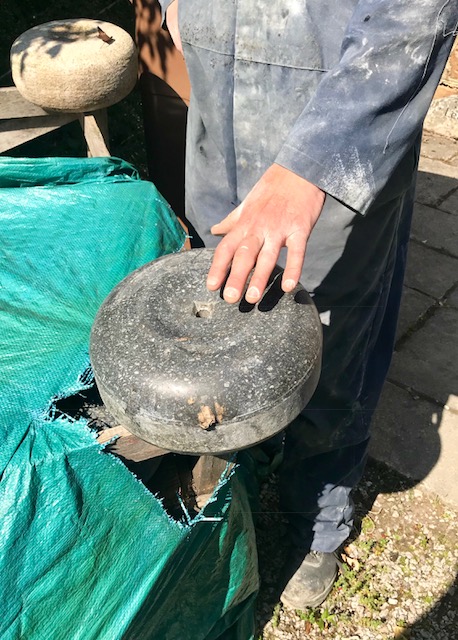
Unsure of the scene, I walked into a small yard and eventually spied some circular stones that could be in the beginning stages of the manufacturing process to become a curling stone - or they could be garden stones, I pondered.  

I ventured on with a veneer of assured confidence with my unsure family aside, like a wayward incarnation of a real-life Clark Griswold on some Olympian National Lampoon romp.  

In short order, we were intercepted by a concerned employee and politely yet firmly directed to an office where I sensed our arrival was not exactly expected nor understood. 

We eventually learned the contact who welcomed us (via email, weeks earlier) to come by for a tour was not at work that day, and I sensed no one was told we would be stopping by for a tour.  

In spite of this "surprise" visit, I was invited to examine a display of souvenir jewelry and miniature curling stone paperweights that served as a gift shop or at least storage for their website’s online gift shop.  

We perused the wares as the awkwardness dissipated, and an office worker tried to determine how to proceed with what is now clearly our unexpected arrival.

As I exited the small office to the yard, curling stones came into view in various states of manufacture or, in the case of those traded-in for new stones, stored for repurposing.  

I was politely informed that someone would be happy to show me around (perhaps escort me off the grounds) and briefly answer questions, and I was presented a professionally produced brochure.

On cue, the aforementioned factory manager Jim Bright appeared, wearing a work jumpsuit that displayed the logo for Kays of Scotland I recalled from the website.  For the first time since arriving, I was now convinced (at last) we were indeed in the correct place!

At the same time, I sensed that I was now the subject of curiosity. Who flies to Europe and drives out here to look at a small factory with their family in tow on holiday? 

After all, there were state-sanctioned castles and abbey tours to occupy tourists!  It also occurred to me I should probably be drinking locally sourced single malt whisky about right now.

Mr. Bright turned out to be a generous, albeit impromptu, host who indulged my questions and curiosity for about 25 minutes while escorting us through the small yet busy complex.  

I worried the extent to which we were keeping him from his work, and he informed me that his experience previously included manufacturing optical lenses to precise specifications; his skills were well-suited for the precision skill involved in fashioning some of the most unique granite in the world into world-class sporting implements that must meet very specific requirements.   

In addition, he informed me that he helped design the machinery for the production of the small souvenir curling stones that are offered for sale.  One such item inevitably became a keepsake/justification of our visit.

Kays of Scotland does not have a regular open-to-the-public factory tour and museum. It is not of the type of outfit found at the Louisville Slugger Baseball Bat Museum and Factory Tour in Louisville, Kentucky.  

Scotland is not the United States where such brand-based manufacturing tourism not involving whisky has a market I quietly determined.  

Perhaps this is rightfully so. Kays of Scotland is a small factory operation, and they have work to do.

I was getting the vibe that my family felt we had other touring to get to, but I decided the local Robert Burns Museum could wait while considering my own thoughts on “the best laid plans of mice and men.”

I was informed by Mr. Bright that this shop creates approximately 1,750 competition curling stones per year for shipment to locations around the world.  The process for each stone involves multiple steps of cutting, joining, diamond cutter lathing, setting and polishing.  

All of this happens after the raw quarried granite from Ailsa Craig arrives on sight.  In addition, the shop refurbishes for the recreational market or, in case that is not possible, repurposes granite for other products from old stones that are traded in on new orders.  

From afar, I peered into the facility that houses the heavy equipment that cuts and polishes the stones.
In the worldwide market for curling stones, Kays of Scotland and their exclusive mining rights to Ailsa Craig have a sole competitor in the way of a quarry in Wales where granite is sourced for manufacturing in a Canadian factory.

Geologists have determined there are two types of granite from the island: the Blue and the Green.  Both types are used in the component manufacturing for their world-class stones that players and aficionados have come to revere.

According to Mr. Bright, stones can last over 100 years, but time, use, storage conditions, climates, and differing ice playing conditions are all variables that can lead to stones eventually losing their action, grip or suitability for play at a given locale.  

Curling venues have house sets of stones that all players are required to use for play.  Individual teams and players do not travel with their own curling stones for play. For this reason, they do not sell stones to individual players.

In essence, the curling stones become part of the venue insuring Scotland’s role in hosting international Olympic competitions for the foreseeable future, and thusly contributes to the specialized niche nature of this business.

As I consider the path from a small granite island in the British Isles to the spotlight of Olympic Ice in the life of a curling stone, the Scottish bagpipes laden hit song by AC/DC comes to mind.  “... It’s a long way to the top if you want to rock'n'roll!”


Photos by J. Brian Carberry except where credited 

Blog Archive

Powered By Blogger
Web Analytics