Tuesday, January 13, 2015

Searching Sundance

 
With the 2015 Sundance Film Festival kicking off next week, today brought a perceived urgency to search for new Olympic-inspired movies on the docket for the big event in Park City.

As noted in festival preview posts of recent years, Utah's mountain resort -- home to several 2002 Winter Games venues and Team USA training sites -- offers a picture postcard locale at which to debut features and documentaries by accomplished and emerging filmmakers.

From what I can tell, the 2015 schedule at Sundance includes only two five-ringed films. The first appears to be an edgy comedy titled "The Bronze" highlighting the trials and tribulations of a once-famous 2004 Olympic gymnast who achieved much acclaim as a teenager with a third-place finish.

The story jumps ahead 10 years to find the former star now crestfallen, surly and living in her parents' basement as a rising gymnastics talent comes knocking for career advice from the woman she idolizes.

Some aspects of "The Bronze" brought to mind the 2011 film "Young Adult" minus the divorce element. Here's hoping the current release has a few more laughs.

The other Sundance entry -- which also potentially highlights athlete idol worship -- is titled "The Face of Ukraine: Casting Oksana Baiul," a documentary short from Australia.

From the brief details found so far, it looks like up to six girls from across the divided national are vying for the opportunity to portray the 1994 Olympic gold medalist in women's figure skating. Interesting.

I reached out to the publicity contact for both films, hoping more details may arrive soon. Until then, here's the festival's YouTube links regarding "The Bronze" for a sneak peek.

Images via Sundance Institute

Atlanta Olympic History @ Atlanta History Center


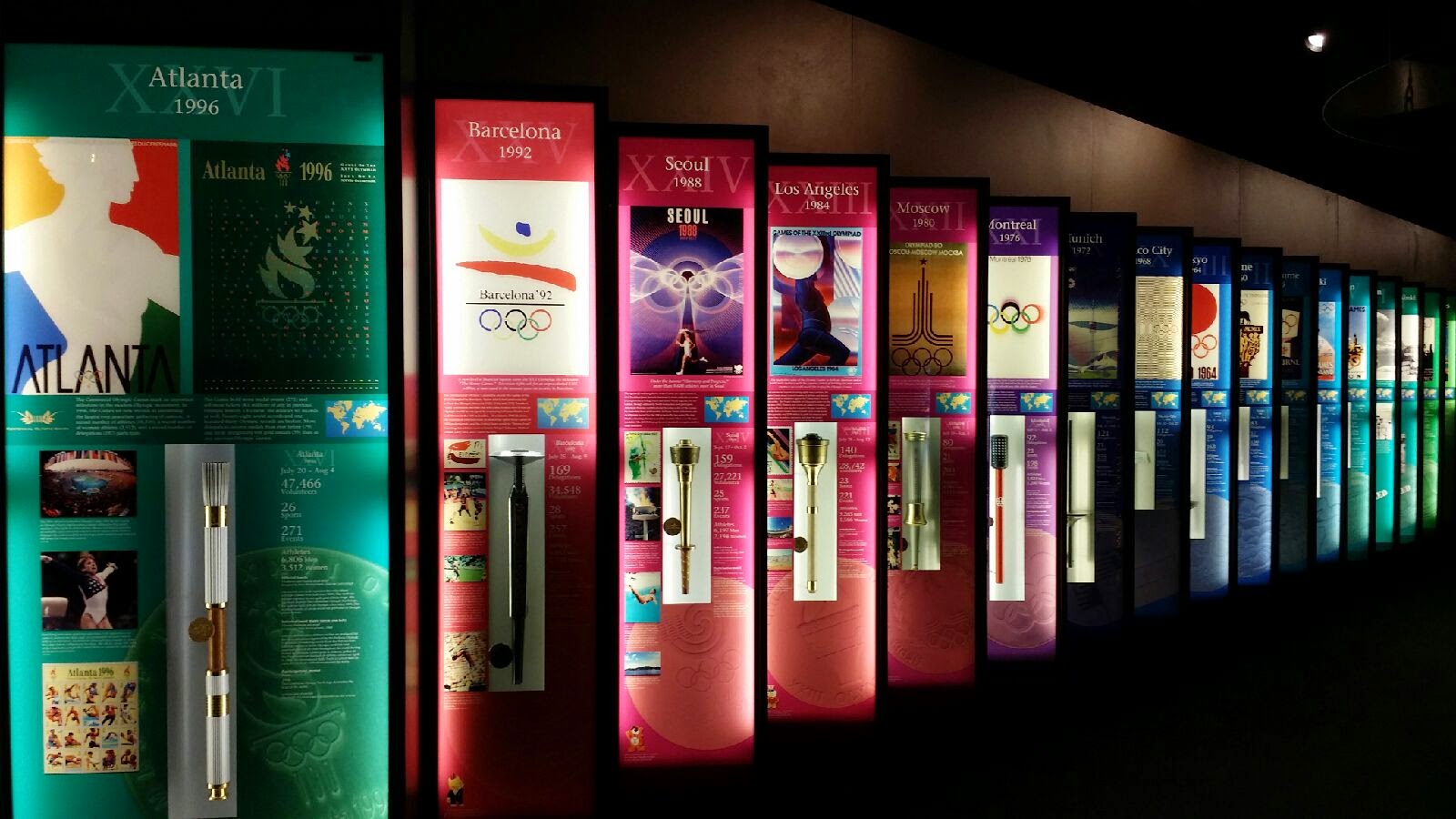
Last month brought an opportunity to revisit the Atlanta History Center as it hosted an Atlanta Press Club fundraising event. Prior to the APC gathering, I took a few minutes to again peek at the collection of Centennial Olympic Games Museum, worth a visit for five-ringed veterans or the uninitiated.

The museum includes an impressive, complete collection of Olympic torches leading to a visitor photo opp position inviting guests to hold an Atlanta '96 Olympic torch handle and smile for the camera.

I also enjoyed the assembly of artifacts from the Olympic bid team members who travelled with
William Porter "Billy" Payne, Ambassador Andrew Young and other volunteers who landed the Games in spite of tough competition from Athens, Melbourne and Toronto (Manchester, England, and Belgrade, Yugoslavia, were also in the running).

Also included are dozens of souvenir objects: Lapel pins, Olympic medals, volunteer and athlete uniforms, sports equipment donated by star athletes and props used in the Opening Ceremony help tell the story with several videos and recordings. An Olympic medalist podium and portion of the state-of-the-art track round out the experience.


A sight for sore eyes was an original model of the Atlanta Olympic Village as it was envisioned and mostly realized on one section of the Georgia Tech campus. The area shows how for a couple of months the "International Zone" of the Village included a flag plaza with banners of 197 competing nations (the athlete transportation plaza), a temporary dining hall and festive welcome ceremony area.

We had this model in our section of the Atlanta Committee for the Olympic Games (ACOG) offices at The INFORUM downtown -- my first Olympic job -- and it was fun to see the model come to life and to work closely with the small army of professionals who made it happen. Good history.

Today's Atlanta Journal-Constitution brought to light a current initiative of the Atlanta History Center. As the museum continues extensive renovations, curators are planning a 2016 exhibition "Atlanta in 50 Objects" for which public input is sought now through March 2.

To nominate an object for the exhibition, visit www.AtlantaHistoryCenter.com/Atlanta-50-objects and submit a brief nomination statement. This blogger already suggested an Atlanta Olympic bid team item to represent one of Atlanta's biggest and most influential dreams coming true. How say you?

Photos by Nicholas Wolaver. Atlanta In 50 Objects logo via Atlanta History Center.


Friday, January 9, 2015

USOC Selects The Athens of America for 2024 Olympic Bid


In case you did not already hear, on Thursday the U.S. Olympic Committee selected Boston -- a.k.a. "The Athens of America" -- as the USA's applicant city for the 2024 Olympic bid process.

Titletown" joins a long list of confirmed and potential (and some surprising) bid cities from five continents (Europe, Asia, Africa, Australia and North America). Rome, Paris, Berlin or Hamburg, Saint Petersburg (Russia, not Florida), Istanbul, Doha, Durban or Johannesburg and even Casablanca round out more than a dozen metropoli with 2024 Olympic aspirations.

GamesBids.com an informative archive of related news, and the organizing committee has a video series worth a peek.

I tuned in to the Team USA morning press conference and media teleconference on Friday with a few questions that weighed on me since the previous afternoon's selection: How does Boston plan to market itself as a domestically famous destination with less recognition outside U.S. borders? What specific points came up in the U.S.O.C. voting? What are more specifics of the bid? As noted in my most recent post, Boston was not my top pick, and skepticism lingered.

But most of my initial questions did get answered, and it seemed clear the Boston team plans a transparent and inclusive preparation for the many stages of the bid process. Venue plan and committee member/supporter specifics will start to be unveiled.

I like that they announced a series of public meetings and a bit of detail on community engagement. It also impressed me the committee gave a shout-out to Chicago 2016 bid team leader Pat Ryan for some innovations he introduced when The Windy City was a candidate (specifically, a type of insurance policy to prevent public funds getting flushed during the bid process).

Finding myself also enjoying the Boston Globe's initial reporting on this hometown news story. A solid opinion piece inviting public discussion set a positive tone for what comes next -- a lot of hard work. Though I'm certainly supportive and now excited about Boston as the USA's applicant city, I do think it has some tough company vying for IOC votes.

It would be nice to know more about the in-room discussions the U.S.O.C. board shared with regards to Los Angeles, San Francisco and Washington, D.C., but the spokespersons stuck to the script when Philip Hersh and others inquired with procedural questions also on my mind. Oh, well -- transparency must be back at the Denver airport meeting rooms where those discussions took place.

One factoid learned from a brief email exchange with a Globe reporter: Though the current Boston bid team really got started in 2013, Boston's Olympic hopes (or at least the hopes of a handful of locals) go all the way back to the 1970s.

I personally recall meeting a Boston 2008 bid team executive for a pin trade at one point.

At any rate, glad to see Boston get off on the right foot for the next phase of the city's Olympic pursuits.

Images via this link and Boston 2024. Image of 2008 Boston Olympic bid pin via OlympanArtifacts.com.

Thursday, January 8, 2015

A Tale Of Four Cities

Later today at the Denver airport, the U.S. Olympic Committee will select Boston, D.C., L.A. or San Francisco as the nation's 2024 summer Olympic bid candidate city.

Though I like the many merits of each market and their bid committee efforts to date, and it excites me the USA will enter the race, I also see bigger Achilles' heels for two of the four bidders.

San Francisco's 2008 treatment of the Beijing Olympic Torch Relay -- during which the city was seemingly shut down by vocal anti-Games demonstrations -- should itself be a major red flag to the U.S.O.C. selection team. Who wants to go see an Oscar winner in a theatre full of screaming infants? Choosing SFO seems the most doomed from the start, and as much as I'd like to experience the Games near the Golden Gate, the timing does not seem right.

I also perceive Boston as a long-shot. Though the city worked on previous bids, and the area's sports legacy is solid, I just don't see Boston as resonating with I.O.C. members. Like Chicago, Boston has a lot of name recognition stateside but may be less-known outside the USA.

Which brings us to Los Angeles (a two-time host in 1932 and 1984) and the District of Columbia.
Love both cities. Love their plans. I also love trying new things and think the USOC may feel that way, too, by placing more faith in a Washington bid.

My friends in each city share universal concerns that past U.S. bid cities faced: Won't the traffic get only worse? Do we want to suffer and endure an eight- to 10-year buildup period? Other general fears of the unknown.

As proven by most Games cities, traffic seems to clear up miraculously during the Olympics (as many locals head out of town). And as for other concerns, didn't someone once say "we have nothing to fear but fear itself" or similar?

I do think it's a shame that Chicago could not mount a follow-up bid to 2016, but too many people remain scarred by that experience (from my view the Windy City did not get a fair shake since the U.S.O.C. shot itself in the foot with an ill-timed pre-vote launch of an Olympic TV channel that went over like a turd in a punch bowl for many IOC members). Fortunately, the USOC has mended bruised relationships and it is encouraging there is now restored confidence in a 2024 bid.

Looking forward to the big decision and announcements of the next 24 hours.

Images via Newslocker, this site and this site.

Tuesday, December 30, 2014

Olympic Dasher at the Nasher

On an autumn 2014 trek to Dallas for a family wedding, I made time to swing by the Nasher Sculpture Center, a favorite art destination in The Lone Star State.

Discovering a major London 2012 Olympic "visitor" there was a nice surprise.

For those in DFW who want to see something cool, of five-ringed relevance, and beyond the Nasher's outstanding permanent collection, a few days remain to catch the intimate but impactful exhibition "Provocations: The Architecture and Design of Heatherwick Studio" on view through Jan. 4 (sorry this post is so late for Big D friends; folks in or visiting L.A. and NYC also may experience this exhibition soon at the Hammer Museum and Cooper-Hewitt, Smithsonian Design Museum, respectively).

The installation of several dozen Heatherwick items -- from a modernized double-decker bus to whirling dervish chairs and models for ultramodern architectural feats -- is well worth a special trip to the Nasher (and later to the Hammer and Cooper-Hewitt).

Olympic fans may not recall Heatherwick by name, but they likely remember the innovative cauldron the firm created for the most recent summer Games. With more than 200 hammered pieces resembling bronzed peace lilies (one created for each National Olympic Committee marching in the Opening Ceremony), the ignited "floral" arrangement blossomed into a temporary cauldron for the duration of the Games before each "lily" joined its NOC on the team's return home.

In a word: Brilliant!

I was lucky to experience the cauldron up close, and also to visit the first stop of this traveling exhibition when it debuted in London during the XXXth Olympiad two-and-a-half years ago, and the Nasher scores big with their showcase of the Heatherwick items.

When viewing this collection in the U.K., the objects seemed cramped and uncomfortably deep within the museum (sadly I cannot recall which). By contrast, the Nasher presentation is airy and light, giving visitors room to breathe in the designs lauded as creations by the "Leonardo da Vinci of our times," Thomas Heatherwick.

Pleasant surprises include:
  • Background and sample components from the British "Seed Cathedral" created for the 2010 Shanghai World Expo. Simply breathtaking.
  • Models and photographs of the Rolling Bridge, which takes on an escargot-inspired shape when deployed and retracted near Paddington Station.
  • Examples of a "cracked earth" desert design making it possible to place retail and green park space slightly underground -- in valuable man made shade -- in some of the world's hottest arid destinations.
  • Dreamy renderings of futuristic creations including a "learning hub" in Singapore and a Thames-spanning "garden bridge"
  • Samples of amazing artwork and displays created for retail clients, and an amazing boat design I predict may appear in future James Bond films with an aquatic-based villain.
Visitors may also get into Heatherwick designs at the museum entry and in the sculpture garden. At the front desk, guests hand-crank their own exhibition "program" from a contraption reminiscent of a miniaturized newspaper or magazine press. Outdoors, be sure to take a whirl on one of the many "spun chairs" that delighted children and the young at heart from ages seven to 75 on the day of my visit (the spinning is smooth and akin to riding a playground swing).

I respect Heatherwick for their approach to client and asthetic needs and personally can hardly wait for a future Olympic host city to engage the firm for venue designs.

If anyone from the LA2024 Olympic bid team is reading this, take note and check out this show when it moves next to the City of Angels.

Here's hoping visitors to the Nasher and other exhibition destinations may find inspiration from what's presented.

Most photos by Nicholas Wolaver; images of Seed Cathedral via this blog and this site.


Thursday, December 18, 2014

Angelina Jolie Delivers The Goods, Unbroken

 
I didn't think much of Angelina Jolie until two events this week: Listening to her Dec. 17 NPR interview to discuss the Christmas Day release of "Unbroken," then experiencing the film at an Atlanta advance screening the same evening.

This movie converted me. Consider me now an official Jolie and "Unbroken" film fan.

I was already an advocate for the Lauren Hillenbrand book "Unbroken: A World War II Story of Survival, Resilience, and Redemption," which gained my attention when first published. Sadly it was only a few months ago I finally made time to read it and listen to the audiobook.

The biography of 1936 Olympian Louis Zamperini, expertly researched by the author of "Seabiscuit," quickly advanced to "best nonfiction" status among recently read books. The text deserves high marks for the emotional roller coaster it delivers, punctuated by the real life and appalling -- often tear-jerking -- events on its pages.

The Jolie-directed "Unbroken" is faithful to the book, and I exited the theatre impressed (and relieved) by the adaptation. It's a crowd pleaser minus the anticipated sentimentality. It inspires patriotism without drowning in red, white and blue rhetoric. And it makes you stop and think about the smallness of many day-to-day problems when compared to a hero war veteran's remarkable, excruciating and epic journey of survival.

"Unbroken" succeeds on the big screen because it lets the biography's hard truths speak for themselves. The opening "We are here" battle scenes captivate. Kudos to the screenwriters, including the Coen Brothers, for achieving a difficult transition from paper to camera.

When the going gets tough and keeps turning only for the worse, the audience -- mostly folks not likely familiar with the book -- reacted strongly, often calling out "unbelievable" and "how did this really happen?" Attendees shared the most audible responses to:
  • Zamperini's arrival at Berlin's Olympic Stadium with its accurate depiction of the final 1936 torch runner igniting the venue's cauldron. The filmmakers even got the time on the clocks correct for this opening ceremony moment -- thumbs up! It's my understanding the "torchbearer" actor is Clay Zamperini, though his relation to Louis remains unclear.
  • The anxious plane crash moments during which airman Zamperini blacked out inside the sinking fuselage lost in the Pacific. Though not detailed in the film, this is one of several life moments Louis attributed to Divine intervention -- when he passed out he was tangled and drowning in the doomed wreckage, but when he awoke he found himself free to swim and reach the surface. Touched by God?
  • The upward count of days (more than 40) the three crash survivors floated with scarce food, stormy seas, looming sharks and a dive-bombing enemy plane bearing down on their raft. Did I mention the sharks? There are a lot of sharks. Big sharks.
  • The shocking and deplorable prison camp treatments at several Japanese sites after Zamperini's naval "rescue" only to be incarcerated for more than two years. A most memorable line arrives with, "I've got good news and bad news." The movie barely scratches the wince-inducing hundreds of disturbing acts unveiled in the book.
  • The innumerable beatings Zamperini endured at the hands of his jailers. Would you keep standing if guards commanded 200 friends to punch you in the face?
I'm not familiar with the actors in "Unbroken" but have a feeling many of them will appear at awards ceremonies and in future films.

The newcomer actor and veteran Japanese musician Takamasa Ishihara, a.k.a. Miyavi, portrays war criminal Mutsuhiro "The Bird" Watanabe, wielding a bamboo cane used for cracking skulls (mostly Zamperini's, depicted by Jack O'Connell). Miyavi effectively unveils The Bird's deplorable deeds on par with the worst James Bond villains.

Many of us heard a friendlier "look me in the eye" before.

The soundtrack by Alexandre Desplat is inspiring and sets the appropriate mood, at times somber and brooding while also positive and uplifting, nudging Zamperini through many struggles.

The emotional payoff for this viewer arrived with some archival 1998 footage of an octogenarian Louis fulfilling a lifelong dream. I appreciated that Jolie and team briefly mention Zamperini's faith and message of forgiveness, neither spoon-feeding nor cramming the lessons down our throats.

My only unfulfilled-by-Jolie wish was that she'd include the Graf Zeppelin's cameo from the first few pages of Hillenbrand's version, but that scene may live on in the imaginations of those who read it. Maybe we'll luck out and find it on the DVD extras.

What was clear through "Unbroken" is that Jolie recognized the national treasure subject and she, and the cast and crew, logged the time to get things right. The film is a fulfilled labor of love, and the aforementioned NPR interview gets to the heart of Jolie's unique kinship established with Zamperini.

Jolie said Louis's request was please "Don't make a film about how great I am or how exceptional I am; make a film that reminds people that they have greatness inside themselves" and she delivered the goods.

Throughout "Unbroken" I counted potential directorial nods to other accomplished filmmakers and their work. See if you recognize subtle salutes to Leni Riefenstahl's original five-ringed film "Olympia" (I wonder if Louis appeared in that film, too, in footage of his 5,000m race), Steven Spielberg for "Jaws" and "Saving Private Ryan," Clint Eastwood for "Flags of Our Fathers" and "Letters From Iwo Jima," and Sir David Lean for "Bridge On The River Kwai."

There's even a dose of tree-lined schoolboy running, reminiscent of "Forrest Gump," and survival scenes from another Tom Hanks film, "Castaway," came to mind when Zamperini's doomed plane hit the ocean (remember the FedEx aircraft filling with water?). And I hinted about "The Karate Kid" earlier in this post.

After the WWII Allied bombardment reaches Tokyo, the "Unbroken" screen fills with images like Atlanta's rubble-strewn cameo in "Gone With The Wind." If "Life of Pi" did not pacify an ocean wanderlust, "Unbroken" will float your boat.

Bravo, Jolie and "Unbroken." Nicely done.

Images via www.UnbrokenFilm.com

Follow-up/Update (June 19, 2015): Not long after completing the review of "Unbroken" late last year, I also read a book by Louis Zamperini and David Rensin titled "Don't Give Up, Don't Give In -- Lessons From And Extraordinary Life" published by Dey Street Books/HarperCollins in November 2014.

The book was written from interviews with Zamperini in the months before his death, and the text features a nice collection of first person stories and suggestions "for living an honorable life" (so sayeth the publisher's press release). It's a good read, and an excellent companion piece to reading "Unbroken" or viewing the film.


Tuesday, December 16, 2014

Wrestling With 'Foxcatcher' Film Review

 
Two weeks ago, I made time to see "Foxcatcher" on the big screen in Chicago. And for days since, the film left me grappling for words to review it. Boiling it down in a few questions:

Is the film well made? Yes.

Does the acting and storytelling live up to the hype of film festival and other critical reviews? Mostly.

Will "Foxcatcher" be an Oscar contender? Maybe.

And do I recommend this film to others? Well, sort of.

After months of waiting and careful travel planning to see "Foxcatcher" -- on theatre screens in only a few cities until later this month -- I pinned hopes very high, elevating the true crime drama to "must see" status for several weeks.

Though I do think audiences will flock and rave about "Foxcatcher," and it is worthy of high praise, it did not live up to the must experience level of expectations this writer set for it. It is a great match of writing, acting and mood-setting cinematography, yes. But I walked away wanting something more.

It's definitely not a "feel good" film; in fact, one critic described "Foxcatcher" as the perhaps "the feel-bad movie of the year" -- a distinction also appropriate for "Gone Girl," which I enjoyed twice in spite of its dark and twisted themes.

By comparison, "Foxcatcher" is not a film that left me thinking or saying "I want to see that again" and though it's likely I'll watch it a second time, it's not likely I'd pay a second or third time (for this writer, a gauge of any film's "must see" status is the desire to repeat screenings with friends or family).

What's to like about Foxcatcher?

The Acting:

Steve Carell portrays John du Pont with vigor, becoming the deranged killer in a manner reminiscent of Jack Nicholson in "The Shining," with Carell's eyes taking on a lunatic gaze with great effect.

According to press materials for the film, Carell and his cast mates had an unusually long range of time, and volumes of material including video, to research their characters.

The three main actors' investment of time in thorough research pays off big time in "Foxcatcher."

Channing Tatum equally took on the many layers of Mark Schultz and the many "chips on his
shoulder" I found to be part of the Olympic gold medalist's autobiography on which "Foxcatcher" is generally based. As in the book, on screen here's a guy with a lot going for him but a background that made him his own worst enemy. It is interesting to me that Tatum described Mark Schultz in a manner on par with  my book review of "Foxcatcher" and its author.

"I don’t think anybody could punish Mark more than he could himself and I think he hardens himself against the world by punishing himself," said Tatum, in the film press release, an apt statement.

Throughout the story, Mark Ruffalo slowly and expertly gains the audience's love and admiration --
as did the real-life Dave Schultz -- which makes the on-screen murder scene all the more appalling. Many in the theatre cried out in shock or dismay with Carell's delivery of du Pont's final words to his victim, "You got a problem with me?"

Viewers get a deep dose of the brotherly love between David and Mark, and the unique paternal role the older brother played in their shared experiences. This is Ruffalo's best work I've seen, and it is worth the price of admission to learn more about the person the elder Schultz was (there's a lot to be learned from Mark as well).

The Action:

The team from "Foxcatcher" did their homework on Olympic freestyle wrestling and it shows. Before a summer 1995 internship at USA Wrestling, I knew next to nothing about the sport (and still have lots to learn).

But even with limited recollection of the official sport and its scoring, the wrestling in "Foxcatcher" seems real because it is real. From a U.S. Olympic Committee blog post -- a personal review by my former USA Wrestling boss -- I learned the lengths to which the filmmakers engaged the sport's national governing body for expert input and authenticity. It is fun to spot cameos by Olympic wrestlers including Bruce Baumgartner, Mark Schultz (the real one) and others on screen, and I suspect in their time working out or training Ruffalo and Tatum they also gave insight to the Schultz routine and their POV on du Pont.

"Foxcatcher" also includes brief glimpses at Modern Pentathlon, Olympic-style shooting and the
world of championship show horses. A favorite non-wrestling scene includes Carell's portrayal of du Pont reacting to his mother's death by casting out her prized equine collection, again with a creepy and somber intensity that nails it.

Back on the wrestling mats, I enjoyed the authentic scenes showcasing the Los Angeles 1984 Olympic experience and Seoul 1988 Olympic trials and competitions right down to the bunting and uniforms. Though executed on screen with timing tweaks different from Schultz's book, the events are intense and well-played.

What's not to like about the movie, and answering the question, "Do you have a problem with me [the film]?" Yes, for this Olympic blogger there were some problems with "Foxcatcher."

  • I wasn't keen on how the filmmakers addressed cocaine use by du Pont and Mark Schultz, whose book mentions this topic with some explanation. The filmmakers took a lot of liberties and changed the context of the drug use, not for the better.
  • This inaccurate depiction of a junkie Mark, blended with an autobiography-text-turned-into
    screenplay scene describing a haircut Shultz gave du Pont, set up some shots that ever-so-subtly make a case that the coach and athlete duo had a more intimate or even a gay kinship. This seemed to stray way too far from the facts described in Schultz's true text.
  • Though necessary to condense the story, I wasn't crazy about the abbreviated timeline of events. Mark Schultz exited Team Foxcatcher just after 1988, and Dave died in early 1996, but the film does a mash-up of these distant events that was artistically decent but bothersome for me (if going for accuracy on the wrestling mat, why not replicate the accuracy in timing?).
  • In spite of input from award-winning musicians including Mychael Danna ("Life of Pi"), the "Foxcatcher" soundtrack selections made no impression for this viewer; seemed like a missed opportunity to engage composers with strong Olympic and/or sad soundtrack creds (think John Williams and "Munich" or "Schindler's List" themes and his other five-ringed compositions).
The official film press kit for notes the director, Bennett Miller, says of "Foxcatcher" and his other true crime works "Capone" and "Moneyball," (the latter of which I admired), "It's fact to fiction as a vehicle back to the truth." O.K., fine. But what about "the truth is stranger than fiction" as food for thought?

Should folks see "Foxcatcher?" Yes. It is a solid film.

Just don't go into the theatre pinning hopes too high for the experience.

Images via Sony Pictures Classics

Follow Up Note (December 27, 2014): Upon viewing "Foxcatcher" for the second time today, I'm writing to amend previous remarks about the music. While I stand by my previous comment that a John Williams composition may have been appropriate, I did pay closer attention to -- and enjoy more -- the Mychael Danna works that unfurl between long silences of the film. There's some strong, albeit somber, piano notes that set the tone for many scenes. As in "The Ice Storm" -- another dark film for which Danna contributed music -- this film is served well by its score.


Blog Archive

Powered By Blogger
Web Analytics