Showing posts with label Atlanta History Center. Show all posts

Saturday, November 21, 2020

Atlanta History Center Opens Signature Exhibition Framing Atlanta's '96 Olympic Journey and Legacy


On Sept. 18, the 30th anniversary of Atlanta winning its bid to host the Centennial Olympic Games, the Atlanta History Center welcomed visitors to the museum's newest signature exhibition "Atlanta '96: Shaping An Olympic & Paralympic City." 

Atlanta History Center
An update in the making for multiple years since the previous Olympic section closed to accommodate the center's excellent Cyclorama installation,    I enjoyed a five-ringed sneak peek on Sept. 15. 

After additional visits on both    opening day and Sept. 19, and more than two months of percolating on observations, the new space remains at once pleasing and perplexing for this blogger. Here's a video the museum posted to describe the experience. 


What follows is a blend of the good stuff (the exhibition is definitely worth a special visit) and items I think would help improve on a solid presentation. 

New surprises and what I liked:

- Clean and classy lines of the timeline displays with the Modern Games' and Atlanta's history on parallel tracks from 1896 to 1996 and beyond

- Views of the original mock-up for Atlanta's hardbound bid publication, reminiscent of Miranda Priestley's dummy magazine copy known as "The Book" in "The Devil Wears Prada"

- First look at a rare, custom-designed Cabbage Patch Doll with pin stripe suit and leather briefcase presented to voting members of the International Olympic Committee

- The impressive hand-painted original model for architect Siah Armajiani's Olympic Bridge and Cauldron, a functional sculpture that did not reach the potential of its sister structure in Minneapolis

- Original artwork -- a massive, colorful canvas -- painted by the athletes of the XXVIth Olympiad in the athlete village at Georgia Tech

- Discovering one extremely rare "Olympic Quilter" pin given to the artisans who stitched up content for the Cultural Olympiad. An equally rare prototype or unreleased pin featuring mascot Izzy carrying a Georgia state flag (circa 1996) also took me by surprise

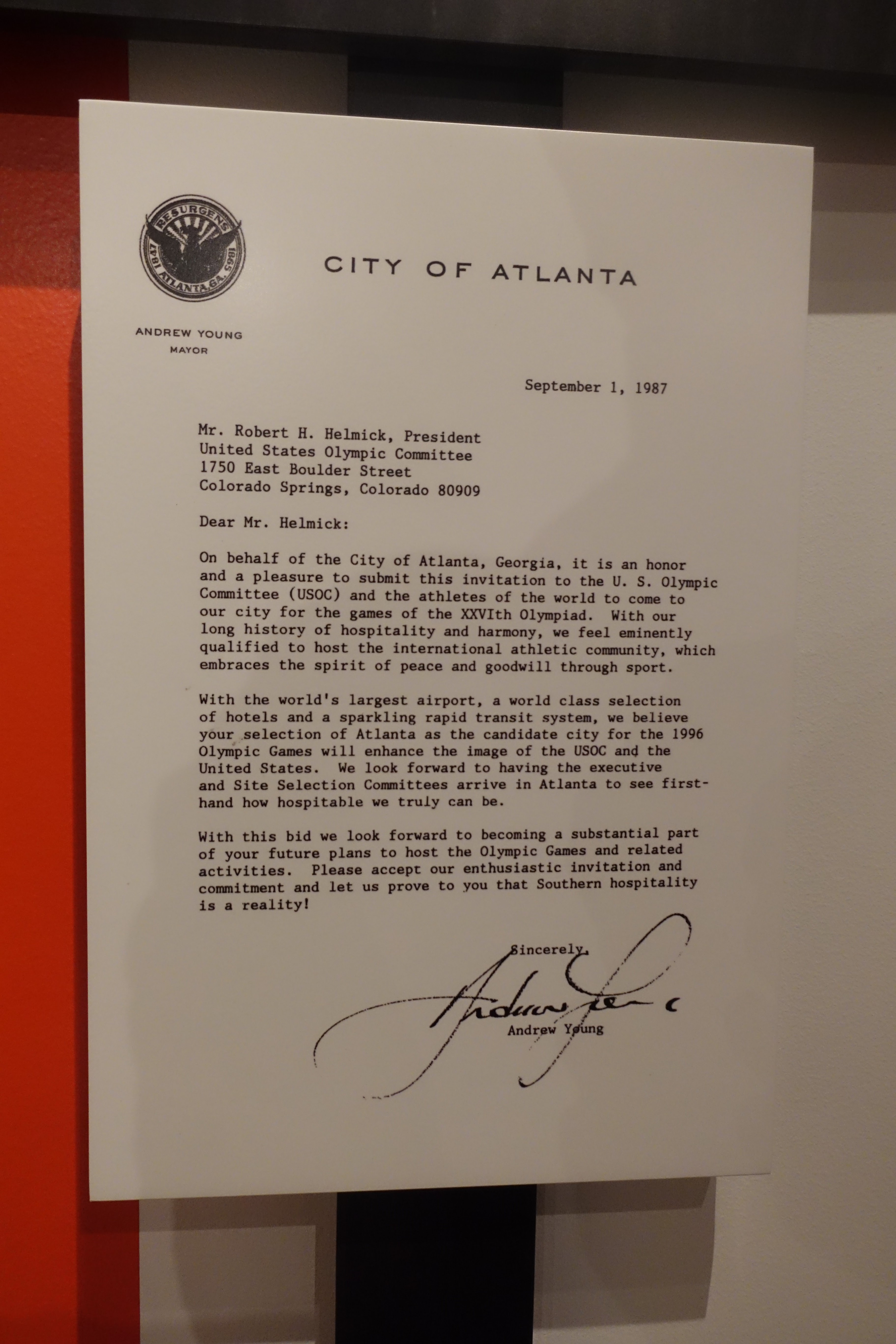
- First look at the set of custom miner's lamps used to transport the Olympic flame from Greece and to many points across the U.S. during the epic 1996 Olympic Torch Relay

- One of the authentic "Info '96" interactive kiosks touting IBM technology and the first official website for a host city

- Displays about important community leaders and the regional causes they championed, providing context for the against-all-odds proposal the Atlanta bid team brought to the city during the later 1980s

- Touchless interactive video players that "talk to the hand" of visitors who wave or make fists to select and play archived content (perhaps the state's first museum to use this technology)

Atlanta History Center
- New and more detailed information about the Shepherd Center and its role, along with the Atlanta Paralympic Organizing Committee (APOC) to secure the Paralympics' parallel journey with each Olympiad since

- All of the feels from viewing footage of Olympic champions' "one moment in time"

- An oversized photo of my longtime friend and mentor cheering at Underground Atlanta moments after IOC President Juan Antonio Samaranch announced the Games are awarded to the city of ... At-lan-ta!


What I miss (or hope they'll bring back over time):

- Video of the aforementioned announcement by J.A. Samaranch, a glaring omission given the local-to-global impact of that moment in the arc of Olympic and the city's history (others alive in 1990 still get goosebumps and sentimental tears watching that Tokyo moment -- am I right?). This, for me, was the biggest "duh!" oversight that could have easily appeared as it did in the previous Olympic section. Why leave out one of the city's proudest, most historic and gleeful moments captured on global news broadcast by hometown network CNN? My only guess is this has to do with exhibition planning by folks who themselves were not eyewitness to Atlanta's global debut that even included the Atlanta History Center in the official bid video

- More of the 1988 to 1990 Atlanta bid mementos (specifically the rarest of the "Circle of A's" bid pins in the form of a gold, silver or pewter women's brooch). A lot of space was used to create a map of bid cities, but the pins incorporated are 'meh' while their collection likely has other hidden gems in storage

- Any one of the Olympic Orders presented to Atlanta organizers (these are the rarest of Olympic honors, and Billy Payne's is apparently on loan, but what about Ambassador Andrew Young's?). Even the Yeltsin Presidential Center in Yekaterinburg, Russia, displays their hometown hero Boris' Olympic Order! (In that nation's language the translation of "duh" is "да" or "yes!")

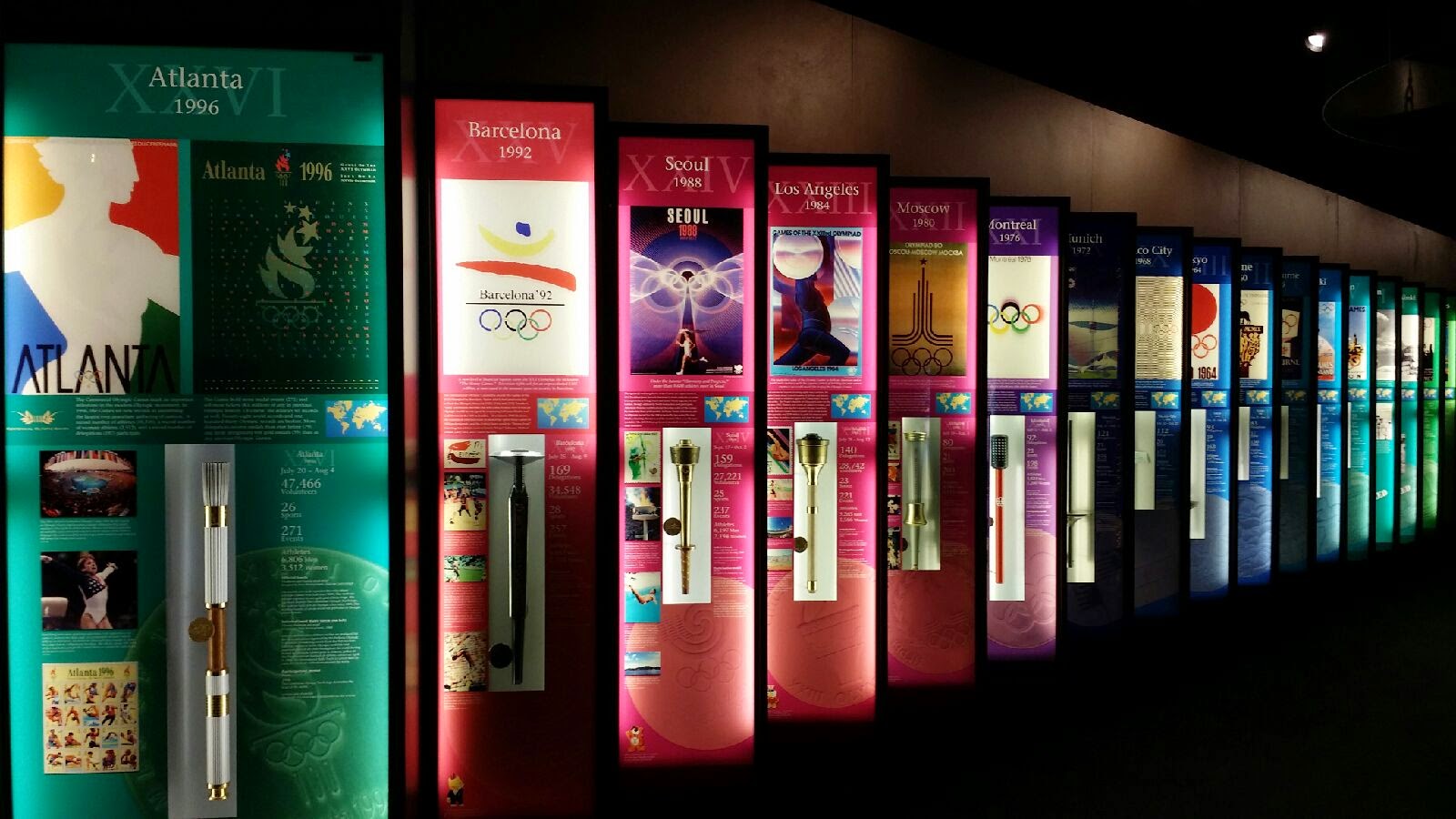
- The complete (or nearly complete) collection of summer Olympic torches, another rare bragging opportunity in storage (to the Atlanta History Center's credit, they do display several summer Games torches). I learned they may not have one of the rarest summer torches, but even a "complete collection minus one" or "complete collection*" with a asterisk would be marvelous. This link includes a photo of the previous museum torch display that's now history

- The museum's signed version of "Summon The Heroes" sheet music autographed by Oscar and Grammy-winning composer John Williams (back in storage?)

- Touchless database of 1996 Olympians (or at least the medal winners). Bonus option would be a database of all the volunteers listed in the margins of every page of the Games' "Official Report"

- The model of the Atlanta Olympic Village that was on view for years (including many months of pre-installation of the new signature exhibition). This could easily fit inside the "glass fence" protecting the enormous athlete-painted canvas, complementing the Olympic Stadium model only steps away. By the way, athletes added to the painting in the "international zone" of the Village (the model portrays this zone).

Also missing are obvious photo opp or selfie-bait spots on which to stand atop the medals podium or hold a '96 torch. This could be easily remedied with a life-sized cutout of any torchbearer or moving a medals podium from storage to the ample corridor facing the exhibition. 

From my view, with only 2,600 square feet available, too much space is filled with anti-Games elements. I liked a look at the successful efforts of few in response to Cobb County government, but did it deserve as much square footage as a nearby Cultural Olympiad showcase? It is important to acknowledge this history, of course, but do visitors need floor-to-ceiling displays on the movements that rode the Games' coattails? (Answer: I don't think so.)

And while another rafters-to-carpet photo shows group prayers in the wake of the Centennial Olympic Park bombing, visitors almost need a magnifying glass to find mention of Richard Jewell, whose image does not appear anywhere in spite of saving countless lives (this feels like another missed opportunity to reshape incorrect history). But, hey, the protesters who got the Games out of Cobb County are heroes, too. Their photo does appear.  

The bottom line is the Atlanta History Center's new signature Olympic exhibition marches to its own drum where other Games museums stick more to a traditional sports museum format. 

With that stated, in spite of a few missed beats, five-ringed fans should check it out. For those who cannot get enough of Atlanta's Olympic history, you may enjoy a trio of thorough blog posts about the Atlanta Games by Sarah Dylla, who worked hard and delivered the points to ponder in this five-ringed exhibition. Dylla also shared more in a conversation aired on WABE-FM's "City Lights with Lois Reitzes." Visit AtlantaHistoryCenter.com or call 404-814-4000 for ticket and other visitor information. 

Photo credits: Atlanta History Center where noted. All other images by Nicholas Wolaver. 


Thursday, November 7, 2019

Upended Lives at Olympics Provide Drama and Richard Jewell Revelations in "The Suspect"

In the next few weeks, Atlantans and media will be buzzing about the new nonfiction book "The Suspect: An Olympic Bombing, The FBI, The Media, And Richard Jewell, The Man Caught In The Middle" by Kent Alexander and Kevin Salwen.

This page-turning volume, a triumphant feat of journalism, research and writing 23 years in the making, encapsulates thorough, at times revealing, details about Jewell, the hero security guard who moved hundreds of concertgoers out of harm's way before a hidden bomb he found detonated at the Atlanta Olympic Games. If contributors from Jewell's inner circle achieve their goal, folks everywhere will at last proclaim the praises of Atlanta's least celebrated hero.

The book also puts a magnifying glass on the Atlanta Journal-Constitution reporting team, notably Kathy Scruggs, as well as a specific FBI agent, Don Johnson and his colleagues, whose work in their respective fields forever impacted Jewell's and his mother Bobi's lives.

Monday afternoon a review copy finally landed on my Midtown front porch, and I delighted in devouring its 368 pages that are equal parts crime drama and unflinching critique of Federal investigations and investigative journalism.

An enclosed press release affirmed my hunch the book was optioned by Warner Bros. for the upcoming Clint Eastwood film "Richard Jewell" set for a world premiere at AFI Fest in Los Angeles on Nov. 20 (with Dec. 13 as the national release day).

One "reveal" of Alexander and Salwen's work is that the film's screenplay, at least in the movie trailer, is close to verbatim from their research of the FBI's interrogation of Jewell.

Juxtaposed with this fact, the book also reveals that Eastwood's screenwriter Billy Ray took at least one major liberty in the script: Jewell's attorneys aptly never allowed the hero guard to record the bomber's 9-1-1 call script, "There's a bomb in Centennial Park ... you have thirty minutes!" (I've previously taken Eastwood and his screenwriter for "American Sniper" to task for playing fast an loose with Olympic facts, the all-time most-read posts of this website).

"The Suspect" is a great read with relevance for anyone passionate about or in law enforcement, news media, Olympic organization, historians (of Atlanta, the USA, true crime or the Games) and the millions of people who experienced or have interest in the Centennial Olympics of 1996.

Make that a must read.

All of the one-time Atlanta Committee for the Olympic Games (ACOG) staff and volunteers will appreciate and remember scores of long-forgotten Games-time intricacies.

Between the book's end pages -- noticeably featuring a hand-drawn bomb site map by Jewell and a Miranda rights form he reluctantly signed during his sideways interrogation (cue the "Richard Jewell" film trailer with John Hamm's stern voiceover) -- readers may be mesmerized about "The Suspect" by the numbers.

Following their 1996 roles that introduced them to their subjects, Alexander and Salwen spent more than five recent years pouring over "tens of thousands" of legal documents, 170,000 ACOG archive pages and reports, thousands of photos, dozens of cases of personal effects, 1,200+ news articles and hundreds of video clips.

They also conducted "187 original-source interviews" and read dozens of books or other materials, initially logging 2,139 footnote entries later converted to narrative source notes on their ABRAMS Books editor's suggestion. The years-long FBI investigation of Jewell and other dead-end leads exponentially adds to the mind-bending facets of the research.

The book project unfolded at a venue the authors dubbed "the cottage," which I envision resembled a "war room" like those seen on any crime drama investigation.

Notable details uncovered and documented include:
  • How Jewell's parents named him after auto racing legend Richard Petty, while nicknames the FBI adopted for too-blurry images of the actual bomber included "Blob Man" and "Goatee Man" (only one of them proved to be the man, Eric Rudolph). Beer-chugging witnesses earned the sobriquet "Speedo Boys"
  • Richard Jewell's secret lasagna recipe he cooked and served to a law enforcement peer from Centennial Olympic Park, only to later learn his invited dinner guest was wearing a wire for federal investigators
  • Which national TV reporters initially proclaimed Jewell a hero then later apologized in months-later follow-up interviews intended to rightfully exonerate him in the public eye (I had no idea Jay Leno apologized after his initial monologue quips comparing the guard to Nancy Kerrigan's attacker)
  • The Atlanta Magazine reporter who agreed to a date with Richard, only to later embarrass a crestfallen Jewell with an unflattering cover story
  • Which local radio station paid a $50,000 settlement after using Jewell's likeness in an unsanctioned outdoor billboard campaign around the song "Freebird"
  • Summaries of the Atlanta Journal-Constitution Games-time "Peach Buzz" columns including the time Donald Trump lost his wallet at The Cheesecake Factory in Buckhead, and AJC non-Olympic reporters including Scruggs, who proudly reported on "distinctively non-sports coverage areas of Security, Neighborhoods and Olympic Transportation" in their "SNOT Pod" newsroom space
  • The downward spiral Scruggs endured years after her Games reporting, including shocking outdoor incidents involving a taxi she commandeered in the buff. 
Several Olympians provided interviews for the authors, including Michael Johnson, who recalled a hospital visit to injured bomb survivors before competing in second gold medal sprint.

Gold medalist Janet Evans, who witnessed the bomb explosion during an in-park TV interview, also garnered frequent mentions in the text (though it is not clear yet that she was interviewed for this book).

Personal revelations for this reader included notes on how Jewell attended the same Olympic baseball game (Cuba vs. Nicaragua) for which I held a ticket and cheered with friends. A day later, some of the federal agents of "The Suspect" watched over the India vs. Pakistan Olympic field hockey game at which I helped Pakistan fans hold aloft a giant green and white flag (my Minnesota State University-Mankato junior-year roommate spotted me on TV while watching at home with his family ... in Lahore).

I learned the most from the chapters about Rudolph -- his capture, prosecution and revelations about his post-Games movements were not on my radar in the early 2000s, though Rudolph's two other despicable attacks in Atlanta were. The book brought to mind vivid memories from news coverage of both events. The bomb he detonated in Birmingham was not "new" to me, but the authors' framing of the scene inspired chills.

Much of the Jewell narrative (until the final chapters) felt more like a fleshed-out version of previously seen reports, like a Titanic-sized version of Marie Brenner's extensive Vanity Fair article after she shadowed Jewell's legal team for months.

But I appreciated the details that at once revealed Jewell's relatable, jovial, every man nature while cracking me up, like this description from page one:
Hopping off the [MARTA] train, Jewell descended International Boulevard, the lime-green lanyard that held his credential swinging across his ample belly.
Been there, done that!

A much bigger revelation: the AJC assigned interns to interview Jewell or help report updates from his residence after Scruggs and colleagues broke their scoop under the screaming headline "FBI suspects 'hero' guard may have planted bomb."

I can't imagine receiving a federal subpoena to testify about either of my internships.

Readers also learn the less-reported aspects of the guard's later-career heroics, including touching stories of a CPR rescue and how he reflected on each anniversary of the night that changed his life. The love of his life provided some of the best heartfelt details, underscoring her own (and other Jewell inner circle members') "... hope that one day Richard Jewell would be remembered by all as a hero."

Writing of the book's biggest revelation -- which took my breath away -- would be an unforgivable spoiler (though I predict other book reviewers will not hold back).

It's fun to learn new vocabulary while reading, and the words bonhomie, putative, and lithe joined my lexicon thanks to Alexander and Salwen. And I was surprised that a book touted as a "gripping story of ... the advent of the 24/7 news cycle" did not include more mid-'90s context from the trials and tribulations of Tonya Harding and O.J. Simpson (especially the former's five-ringed connections).

Meanwhile, I found just two glaring errors and one minor one in "The Suspect."

First, the authors referred to the "seven-building Olympic Village complex" President Bill Clinton and the First Family visited. Come again?

In the "Blue Zone" of Georgia Tech's west campus -- where I was an ACOG-employed Village housing manager adjacent to the Olympic Aquatic Center -- we had more than 20 buildings including the dorms built to eventually house Team USA and delegations from Russia, Egypt, Indonesia, Germany, the U.K. and dozens of other national Olympic Committees including the heavily-fortified Israeli team quarters.

My sister worked in the distant "Red Zone" north of 10th Street, which had several buildings visited by Spain's Royal Family. And over in the "Green Zone" was my Games-time housing in a frat house (one of about 20 used by NOCs).

I don't recall what the brand new towers along the Downtown Connector were named ("Blue Zone?") but it was fun attending the opening press conference with ACOG in spring 1996.

Maybe the authors only considered the "International Zone" around Georgia Tech's Ferst Center for the Arts to be the "Village complex" they described. As Hillary Clinton has proven many times, forgiveness is key, and perhaps it takes a village to get these Georgia Tech and former Georgia State University towers counted. I forgave the miscount.

An even less intrusive-to-my-eyes flub was the writers' mention of a James Brown concert at a bar named "Tabernacle."

No doubt, they meant the festive church-turned-concert hall that's still rockin' and rollin' next to the Atlanta Ferris wheel installed years later.

I'm less forgiving and not forgetting the page on which the authors recounted memories of the host committee's COO, who famously slept in his office at The INFORUM, the ACOG headquarters building which overlooks Centennial Olympic Park, some nights of the Games.

According to Alexander's and Salwen's interviews, when the bomb exploded just after the A.D. Frazier conked out in his office,
He leapt from bed ... [and] ran to his balcony barefoot and stared at the chaos and emergency lights below. Bodies were strewn across the bricks of the park. His mind flashed to the movie Saving Private Ryan, with its vivid, brutal scenes of battle. Rattled, Frazier spun and hurried back inside his darkened office, switched on the desk lamp and dialed Payne. 'Billy, we've got a problem.
I know Frazier to be wicked smart, but not clairvoyant nor one who could predict future film scripts -- the problem with this recollection, as documented in "The Suspect," is that Steven Spielberg's epic war picture did not debut until 1998.

Sidebar: I also know A.D. did not sleep on the couch by his office 24 hours after the bomb, because I tearfully fell asleep on that sofa during my own visit to overlook the park in the early hours of July 28, 1996. The sodas in his mini-fridge provided comfort as well.

Atlantans have the opportunity to meet "The Suspect" authors at the Atlanta History Center on Nov. 12 at 7:30 p.m.

They'll be joined on stage by former AJC Senior Managing Editor Bert Roughton, a book source who wrote this Sunday AJC opinion piece about his colleague Scruggs, as well as event moderator John Pruitt, formerly of WSB-TV. Tickets are $5 for members and $10 for non-members. For more information visit this link.

On the invitation of the ABRAMS Books publicist, I delivered questions tailored for each author and will follow-up this post with their Q&A responses. What questions do you have for this remarkable writing duo? Please post them in comments and I will try to ask at the AHC event.

Book and author images via ABRAMS. Book cover photo via Bobi Jewell with jacket design by Devin Grosz. Author photo by Allison Shirreffs. Other photos via Associated Press, DP/AFP/Getty, ESPN and GeorgiaEncyclopedia.org. 

Wednesday, July 20, 2016

Remembering July 19, 1996

As the sun set on July 19, 2016, many an Atlanta Olympic veteran likely spent time reminiscing.

On this evening 20 years ago, the Centennial Olympic Games opened with great music, Georgia luminaries, star athletes and even a parade of pickup trucks!

The anniversary may be bittersweet for some, considering the night's greatest surprise in 1996 -- Muhammad Ali, who greeted Janet Evans and the world with torch in hand -- died earlier this year, a month or so shy of again celebrating his favorite Games experience (Ali wrote in his autobiography how he could not sleep after lighting the cauldron).

During the last week or so, Atlanta media pulled out the stops for 20th anniversary coverage. 

Local NPR affiliate WABE-FM created a series reliving the 1996 Cultural Olympiad -- great reporting in collaboration with ArtsATL.com

The station also aired a one-hour special and even wrote up Nike's new for 2016 Atlanta '96-inspired sneakers 

It was fun to read about the Atlanta History Center's plans to update the Centennial Olympic exhibition, which will close in a few weeks and reopen next year -- visitors can enjoy one of the 1996 opening ceremony costumes (a giant fish puppet) now on view in the entrance lobby.

The Atlanta Journal-Constitution also created many column inches about Atlanta's Games, including a story about three couples who met and married while working at the Olympics (unmentioned with one couple's memories was my cameo role as neighbor encouraging a job application that led to their introduction).

The city and Centennial Olympic Park also pulled out many stops to host a 20th anniversary "Relive the Dream" celebration hosted by Billy Payne, Andrew Young and a cast of medal-winning athletes.

It was fun to spend Saturday catching up with old friends while meeting new contacts. 

Unfortunately, the "dream" evening on July 16 was not all fun and Games due to two lightning delays. Though they eventually got the party started and the content was fun, a handful of attendees took the organizers to task on Facebook with a few harsh but apt emoticons and comments. 

One of my public relations mentors, his wife, a longtime Olympic historian friend and I spent much of the event playing armchair quarterback to the organizers, ultimately deciding/lamenting the majority of the crowd enjoyed themselves but the event's disarray provided a snapshot of snafus parallel to the issues that played out in grand fashion during those 16 days and nights of 1996. 

The anniversary event scene came complete with crass street vendors, tents and credentials for the feted "haves" gazed upon by the excluded masses of "have nots" and other elements that frustrated many of the worker bees from two decades back. 

When I mentioned our observations to a prominent Olympic historian yesterday, he replied with his take that Atlanta was the "first Olympics at which most of the athletes were professionals and the organizers were all amateurs" -- hysterical! 

But, hey -- where would we be without the Atlanta Games experience? I am thankful Payne went to church and scribbled "Olympics" on his working list of community projects in 1988, and that the experiences afforded in 1996 put me on track to attend my 10th Games at Rio starting next week.

I also appreciate the hard work that went into the anniversary event.

This evening the Olympic news outlet Around The Rings hosted a fun party in honor of the Atlanta milestone, and some of my favorite memories of '96 came to mind:

-- Watching the Opening Ceremony live in the kitchen of a Chinese restaurant with my sister, a fellow Olympic Village team member, before we returned to Georgia Tech for the late shift and athletes coming home for the evening

-- Getting acquainted with ACOG Communications Manager Dick Yarbrough and the organization's archivist during work hours (learned the most enriching and "real" Games stories from both of them)

-- Sharing many social gatherings with fellow 1995 USOC interns-turned-Atlantans during the pre-Games spring of '96

-- Following-up the ACOG experience with a bonus two months of Paralympic employment and an additional wave of fun times paired with hard work.

There are many Games-time friends with whom I've lost touch -- would love to reconnect with so many of these people. 

One person in particular is a Village volunteer who attended the University of Georgia. On the last night of the Atlanta Olympic Village, which was Aug. 6, 1996, the two of us visited 4,000 dorm rooms in search of Olympic pins, and I've missed the shared laughter over all the random stuff we discovered the athletes left behind. 

Here's hoping my long-lost friend Emily Sanders is out there and enjoying her Olympic memories as am I.

Photos via Yahoo, Nike, Atlanta History Center. Park photo copyright Nicholas Wolaver.

Wednesday, January 27, 2016

Atlanta In 50 Objects Includes Five Olympic Rings

As the world awaits the start to Rio 2016, many Atlanta locals are wondering how their city may commemorate the 20th anniversary of the Centennial Olympic Games.

Those inclined to reminisce about the glory days of '96 may do so at the Atlanta History Center, home of the Centennial Olympic Games Museum, which I wrote up on this blog about a year ago.

This time last year I also mentioned the Atlanta History Center's call for public suggestions to inform a now open temporary exhibition titled "Atlanta In 50 Objects." A recent three-day weekend afforded time for a peek at the final 50, and here's what I found.

Venue organizers describe "Atlanta In 50 Objects" with the following introduction:

The exhibition is filled with prized Atlanta-rooted treasures -- from Martin Luther King Jr.'s 1964 Nobel Peace Prize acceptance speech manuscript to Georgia Tech's Ramblin' Wreck and a 1915 Coca-Cola bottle mold to a touchable cast of Willie B's handprints -- as well as plenty of surprises."

While it did not surprise me an Atlanta Olympic Torch made it into the exhibition (several folks like me suggested a representation of the Games), there were plenty of nice surprises -- including more items with five-ringed connections -- throughout "Atlanta In 50 Objects."

The most prominent Games keepsake, as I mentioned, is a torch on view with a poster-sized photograph of Muhammad Ali as the final torchbearer of the 1996 relay. 

It surprised and delighted me this Olympic feature is displayed beside one of Hank Aaron's home run bats for a fun "sports corner" in the exhibition (the Braves also appear elsewhere as a World Series ring is on view).

Now that composer and American treasure John Williams just earned his 50th Academy Award nomination, it was super cool to find a signed copy of the trumpet players' music sheets for "Summon the Heroes" personalized from Williams to Billy Payne. 

I also enjoyed finding a rare Atlanta Committee for the Olympic Games (ACOG) golden ticket presentation box displayed as another Centennial Games Keepsake. These were presented to the leadership of key sponsors of the Atlanta Games during the Opening Ceremony, and many of the few sets made remain in the private collections of the executives who received them.

(Sidebar: I've been trying to sell an identical, rare brass Olympic ticket presentation box on Ebay for a friend since last spring ... bids are welcome and encouraged for those who wish to own a museum quality piece of Olympic history!).

I loved seeing models of downtown Atlanta showcasing local architect hero John Portman -- several of his buildings were used by ACOG and the International Olympic Committee or national Olympic committees before and during Atlanta's Games.

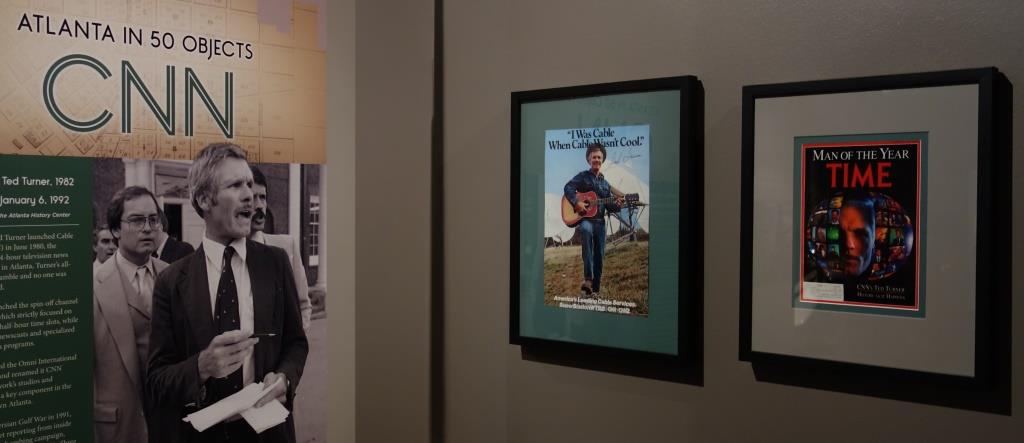
Time Man of the Year and CNN/TBS founder Ted Turner also got a space among the 50 objects, which span the 1800's to modern times. 

Kids may love spotting one of the Chick-fil-A cows or the "Pink Pig" ride while readers may enjoy the first edition of "Gone With The Wind" (reportedly the most successful book in publishing history behind only the Bible). 

"Atlanta In 50 Objects" is on view through July 10.

Photos by Nicholas Wolaver


Tuesday, January 13, 2015

Atlanta Olympic History @ Atlanta History Center


Last month brought an opportunity to revisit the Atlanta History Center as it hosted an Atlanta Press Club fundraising event. Prior to the APC gathering, I took a few minutes to again peek at the collection of Centennial Olympic Games Museum, worth a visit for five-ringed veterans or the uninitiated.

The museum includes an impressive, complete collection of Olympic torches leading to a visitor photo opp position inviting guests to hold an Atlanta '96 Olympic torch handle and smile for the camera.

I also enjoyed the assembly of artifacts from the Olympic bid team members who travelled with
William Porter "Billy" Payne, Ambassador Andrew Young and other volunteers who landed the Games in spite of tough competition from Athens, Melbourne and Toronto (Manchester, England, and Belgrade, Yugoslavia, were also in the running).

Also included are dozens of souvenir objects: Lapel pins, Olympic medals, volunteer and athlete uniforms, sports equipment donated by star athletes and props used in the Opening Ceremony help tell the story with several videos and recordings. An Olympic medalist podium and portion of the state-of-the-art track round out the experience.


A sight for sore eyes was an original model of the Atlanta Olympic Village as it was envisioned and mostly realized on one section of the Georgia Tech campus. The area shows how for a couple of months the "International Zone" of the Village included a flag plaza with banners of 197 competing nations (the athlete transportation plaza), a temporary dining hall and festive welcome ceremony area.

We had this model in our section of the Atlanta Committee for the Olympic Games (ACOG) offices at The INFORUM downtown -- my first Olympic job -- and it was fun to see the model come to life and to work closely with the small army of professionals who made it happen. Good history.

Today's Atlanta Journal-Constitution brought to light a current initiative of the Atlanta History Center. As the museum continues extensive renovations, curators are planning a 2016 exhibition "Atlanta in 50 Objects" for which public input is sought now through March 2.

To nominate an object for the exhibition, visit www.AtlantaHistoryCenter.com/Atlanta-50-objects and submit a brief nomination statement. This blogger already suggested an Atlanta Olympic bid team item to represent one of Atlanta's biggest and most influential dreams coming true. How say you?

Photos by Nicholas Wolaver. Atlanta In 50 Objects logo via Atlanta History Center.


Blog Archive

Powered By Blogger
Web Analytics