Showing posts with label Olympia. Show all posts

Friday, June 23, 2023

Paris 2024 Unveils Grand Relais de la Flamme


Want to help the Olympic flame reach Paris? 

There's still time for nominations -- deadline 15 July -- for those seeking to fill one of the 10,000 torchbearer segments unveiled this Olympic Day. 

Each torchbearer will transport the flame about 200 meters, or just over 650 feet, which is shorter than my occasional Midtown Atlanta walks for lunch at Mary Mac's Tea Room

In press materials, this is estimated at four minutes per segment for the average torchbearer. Less officially that's 19 to 22 seconds for Usain Bolt or Florence Griffith-Joyner, respectively, the world and Olympic record holders for the same distance. 

With help from Google Translate, I call it la petite segment (though la petite tranche sounds more dramatic). 

During an online media preview held Tuesday morning, 2024 Olympic press team members showcased next year's torch relay route and other details under embargo until noon today in Paris. Since the first media question on the call regarded the in-progress police raid at Paris 2024's headquarters, it was not immediately clear how much resonated with other reporters in attendance. 

For this writer, the scope of next year's five-ringed route is impressive, as much for its blend of torch relay traditions with new elements as for its first-time destinations exotiques

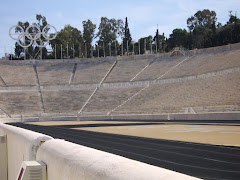
Of course, the map starts in Olympia, Greece, where the Hellenic Olympic Committee will welcome the host city to launch the relay with rays from the sun on April 16, with VIP and Greek runners helping whisk aloft torches toward an April 26 ceremony at the Panathenaic Stadium in Athens. 

Borrowing from past relays, the Olympic flame and its entourage will next travel by ship -- specifically aboard the triple-masted Belem -- embarking from the Port of Piraeus on April 27, heading westward to Marseille in time for a May 8 arrival ceremony. Historians may appreciate the Belem enjoyed its maiden voyage in 1896, the year Athens hosted the first modern Olympiad. 

I'm not sure how the route overlaps with past torch relays on French soil, but the chosen path generally hugs the southern coast and border -- including a hop to Corsica -- then north through several western towns until arriving at coastal Brest, where on June 7 things get intéressante thanks to the crew of another sailing vessel, the impressive Maxi Banque Populaire XI, capable of getting the Flamme Olympique across the Atlantic in eight days. This video provides a peek aboard.

Simultaneous to this oceanic crossing for the flame's first visits to Guadeloupe (June 15) and Martinique (June 17), other segments will be carried at ceremonies in French destinations including Guyana (June 9), Reunion (June 12) and French Polynesia (June 13), where weeks later Olympic surfers will ride the waves. Sidebar: Martinique is where Humphrey Bogart got quizzed RE: whistling in "To Have and Have Not."

Not sure how -- my guess is by jet (as it was not made clear in the press kit) -- but on June 18 the flame returns to France tout suite, where voilà, the route resumes in Nice for its five-week final march to the City of Lights. 

One noted curiosité: though the eastern map pinpoints a visit to 1924 Olympic host Chamonix, the route was charted sans Albertville and Grenoble, perhaps intentionally, which may leave each city's chambre de commerce to exclaim sacrebleu and others with their culotte dans une liasse.

No matter the possible flaming snubs, of the 2024 route -- it's a lot! 

Not the longest nor most elaborate torch relay, but definitely an expansive plan that will give tens of thousands of islanders or South American mainland and French residents a new or renewed option to experience the moving Olympic flame tradition. 

Those seeking to complete nominations may find helpful the Paris organizing committee's FAQ for the process.

As for the crew of Maxi Banque Populaire XI, they'll be looking for Mother Nature to follow Lauren Bacall's instructions to put [her] lips together and blow

Images courtesy Paris 2024, CFP on CGTN.com, and this Dailymotion link. Lauren Bacall photo via We Are Movie Geeks. Florence Griffith Joyner photo via Paul Hellstern/Daily Oklahoman


Tuesday, February 17, 2015

Help Bring Olympic History to Light on the Silver Screen in Time for 2016

Olympic movie and history buffs have an opportunity to help get a potential five-ringed gem to the silver screen in time for next year's film festival season and the Rio 2016 Olympic Games.

Through the crowdfunding site Seed & Spark, now through March 17, anyone may contribute funds to help complete the documentary "Olympic Pride, American Prejudice" by Atlanta-based filmmaker Deborah Riley Draper, whose team seeks to bring to light the seldom-heard stories of African American Olympians who competed at the 1936 Berlin Olympiad.

For more specifics on the donation process, click the links above or scroll to the base of this post, post-haste.

Paraphrasing the film synopsis: "Olympic Pride, American Prejudice" will be a feature length documentary exploring the trials and triumphs of 18 African American athletes who represented Team USA in Germany.

Set against the strained and turbulent atmosphere of a racially divided America -- torn between boycotting Hitler’s Olympics and participating in the Third Reich’s grandest feat of propaganda -- the film follows 16 men and two women as they prepared for, traveled to, competed in and returned from Berlin.

With an Olympian-level blend of grace and dignity, these athletes represented a nation that considered them second class citizens, and their competitions took place in a nation that rolled out the red carpet in spite of an undercurrent of Aryan superiority and anti-Semitism.

I spoke with Riley Draper, who explained the idea for the film started with research of a jazz singer from Chattanooga who later was reportedly interned by the Nazis. Articles on the musician included references to African American Olympians who competed in Berlin, and as Riley Draper gained some Olympic experiences and interest during a U.S. Track & Field assignment at the 1996 Atlanta Games, the seldom-heard stories of these athletes stuck with her.

Though many know the story of Jesse Owens' feats on the track in Berlin, the other 17 black athletes'
experiences are known to comparatively few.

"I wanted to bring to light these heroes who created a precursor to the Civil Rights Movement," said Riley Draper.

Research for "Olympic Pride, American Prejudice" yielded that the 18 athletes came from across the U.S., with attendance at big colleges as a common thread among the "great student athletes" selected for Team USA. Some medaled in Berlin, though with considerably less fanfare than Owens.

Riley Draper said some of the athletes also made the cut, while more did not, for the original Olympic documentary film, Leni Riefenstahl's "Olympia." And in one case, the German filmmaker
stirred the political pot in the 1936 Cultural Olympiad by displaying images of black U.S. athletes she snapped as artsy photographs during her trip to the 1932 Los Angeles Olympics.

One U.S. athlete set as part of the new film is Jack Wilson, the silver medalist in boxing. Another is Archie Williams, who won gold in the 400m race.

And in high jump, Cornelius Johnson and David Albritton earned gold and silver, respectively, while teammate Delos Thurber also made the podium for bronze (a clean sweep). As rising stars, Albritton and Owens lived parallel lives as rural Alabama natives who succeeded on the track.

I personally look forward to learning more about Johnson and all of the athletes to be profiled through “Olympic Price, American Prejudice.”

Back to the film’s synopsis: "The athletes experienced things that they were not expecting -- applause, warm welcomes, an integrated Olympic Village and the respect of their competitors. They were heroes on the world’s stage who returned home to find only short-lived glory. Their story is complicated … a vital part of history as relevant today as it was almost 80 years ago."

Riley Draper and her team plan to “utilize the wealth of newsreel material, newspaper articles, photographs, personal interviews and never-before-seen footage as well as resources from the personal archival collections of Olympians and Foundations in both the U.S. and Germany.”

She also said research to date included a wealth of detail provided by archives managed by the LA84 Foundation, the National Archives and the Avery Brundage Collection at the University of Illinois.

When I asked the extent to which the International Olympic Committee/Olympic Museum, U.S. Olympic Committee, International Society of Olympic Historians (ISOH) or travels to other domestic or international archives are on the filmmaker’s wish list (as part of their fundraising goals), Riley Draper said she was open to additional sources but travel to Berlin to capture in-stadium footage -- and more interviews of surviving athletes or spectators -- tops the list.

The crowdfunding site lists several types of equipment needs, expenses for everything from insurance and narration to image licensing, and travel items.

Donations of as little as $1 or in the form of Delta Air Lines SkyMiles are accepted, and donor who provide at higher levels may opt-in to pre-release perks (including an on-screen credit as a supporter). For readers who choose to contribute, please consider doing so by selecting this blog and/or blogger as the source providing referral to Seed & Spark.

Thank you for your part in bringing “Olympic Pride, American Prejudice” to the big screen. Additional information is also available via the film’s official site, 1936OlympicsMovie.com.

Images via www.1936OlympicsMovie.com


Thursday, December 18, 2014

Angelina Jolie Delivers The Goods, Unbroken

 
I didn't think much of Angelina Jolie until two events this week: Listening to her Dec. 17 NPR interview to discuss the Christmas Day release of "Unbroken," then experiencing the film at an Atlanta advance screening the same evening.

This movie converted me. Consider me now an official Jolie and "Unbroken" film fan.

I was already an advocate for the Lauren Hillenbrand book "Unbroken: A World War II Story of Survival, Resilience, and Redemption," which gained my attention when first published. Sadly it was only a few months ago I finally made time to read it and listen to the audiobook.

The biography of 1936 Olympian Louis Zamperini, expertly researched by the author of "Seabiscuit," quickly advanced to "best nonfiction" status among recently read books. The text deserves high marks for the emotional roller coaster it delivers, punctuated by the real life and appalling -- often tear-jerking -- events on its pages.

The Jolie-directed "Unbroken" is faithful to the book, and I exited the theatre impressed (and relieved) by the adaptation. It's a crowd pleaser minus the anticipated sentimentality. It inspires patriotism without drowning in red, white and blue rhetoric. And it makes you stop and think about the smallness of many day-to-day problems when compared to a hero war veteran's remarkable, excruciating and epic journey of survival.

"Unbroken" succeeds on the big screen because it lets the biography's hard truths speak for themselves. The opening "We are here" battle scenes captivate. Kudos to the screenwriters, including the Coen Brothers, for achieving a difficult transition from paper to camera.

When the going gets tough and keeps turning only for the worse, the audience -- mostly folks not likely familiar with the book -- reacted strongly, often calling out "unbelievable" and "how did this really happen?" Attendees shared the most audible responses to:
  • Zamperini's arrival at Berlin's Olympic Stadium with its accurate depiction of the final 1936 torch runner igniting the venue's cauldron. The filmmakers even got the time on the clocks correct for this opening ceremony moment -- thumbs up! It's my understanding the "torchbearer" actor is Clay Zamperini, though his relation to Louis remains unclear.
  • The anxious plane crash moments during which airman Zamperini blacked out inside the sinking fuselage lost in the Pacific. Though not detailed in the film, this is one of several life moments Louis attributed to Divine intervention -- when he passed out he was tangled and drowning in the doomed wreckage, but when he awoke he found himself free to swim and reach the surface. Touched by God?
  • The upward count of days (more than 40) the three crash survivors floated with scarce food, stormy seas, looming sharks and a dive-bombing enemy plane bearing down on their raft. Did I mention the sharks? There are a lot of sharks. Big sharks.
  • The shocking and deplorable prison camp treatments at several Japanese sites after Zamperini's naval "rescue" only to be incarcerated for more than two years. A most memorable line arrives with, "I've got good news and bad news." The movie barely scratches the wince-inducing hundreds of disturbing acts unveiled in the book.
  • The innumerable beatings Zamperini endured at the hands of his jailers. Would you keep standing if guards commanded 200 friends to punch you in the face?
I'm not familiar with the actors in "Unbroken" but have a feeling many of them will appear at awards ceremonies and in future films.

The newcomer actor and veteran Japanese musician Takamasa Ishihara, a.k.a. Miyavi, portrays war criminal Mutsuhiro "The Bird" Watanabe, wielding a bamboo cane used for cracking skulls (mostly Zamperini's, depicted by Jack O'Connell). Miyavi effectively unveils The Bird's deplorable deeds on par with the worst James Bond villains.

Many of us heard a friendlier "look me in the eye" before.

The soundtrack by Alexandre Desplat is inspiring and sets the appropriate mood, at times somber and brooding while also positive and uplifting, nudging Zamperini through many struggles.

The emotional payoff for this viewer arrived with some archival 1998 footage of an octogenarian Louis fulfilling a lifelong dream. I appreciated that Jolie and team briefly mention Zamperini's faith and message of forgiveness, neither spoon-feeding nor cramming the lessons down our throats.

My only unfulfilled-by-Jolie wish was that she'd include the Graf Zeppelin's cameo from the first few pages of Hillenbrand's version, but that scene may live on in the imaginations of those who read it. Maybe we'll luck out and find it on the DVD extras.

What was clear through "Unbroken" is that Jolie recognized the national treasure subject and she, and the cast and crew, logged the time to get things right. The film is a fulfilled labor of love, and the aforementioned NPR interview gets to the heart of Jolie's unique kinship established with Zamperini.

Jolie said Louis's request was please "Don't make a film about how great I am or how exceptional I am; make a film that reminds people that they have greatness inside themselves" and she delivered the goods.

Throughout "Unbroken" I counted potential directorial nods to other accomplished filmmakers and their work. See if you recognize subtle salutes to Leni Riefenstahl's original five-ringed film "Olympia" (I wonder if Louis appeared in that film, too, in footage of his 5,000m race), Steven Spielberg for "Jaws" and "Saving Private Ryan," Clint Eastwood for "Flags of Our Fathers" and "Letters From Iwo Jima," and Sir David Lean for "Bridge On The River Kwai."

There's even a dose of tree-lined schoolboy running, reminiscent of "Forrest Gump," and survival scenes from another Tom Hanks film, "Castaway," came to mind when Zamperini's doomed plane hit the ocean (remember the FedEx aircraft filling with water?). And I hinted about "The Karate Kid" earlier in this post.

After the WWII Allied bombardment reaches Tokyo, the "Unbroken" screen fills with images like Atlanta's rubble-strewn cameo in "Gone With The Wind." If "Life of Pi" did not pacify an ocean wanderlust, "Unbroken" will float your boat.

Bravo, Jolie and "Unbroken." Nicely done.

Images via www.UnbrokenFilm.com

Follow-up/Update (June 19, 2015): Not long after completing the review of "Unbroken" late last year, I also read a book by Louis Zamperini and David Rensin titled "Don't Give Up, Don't Give In -- Lessons From And Extraordinary Life" published by Dey Street Books/HarperCollins in November 2014.

The book was written from interviews with Zamperini in the months before his death, and the text features a nice collection of first person stories and suggestions "for living an honorable life" (so sayeth the publisher's press release). It's a good read, and an excellent companion piece to reading "Unbroken" or viewing the film.


Monday, November 10, 2008

A Path of Northern Lights


The chilled nights of autumn inspire thoughts of how to keep warm. One method for consideration: Checking out the info for the 2010 Winter Olympic Torch Relay set to begin in Olympia, Greece, less than one year from now.

According to the VANOC website, the relay will involve 12,000 runners across Canada, blazing "A Path of Northern Lights" along the massive route (I'm struggling to convert the 35,000 km to South of the border figures, but it will take three months to complete the journey).

I'm diggin' the Lynda Carter-like female illustration incorporated with the Vancouver 2010 "Look of the Games" on the website. Makes me ponder, "What would Wonder Woman look like wearing a red suit covered with maple leaves rather than the Stars and Stripes?"

Blog Archive

Powered By Blogger
Web Analytics