Showing posts with label 1996 Olympics. Show all posts

Sunday, August 18, 2019

Clint Eastwood Crew Films Family Jewell In Atlanta

Olympic park/Eastwood mash up image via JoBlo.com


For film buffs and Atlanta residents, summer headlines about Warner Bros. casting a new feature based on Richard Jewell may be old news.

For those further afield, the following roundup includes updates and photos from the set of the upcoming movie centered on the hero of the July 1996 Olympic Park bombing.

Hopefully a detail or two may also serve as informative updates for local readers.

I enjoy Clint Eastwood, a longtime favorite of this writer, equally for his behind-the-camera work and for original characters he created as an actor.

His film career spanning seven decades seldom includes five-ringed themes, but that's quickly changing with Eastwood directing a new picture based on the 1997 Vanity Fair article by Marie Brenner titled "American Nightmare: The Ballad of Richard Jewell," about which I first posted details in 2015.

At that time, Jonah Hill and Leonardo DiCaprio were set to star as the 1996 Olympic park security guard hero-turned-bombing suspect and one of his attorneys, respectively.

Consider me anxious -- for nearly four years and counting -- to experience this film.

For context: Getty Images photo of bomb investigation site taken July 27, 1996


Thanks to an online post by a fellow writer, earlier this month while my girlfriend visited from Russia, we enjoyed an extended peek at one of the Atlanta sets created for the film. For almost a week, Centennial Olympic Park's north end served as a closed set for Eastwood's team.

We snapped two night photos and several daytime images, sprinkled about this post (though not one is worth a thousand words in this case).

The image at right, for instance, offers a little taste of the set designers' take on Atlanta's "look of the Games" complete with an original Olympic torch logo created for the film.

More on what we learned around the site, where one overnight sequence involved detonating noisy pyrotechnics, follows later in this post, but first a bit more recent background.

During spring 2019, online sources said Eastwood reconfirmed involvement with the project in May, a cast was locked in within weeks, and shooting began in July. As of two weeks ago filming remained underway at multiple locations across Atlanta, with reported sightings of cast and crew both downtown and the city's upscale Buckhead district.

Paul Walter Hauser landed the title role. Some may recall his Olympic-tethered scenes in "I, Tonya" with pivotal action (sans Nancy Kerrigan knee-bashing gear) set inside Decatur's local favorite Asian restaurant, The Golden Buddha.

Paul Walter Hauser in "I, Tonya"
There's definitely a Hauser resemblance to Richard Jewell in other "I, Tonya" scenes as well.

Richard isn't the only Jewell family member who'll appear in Eastwood's project. Misery loves company as Kathy Bates signed on in (what I guess to be) a supporting role as Bobi Jewell, the security guard's mother with whom he resided, and endured throngs of media staked out at their apartment, when their lives were upended.

The film also stars Olivia Wilde as the Atlanta Journal-Constitution reporter whose cover story about the bombing investigation put Jewell in a global spotlight, while Jon Hamm will don, er, drape the shoes and uniform of Tom Shaw, possibly a pseudonym for Georgia Bureau of Investigation officer Tom Davis, who helped Jewell to relocate bystanders before Eric Rudolph's pipe bomb detonated.

Sam Rockwell stars as Richard's criminal attorney Watson Bryant. It remains unclear whether Jewell's libel attorney, who made a name for himself by representing pariah clients, will be portrayed.

Now back to the local sets for the film.

In Centennial Olympic Park, Eastwood's crew built a replica of the AT&T stage, sound/lighting tower and concert area that operated in the summer of 1996. As a one-time Atlanta Committee for the Olympic Games employee who watched the stage's original construction from the lunch room balcony of The INFORUM (ACOG's headquarters), no matter the angle the modern rebuild looked authentic.

From our western-edge vantage to view filming, we noted some of the finer details of the set, such as the mock Atlanta Olympic banners donning many stage elements.


In the rain, when some extras retreated to a staff tent and others stopped along the fence line to visit with non-cast friends, we noted their costumes included Olympic-branded gear with logos that matched the banners (both are of mock logos, not the actual AGOG trademarks and rings).

Nice touches, right down to the security guard pith helmets and baseball caps.

According to the Vanity Fair article, on the evening of July 26, 1996, a band named Jack Mack and the Heart Attack was playing just before the bomb exploded. We neither saw nor heard any music, as the evening of our scouting they were already filming post-explosion emergency response.


We also saw no EMT vehicles in scenes being filmed at night, but the following afternoon we spotted ambulances and police cruisers circa 1996 (or at least dressed to resemble the era) parked on the set as well. The blue pickup truck has a resemblance to Richard Jewell's personal vehicle, and the FBI investigations van (see photo) also looked "real" in broad daylight.

The centerpiece of the set was a recreation of the sound tower including a park bench like the one under which the original Jewell discovered Rudolph's backpack.

The set designers really nailed it (no pun intended) with "the look" of the damaged tower as it appeared during the 1996 investigation and as the park reopened with Ambassador Andrew Young leading the ceremony all those years ago.

A security guard hired for the film set informed us that the mock bombing, which took place in the middle of the night, brought at least one disgruntled hotel guest to the set to express her frustration for getting jarred out of bed without warning.

I am really curious who created the Olympic sport pictograms that decorated the set, and would love to know who was involved with the fictional XXVI Games banners. The color schemes are this close to authentic. Too bad, but the costume designer did not resurrect the brown skorts donned by summer of '96 female volunteers ... well, not "too bad," actually (they were terrible).

Our study of the set gave me hope Eastwood is committed to creating an authentic audience experience.

Reflecting on "The Ballad of Richard Jewell" article and its conversion for the screen, taken on by Billy Ray of "The Hunger Games" and "Flightplan" fame, I admit to biting my nails about the screenwriter taking liberties with Olympic facts as did the scribe for an earlier Eastwood film.

In 2014, Eastwood and Jason Hall -- screenwriter for "American Sniper" -- played fast and loose with five-ringed details, inspiring the most-read post on this blog (and the second-most read) in which the facts about an "Olympic sniper from Syria" are verified by the Arab state's national Olympic committee (there was no such character in real life).

For the Jewell feature, it's been reported the 2019 AT&T stage set included an actor portraying Kenny Rogers, the Georgia-based singer who did perform in the park in 1996 but, according to the Vanity Fair article, appeared in concert earlier in the week (not the bombing eve).

One wonders: when the final cut hits theatres, will Rogers show up in place of Jack Mack and the Heart Attack during the climactic bombing scene Eastwood & Co. recreated?

I am eager to see how and whether other International Olympic Committee, ACOG or USOPC (then USOC) players may show up in Eastwood's picture. For instance, an archived joint press conference hosted by the IOC, ACOG and FBI includes officials who are potentially quotable in Ray's screenplay, but only the FBI official is listed in IMDB.

Olympian Janet Evans appeared in explosion footage during a live interview that took place on the fateful night -- no listing for her portrayal in Eastwood's film, however.

And though the recreated AT&T stage includes several NBC affiliate studio spaces branded on the set, there are no IMDB-listed credits for cast members portraying NBC, CNN nor other national network reporters who covered the bombing and investigation.

As of this post, the only exception found in IMBD is a cast listing for an actor portraying Bryant Gumbel, who interviewed Jewell in the latter months of 1996, according to Vanity Fair.

It's my understanding "The Ballad of Richard Jewell" filming remains underway in Atlanta. I'll be on the lookout for signs with the production code "KIKI" and post updates as additional details emerge (please share via comments if you have them -- would love to hear from the extras selected for the film).

Photos by Nicholas Wolaver and Valentian Kucheriavenko except the movie still of Hauser from "I, Tonya" via Neon; top image of Eastwood via this site; Getty Images photo of bombing investigation at sunrise 7/27/1996 via this CNN archive link


Tuesday, January 13, 2015

Atlanta Olympic History @ Atlanta History Center


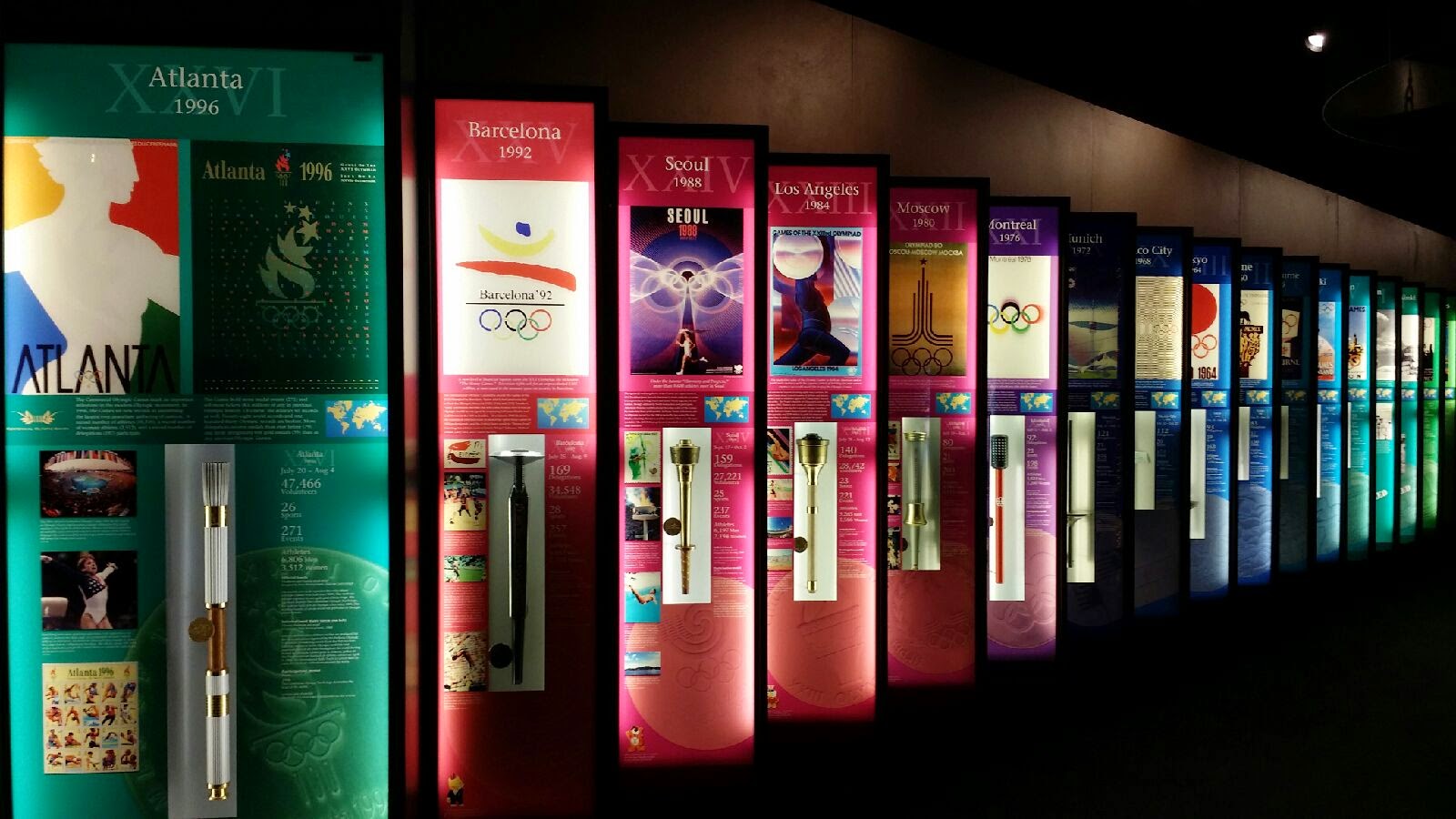
Last month brought an opportunity to revisit the Atlanta History Center as it hosted an Atlanta Press Club fundraising event. Prior to the APC gathering, I took a few minutes to again peek at the collection of Centennial Olympic Games Museum, worth a visit for five-ringed veterans or the uninitiated.

The museum includes an impressive, complete collection of Olympic torches leading to a visitor photo opp position inviting guests to hold an Atlanta '96 Olympic torch handle and smile for the camera.

I also enjoyed the assembly of artifacts from the Olympic bid team members who travelled with
William Porter "Billy" Payne, Ambassador Andrew Young and other volunteers who landed the Games in spite of tough competition from Athens, Melbourne and Toronto (Manchester, England, and Belgrade, Yugoslavia, were also in the running).

Also included are dozens of souvenir objects: Lapel pins, Olympic medals, volunteer and athlete uniforms, sports equipment donated by star athletes and props used in the Opening Ceremony help tell the story with several videos and recordings. An Olympic medalist podium and portion of the state-of-the-art track round out the experience.


A sight for sore eyes was an original model of the Atlanta Olympic Village as it was envisioned and mostly realized on one section of the Georgia Tech campus. The area shows how for a couple of months the "International Zone" of the Village included a flag plaza with banners of 197 competing nations (the athlete transportation plaza), a temporary dining hall and festive welcome ceremony area.

We had this model in our section of the Atlanta Committee for the Olympic Games (ACOG) offices at The INFORUM downtown -- my first Olympic job -- and it was fun to see the model come to life and to work closely with the small army of professionals who made it happen. Good history.

Today's Atlanta Journal-Constitution brought to light a current initiative of the Atlanta History Center. As the museum continues extensive renovations, curators are planning a 2016 exhibition "Atlanta in 50 Objects" for which public input is sought now through March 2.

To nominate an object for the exhibition, visit www.AtlantaHistoryCenter.com/Atlanta-50-objects and submit a brief nomination statement. This blogger already suggested an Atlanta Olympic bid team item to represent one of Atlanta's biggest and most influential dreams coming true. How say you?

Photos by Nicholas Wolaver. Atlanta In 50 Objects logo via Atlanta History Center.


Sunday, June 14, 2009

Taking In The Telfair Museum


One cause for recent pause in blog posts was some personal travel. For Mother's Day, I brought mom to Georgia for her first holiday in the Heart of the South and four days of sightseeing. We split the mini-vacation into two days in Atlanta and an overnight trek to Savannah -- always a nice break from the big city.

In Savannah, we took in some popular favorites: Wading in the surf at Tybee Island, dining at a local dive with a delicious crab boil on the menu, and a trolley tour that picked us up just after a fantastic breakfast at Huey's on the historic waterfront. We also passed the Savannah Marriott and got a reminder of the city's role as host of the 1996 Centennial Olympic Games sailing competition.

With thanks to the responsive team at the Telfair Museum of Art, during a stop from the trolley tour, we experienced Telfair's Jepson Center for the Arts, a beautiful modern building on Savannah's historic Telfair Square.

According to the Telfair website, this modern expansion of the museum is designed by Moshe Safdie -- if you've been near the 1976 Montreal Olympic Stadium and complex, you've likely seen Safdie's nearby creations tied to Expo 67 (according to the archives on the website for Safdie's architecture firm, several of his other designs were built in Vancouver and will be visible during the 2010 Vancouver Winter Olympic Games -- also learned today that Safdie has the commission for the planned National Health Museum near Centennial Olympic Park in downtown Atlanta).

We found the Safdie building for Telfair to be intriguing and bright. Since my mom is a specialty seamstress, we also found it curious and cool that a professional photographer was snapping photos of a model in the grand atrium at Telfair during our visit (see photos -- the gown donned by the presumed Savannah College of Art student is made of recycled Walmart and Target plastic shopping bags (disclosure: Walmart is a client of Edelman, the firm where I work).

Our visit coincided with the final days of a Telfair exhibit titled "Robert Colescott: Troubled Goods." Must admit it was not my cup of tea, but I do look forward, and hope to return, to see more of the Telfair Museum of Art's permanent collection and upcoming events.

Thursday, December 11, 2008

Dreamboat Annie

The rockin' sister duo Heart -- seen here with a cover shot by Annie Leibovitz circa 1980 -- has long been one of my favorite bands. I lose track -- either Heart or Don Henley provided my first outdoor rock concert experience (both played the glorious Oklahoma City Zoo Amphitheatre during 1990), each serving as an upgrade follow-up to Janet Jackson's big show at the Myriad Convention Center that summer of 1990. Good times!


Though "Dreamboat Annie" is a great Heart tune, this blog entry is not really about music. The song's title is just a pseudo-clever starting point for another thread of Olympic connections that goes something like this:

Ann & Nancy Wilson -- Heart -- "Dreamboat Annie" -- Rolling Stone magazine -- Heart photo on cover of Rolling Stone (thanks, Google) -- cover photo by Annie Leibovitz -- Annie Leibovitz portrait photos -- Annie Leibovitz Olympic Project for Atlanta's 1996 Olympic Games -- Annie Leibovitz back in Atlanta on Dec. 10, 2008.

(The thread could also spin off, I suppose, with references to "It's A Hard-Knock Life" and such, but I digress.)

Last night in Atlanta, former Rolling Stone photographer Annie Leibovitz was in town showcasing her latest Random House book titled "Annie Leibovitz At Work" to a packed house in the cavernous main gymnasium of the Marcus Jewish Community Center of Atlanta (MJCCA).

To me it was fitting that the world-famous photographer took the stage in a gym, since more than one segment of her live presentation (complete with wall-sized projections of some of her most famous photographs) referenced work with Olympic athletes.

Before delving into Leibovitz's presentation (see video), some notes about the book:

"Annie Leibovitz At Work" just hit bookstore shelves and includes 230 or so pages with about one iconic image for every three pages of text written from conversations Leibovitz shared with the book's editor, Sharon DeLano (though the text is written first person, I suspect DeLano did the lion's share of writing as, in person, Leibovitz seems to be a woman of few yet thoughtful words).

Of course, the book includes the famous images of John Lennon and Yoko Ono, the Rolling Stones, a rose-covered Bette Midler, Meryl Streep, Whoopi Goldberg (in milk-filled bathtub), Demi Moore and Queen Elizabeth. Also featured are some stunning aerial shots of Monument Valley, dramatic war images from Sarajevo (site of the 1984 Winter Olympic Games -- one shot near the city's Olympic stadium included) and interesting family portraits that give some ideas for capturing loved ones on film during the holidays ... though none will be taken involving bathtubs full of milk). The accompanying text provides some brief or personal stories behind each image, or some general comments or tips on photographic technique. It's a fast read -- three Olympians appear (Carl Lewis, Evander Holyfield and Charles Austin).

So, back to Annie Leibovitz's presentation.

Leibovitz admitted in so many words that she is not a natural born public speaker. She shared some prepared remarks as an introduction before spending most of the event seated in a leather chair and reading directly from the text.

I was surprised and delighted that some of her most impromptu departures from the text came while describing work with nine-time Olympic gold medalist Carl Lewis, who she photographed just before the 1996 Games. Leibovitz used her story behind the photo to drive home two main points of the evening -- there are some shots that become part of history (capturing Lewis at his pre-Games peak as one example), and you should follow through on commitments even when you don't think you want to (she almost skipped photographing Lewis as he was not expected to medal in Atlanta -- a few weeks later he became only the third person to win nine gold medals).

What did not entirely surprise me (an explanation why begins in two paragraphs) is that Leibovitz remarked on the diversity of connections made with her portrait subjects to arrive at "the shot" -- her most vivid descriptions on this topic came while showcasing a range of photos of Arnold Schwarzenegger during his early career, Hollywood days and pre-political aspirations, as well as her memories of working with dancers and athletes (her new book includes notes from working with Olympic hurdler Edwin Moses that paint this picture).
Leibovitz closed the remarks by taking a few questions from the audience. I was next in line at the microphone, ready with a personal question for Annie, when she cut off the Q&A to start signing books (DANG!). Eventually, later in the evening, I did get to ask my question, "where was you photo of Olympic silver medal-winning wrestler Matt Ghaffari taken?"

Here is the back story to explain why I posed this question (Leibovitz's answer also follows):

When I was an intern at the U.S. Olympic Training Center in Colorado Springs during the summer of 1995 (assigned to work in the public relations department at USA Wrestling), one morning I arrived at the USA Wrestling office to find a message from my boss. He said, in so many words, "There's some hot-shot photographer in town to take photos of a couple of [Atlanta Olympic-bound] wrestlers -- we need you to go with the wrestlers when the photographer comes to pick them up, and spend the day with the crew taking the photos."

As planned, a crew picked up the wrestlers (including Matt Ghaffari, an Iranian American who is one of the most genuine and coolest Olympians anywhere -- a real class act) and I to a public park with a massive green lawn and Pike's Peak looming to the west under a cloudless summer sky.

I was confused because there appeared to be two freshly placed dump truck loads of dirt -- one was sand, the other a darker clay -- recently poured on one flat expanse. The whole scene was punctuated with huge scaffolding covered with tarps, and a couple of ladders were in place. We were at the photographer's "studio" for the day. The photographer, of course, was Annie Leibovitz!

Leibovitz had a big crew and it was clear no expense was spared. Easily more than $100,000 went into this one setting as the dirt was used to create a wrestling venue inspired by ancient Olympic wrestling sites near Olympia, Greece, and the different shades of soil were trucked in to provide a range of hues for black and white Polaroids that Leibovitz started shooting as the wrestlers got going on the Terra firma.

I still have the business card for the Swatch public relations executive who was on site, presumably bankrolling the whole operation for what became Leibovitz's 1996 book titled "Olympic Portraits" (my good friend, Meghan, gave me a sweet Swatch featuring some of the photos from that book -- thanks, Meg).

Imagine my stunned surprise when, during our picnic lunch (arranged by Annie's intern and yours truly -- go, interns, go!) in the park, Leibovitz pretty much scrapped the entire "Greek dirt wrestling" set up because Ghaffari, the USA wrestler who went on to win silver in Atlanta, started telling Annie a very personal story about how as a boy his father taught him to wrestle by "pretending your opponent is a tree and you are trying to wrestle a tree out of the ground."

Leibovitz LOVED this -- you could see the wheels turning behind her tortoise-shell glasses as she asked Ghaffari to take hold of the oak trees under which we were lunching. After just a few more Polaroids we were all sent packing. Photo shoot's over, folks! So long, Annie Leibovitz.

The thing is, on that summer internship day in Colorado, I had NO CLUE -- ZERO -- who Annie Leibovitz was -- the entire day! The name did not ring a bell at all. For real. It was a day or two later, when I told a fellow intern or a family member about work that day in passing, that it finally registered "Holy Sh*t! That was that Annie Leibovitz!" I still cringe about my naïveté that day!

I also cringe because, as an intern on site at the photo shoot, I was asked to help collect all the trash and "Polaroid rejects" belched out of Annie's camera into the dirt. At one time my hands held dozens of "no good" photos staged and lost forever following Leibovitz's work on the ladders (I kick myself monthly on this point -- these shots would be extremely rare Annie Leibovitz originals now, and they are in some landfill instead of my apartment!).

I learned the following year, when the Leibovitz Olympic book debuted at an Atlanta Committee for the Olympic Games (ACOG) press conference at The INFORUM in Atlanta, that Leibovitz wound up re-shooting Ghaffari wrestling trees at another location later in 1995. As an ACOG staff member, I was in attendance at the packed press event, and tried to pose the question at a cut-short Q&A there, too -- until yesterday it was my understanding the final Ghaffari wrestling trees portrait was snapped at Midtown Atlanta's Piedmont Park, down the street from my current residence.

The answer, after 12 years: Annie Leibovitz does not remember!

While she signed a copy of "Annie Leibovitz At Work" she answered my question with a friendly and frank reply that they did re-shoot the "wrestling trees" at a later date, but she was not sure when or where. She offered a sincere thank you and handshake during our brief reunion (she has, by the way, some of the most graceful, large and strong hands of any handshake in recent memory) she asked about Ghaffari and how he is doing, perhaps signalling that although he was not the most famous celebrity in her repertoire, a connection was made that day in Colorado Springs.

She did not remember me, so it seems we're "even" on naïveté about each other (ha-ha).

I appreciate Annie Leibovitz taking time to answer one more question -- this one for the Flip Video camera -- just after signing the last of thousands of books sold at last night's MJCCA event.

The question: Would she take on another Olympic project in the future?

The answer (see video) yielded a surprise -- Leibovitz apparently was supposed to attend the Atlanta Games but was denied access near the last minute. It's tough to read whether she remains miffed about this fact (will let you, video viewers, draw your own conclusions).
It is my hope the future will in fact bring Olympians into focus for Leibovitz's craft (if Swatch is out there reading, let's see what you can get in the works for Vancouver 2010 or London 2010, OK?).

Friday, July 25, 2008

History Repeats Itself


Got a heads up today that the Atlanta History Center has a recent new arrival to its Olympic collection from the 1996 Summer Olympics of Atlanta: A torch from the 2008 Olympic Torch Relay. Anyone visiting, or residing in, the U.S. South before or during Beijing's go would likely enjoy the museum's collection from Atlanta's glory days. Good stuff!

Blog Archive

Powered By Blogger
Web Analytics