Showing posts with label AJC. Show all posts

Sunday, December 15, 2019

Spoilers Galore: Fact versus Fiction Spanning Director Clint Eastwood's "Richard Jewell"

At the world premiere of "Richard Jewell" held Nov. 20 at AFI Fest, audiences finally experienced the dramatic screenplay penned by Billy Ray.

As the credits rolled, director Clint Eastwood's work aptly earned a 30-second ovation.

In the month since, more than 700 readers clicked on the first review published by an Atlanta-based outlet (this site).

The Atlanta Journal-Constitution (AJC) was the only other Georgia outlet with writers on the scene in Hollywood, and their review appeared a few days later, no doubt enjoying thousands more clicks.

Regardless, a scoop is a scoop, yes?

A cavalcade of critical and fan reviews -- generally skewing positive -- followed since, and many folks professional or otherwise are writing and discussing what Eastwood and Ray got right or wrong in "Richard Jewell." As noted in my review, one factor that makes a film great is its ability to inspire conversation -- this release definitely does just that.

What follows is a working list of "Fact versus Fiction Spanning Clint Eastwood's 'Richard Jewell'" compiled from attending the film twice, once in LA, again opening day (Dec. 13) in Atlanta.

The below list also relies on numerous third-party sources including several interviews, public events, and thorough examination of the film's two main sources. I'm saving my conversations with Mr. Eastwood and the film's star, Paul Walter Hauser, for another post.

Ray's source material included a 22-page Vanity Fair article written by Marie Brenner, who embedded with Jewell's legal team for several weeks in 1997. On Dec. 10, Simon & Schuster re-released "A Private War" -- a collection of Brenner's essays -- under the updated title "Richard Jewell and Other Tales of Heroes, Scoundrels, and Renegades" ($17).

Ray also relied upon a new book optioned for the film, "The Suspect" by Kent Alexander and Kevin Salwen (Abrams Books, $28), an excellent narrative nonfiction work reviewed here. The authors took inspiration from other well-written nonfiction works including "Devil In The White City" and "The Boys In The Boat," the latter a Games-centric book.

Fan-designed lapel pin
In broad strokes, much of the "Richard Jewell" screenplay plays true to real-life challenges faced by Jewell (Hauser), his mother Bobi (Kathy Bates), and his legal team.

The production achieved great authenticity by filming at actual locations of 1996 events, notably Centennial Olympic Park, which set designers researched at the Atlanta History Center, later decking out the park with excellent attention to detail.

On the other end of the spectrum, Ray was most loose with his characterization and the on screen actions of reporter Kathy Scruggs (Olivia Wilde). Ray defended his work to a reporter at Deadline.com on the eve of the film's wide release.

More detailed facts and fictions, or liberties taken, including several spoilers for both the film and the book "The Suspect," are presented here as a working list generally in order from the start to finish of the 129 minute film. As this is a working list compiled and posted Dec. 15, 2019, I will offset additions or edits with the date of an addition or strikethroughs for corrections:
  • Jewell did work at the U.S. Small Business Administration in downtown Atlanta. It is not clear to me if 75 Spring Street, the address cited in the film (Richard B. Russell Federal Building) was the SBA address in 1986. SBA is now at Peachtree Center.
  • Jewell earned the nickname "Radar" after a "M*A*S*H" character thanks to his reputation for anticipating the needs of coworkers, including real-life SBA lawyer G. Watson Bryant.
  • The character Watson Bryant (Sam Rockwell) is a mashup of several Jewell legal team members; in the words of one film consultant, "No one wanted to watch a movie with a bunch of lawyers."
  • CNN Center, which is not far from the Russell Building, did have an arcade frequented by Jewell and Bryant. But according to "The Suspect" their games of choice were Galaxian and Xevious rather than Turkey Shoot as seen in the film.
  • Snickers candy bars were a favorite of Jewell, according to "The Suspect."
  • Jewell exited SBA due to government cutbacks, but he quickly found work as a retail security guard, an early step in his progression toward law enforcement career goals.
  • Jewell did eventually work at Piedmont College in Demorest, Ga. Busting students for drinking on campus, and stopping drivers off-campus, did lead to his invitation to resign or be fired. In real life, according to "The Suspect," he opted to resign at the behest of his campus police boss, not the university president. This was Jewell's second "forced resignation" in North Georgia.
  • Jewell's real-life friend Dave Dutchess (Niko Nicotera), who first appears in the shooting range scene and returns late in the film, met Jewell during his SBA days. The real Dutchess is 10 years Jewell's senior ("The Suspect").
  • Kathy Scruggs was the lead AJC police beat reporter. Her Games-time assignment was sharing the Olympic security beat with colleague Ron Martz,
    Actual AJC badge of '96
    and the overall AJC Olympic reporting team worked in a special non-sports coverage group for Security, Neighborhoods and Olympic Transportation, a.k.a. "SNOTpod" ("The Suspect").
  • The AJC's office at the time was 72 Marietta Street, around the corner from the park. Footage of the building's exterior and signage, later in the film, is likely from 1996.
  • Scruggs was known in the newsroom for salty language and provocative attire, which one former AJC colleague described to me with the pejorative nickname "K-mart Scruggs"
  • Scruggs and Martz (David Shae) did not bump into each other and compare notes near the park on or around either concert as shown in the film. It's also unlikely Scruggs connected with one of her sources during "Macarena" line dancing. Martz's sarcastic "scoop" about a cop's relation to an Olympian is also likely fiction.
  • The FBI agent portrayed by Jon Hamm has a fictional name. Another mashup character, he is closest to resembling the actual agent named Don Johnson, according to "The Suspect."
  • The opening ceremony footage is real and was provided by the Clinton Presidential Library and/or International Olympic Committee, according to the film's credits.
  • AT&T was the sponsor of the main concert stage at Centennial Olympic Park. It was branded "Global Olympic Village" which caused some confusion in early reports of the bombing (some reporters stated the athletes' Olympic Village at nearby Georgia Tech was the attack site).
  • The footage of children playing in the Olympic rings fountain is real but filmed years after 1996 as the skyscraper section of the Omni Hotel at CNN Center, which appears in the background, opened in 2003.
  • Kenny Rogers did perform at the park, and his show took place earlier in the week, according to "The Suspect." The Rogers impersonator on screen is Ronnie Allen, according to the film credits and IMBD. Jewell's mother, Bobi, did attend the concert.
  • It is possible the end-of-concert fireworks and skyline footage is from 1996, but more likely filmed in summer 2019.
  • At least one of the Olympic pins briefly spotted in the park sequence resembles a design for the 1996 Olympin collectors club member badge. Other pins seen later in Jewell's scrapbook are mostly generic USA patriotic designs, or what appears to be a fictional mascot pin (not close to the actual '96 mascot Izzy).
  • All of the Centennial Olympic logos, from street banners to posters (at on screen restaurants
    Movie set street banner
    and the AJC newsroom), to would-be athlete uniforms donned by a group thanking Jewell, are fictional prop pieces. More notes on this appear in this summer post.
  • Jewell kept a cooler of cold water and Cokes for fellow guards and bystanders ("The Suspect").
  • The portrayal of the beer-drinking teens, as well as the dialogue Jewell and police shared once the bomb backpack was spotted, is nearly verbatim from the prologue to "The Suspect" though names of officers and bystanders are changed or omitted.
  • One of the teenagers did tip the Alice pack onto its back, which made the blast propel nails skyward rather than into the crowd. Pieces were found as far away as the eighth-level rooftop of the neighboring INFORUM building, one of the Atlanta Committee for the Olympic Games (ACOG) office locations. In present day, the building is branded for tenant American Cancer Society.
  • NationsBank Plaza, now named Bank of America Plaza, one of the city's tallest buildings, appears in the background. During summer 1996, its neighboring skyscraper BellSouth Tower (now AT&T) was decked out with pink and yellow neon, strobe lights and laser flashers not portrayed in the film.
  • Once a bomb tech peered into the backpack planted by Eric Rudolph, law enforcement and Jewell did start clearing the area, and Jewell ran through the sound an light tower pulling out staff. He was in a "safe zone" guarded from the blast, which knocked him off his feet.
  • The film gets the numbers right in terms of injuries and victims
  • In the IMDB cast list the lone victim of the blast is named "woman in park" seen taking photos
    View from INFORUM rooftop 7/27/96
    with "girl in park." The real-life person was Alice Hawthorne, who died as a result of her injuries. This AJC interview by Shelia Poole sheds light on what happened to her surviving daughters and other family members.
  • Another casualty of the event, a camera operator from Turkey who had a heart attack, is not portrayed on screen.
  • The fan-shaped sculpture, installed at the park for the '96 Games, was damaged by the hail of nails. At least one hot nail seared into the copper surface of the artwork is still visible in 2019.
  • In real life, Scruggs was nowhere near the park when the bomb exploded. She was asleep in north Atlanta and did not hear/check her beeper until the following morning. Mortified, she raced downtown to start research on the attack, according to "The Suspect."
  • As the actual Scruggs was asleep, the scene of Scruggs (Wilde) and Martz praying for a great scoop obviously never happened.
  • Jewell did have a team of publicists from AT&T and their PR agency, Cohn & Wolfe, helping to book interviews for the hero. This team appears as one mashup character named Tim Barker (Billy Slaughter).
  • The Katie Couric "TODAY" interview is an abbreviated version of the actual interview with Jewell. But this interview took place not on the morning after the bombing; rather, the following Tuesday (hours before Jewell's FBI interview). Not portrayed in the film: A series of CNN studio appearances and phone interviews with USA Today and an AJC intern ("The Suspect").
  • A book deal offer did inspire Jewell to track down his lawyer friend Watson.
  • The FBI did respond to tips provided by Piedmont College and other former employers who expressed concerns about Jewell's overzealous, attention-seeking behavior (Brenner and "The Suspect").
  • As portrayed on screen, in 1996 a Centennial Park acquaintance (a Georgia Bureau of Investigation officer) was recruited by the FBI to wear a wire and quiz Jewell over a lasagna dinner prepared by Richard in the apartment he shared with Bobi ("The Suspect").
  • There was an FBI Behavioral Science Unit (BSU) document that quickly took shape as the bombing investigation rolled through its first 72 hours. Though the film is slightly off in its timeline and players who shared this report, the film is accurate in that it eventually outlined a Jewell-specific profile ("The Suspect").
  • According to numerous AJC columns and reports quoting the current AJC editor, conversations
    with former editors and colleagues, and facts presented in "The Suspect" and Brenner's piece, it is highly unlikely if not entirely false that Scruggs offered or traded sex for the source confirming her scoop about Jewell. Screenwriter Ray took the greatest liberties with this portrayal in the script. Bert Roughton, now retired from the AJC, explained his version of the timeline in "The Suspect" and at an Atlanta History Center book launch event held Nov. 12 reported here. These details presented in the book also negate the on-screen scenes of Wilde, as Scruggs, whispering her scoop to Martz.
  • Scruggs never hid in the back seat of the lawyers' cars (fictional for dramatic effect).
  • According to former AJC "PeachBuzz" reporter Richard Eldredge, who posted a film review on his site EldredgeATL.com, there was no "Scruggs celebration" of the scoop in the newsroom. Newsroom applause instead remained in reserve for days when the newspaper and its reporters won Pulitzer Prizes, according to AJC '96 features editor-turned-freelance film critic Wendell Brock's review published the day of the film's release.
  • The FBI did entice Jewell to be interviewed under the "training video" ruse, and it worked until FBI Director Louis Freeh called from Washington, D.C., demanding agents to read Miranda Rights. This scenario was condensed by screenwriter Ray for dramatic effect ("The Suspect").
  • The AJC afternoon edition breaking the news about Jewell did not run until after the AJC editors held the story for more than 24 hours and they read the story to the FBI communications director, who verified its accuracy and that publishing the news would not hinder the investigation. This is according to "The Suspect" and comments made by Roughton at book events or by phone/email with me since his summer column published in the AJC.
  • CNN ran a live segment and read/held up the AJC headline on live TV as portrayed. This happened during Jewell's FBI interview and was the prompt for Freeh, watching live in Washington, to call the Atlanta bureau in regards to Miranda Rights ("The Suspect").
  • Unlike his on-screen portrayal, Jewell did sign a document regarding his Miranda Rights while awaiting a callback from his attorney. A copy of the document appears on the back endpapers of "The Suspect."
  • Jewell did call Bryant's office from the FBI bureau. Watson did not return the call from the
    office; rather, he called from his SUV after his assistant, Nadya (Nina Arianda), and he read the AJC during an afternoon as Olympic spectators. Bryant did curse out the FBI. ("The Suspect")
  • The Motorola-designed gray plastic cell phones used as props for Wilde and others were more accurate than the early 2000s flip phone prop held by Hauser in multiple scenes of Jewell placing calls.
  • The scene of Bobi and Richard watching Tom Brokaw (actual NBC footage in film) is mostly accurate though was as upsetting for Richard as his mother (Brenner)
  • The attorney's live TV interview with MSNBC's Bryant Gumbel (Garon Grigsby) is abbreviated but draws inspiration from the actual interview.
  • The film portrays Bryant and Nadya walking the phone booth to park route, and later Scruggs doing this as well, to determine Jewell could not have placed the 9-1-1 call. But it reality it was an AJC reporter, Bill Rankin, who did this research, according to this report by AJC columnist Bill Torpy. Independent of the AJC research, CNN also had a reporter conduct this research, according to comments made by former CNN executive Tom Johnson during a Dec. 9 book event hosted by the Atlanta Press Club. The AJC and CNN timelines of their parallel efforts will appear on a separate post.
  • Jewell did offer "take the carpet" when the FBI extracted evidence from his residence.
  • Bobi Jewell did get upset the FBI confiscated her prized Tupperware collection they later ruined with Sharpie ink (Brenner).
  • The scene during which the FBI dupes Jewell into recording Rudolph's 9-1-1 call script never happened. Jewell's legal team prevented this voice sample from ever taking place (Brenner).
  • Dutchess was questioned by the FBI, but not in Georgia (instead, West Virginia).
  • The scene of Bryant and Jewell confronting Scruggs in the AJC newsroom is completely
    fiction. Jewell was not face to face with Scruggs until years later in lawsuit-related deposition. The AJC's downtown office was secure, not configured to allow access for visitors to "barge in" and confront reporters.
  • The reel of President Clinton on newsroom TV (behind Rockwell and Hauser) is actual footage from hours following the bombing.
  • Jewell did take a polygraph and pass with the highest rating for "no deception" detected (Brenner)
  • Jewell and his legal team did visit the FBI office in October 1996, and Jewell explained his comments predicting Atlanta's messy traffic, as shown on screen (Brenner). This meeting involved a different cast of individuals than portrayed on screen, but Jewell did explain his upset stomach before the bombing, and his admiration for his assigned guard spot as "a sweet site" to admire women (Brenner).
  • Jewell did speak of his innocence at the FBI meeting, but Ray embellished the content of Jewell's response to create his "speech" to agents (Brenner).
  • The contents of the Jewell apartment took hours to collect but only five minutes to return ("The Suspect").
  • Jewell did receive a letter from the FBI declaring he was no longer a suspect. As shown in the film, the letter was signed by Kent Alexander, then U.S. Attorney for the Northern District of Georgia, now co-author of "The Suspect" The letter was not delivered by an agent nor at a
    diner, as portrayed with Hamm. Alexander handed the letter to a Jewell attorney not portrayed on screen. 
  • There was a heavily attended press conference hosted by Jewell's legal team, with Bobi Jewell speaking -- inspiration for Kathy Bates' script during this emotional scene of the film. Screenwriter Ray lifted direct quotes from Bobi's remarks, but shortened them and changed the order. Verbatim quotes, as noted in "The Suspect" include:
"The media has portrayed my son as the person who committed this crime. They have taken all privacy from us, they have taken all peace. I do not think any of you can begin to imagine what our lives are like. My son is innocent. Mr. President, please clear my son's name."
  • Jewell did move on from the 1996-1997 events to become a police officer in North Georgia. The film did not mention several colorful and touching moments of his latter years, including meeting his wife, and saving another life, as noted in "The Suspect."
  • "The Suspect" also secured THE SCOOP on Scruggs' informant; you'll have to read the book to learn who it was, as the AJC never revealed her source.
Image of "Fact versus Fiction" from this site. Stills from "Richard Jewell" via Warner Bros. Park site from INFORUM vantage via Getty. Park banner and Scruggs I.D. photos by Nicholas Wolaver. Ali and Evans image via Janet Evans' Twitter account and Today.com (likely a wire service or IOC photo).

Thursday, November 7, 2019

Upended Lives at Olympics Provide Drama and Richard Jewell Revelations in "The Suspect"

In the next few weeks, Atlantans and media will be buzzing about the new nonfiction book "The Suspect: An Olympic Bombing, The FBI, The Media, And Richard Jewell, The Man Caught In The Middle" by Kent Alexander and Kevin Salwen.

This page-turning volume, a triumphant feat of journalism, research and writing 23 years in the making, encapsulates thorough, at times revealing, details about Jewell, the hero security guard who moved hundreds of concertgoers out of harm's way before a hidden bomb he found detonated at the Atlanta Olympic Games. If contributors from Jewell's inner circle achieve their goal, folks everywhere will at last proclaim the praises of Atlanta's least celebrated hero.

The book also puts a magnifying glass on the Atlanta Journal-Constitution reporting team, notably Kathy Scruggs, as well as a specific FBI agent, Don Johnson and his colleagues, whose work in their respective fields forever impacted Jewell's and his mother Bobi's lives.

Monday afternoon a review copy finally landed on my Midtown front porch, and I delighted in devouring its 368 pages that are equal parts crime drama and unflinching critique of Federal investigations and investigative journalism.

An enclosed press release affirmed my hunch the book was optioned by Warner Bros. for the upcoming Clint Eastwood film "Richard Jewell" set for a world premiere at AFI Fest in Los Angeles on Nov. 20 (with Dec. 13 as the national release day).

One "reveal" of Alexander and Salwen's work is that the film's screenplay, at least in the movie trailer, is close to verbatim from their research of the FBI's interrogation of Jewell.

Juxtaposed with this fact, the book also reveals that Eastwood's screenwriter Billy Ray took at least one major liberty in the script: Jewell's attorneys aptly never allowed the hero guard to record the bomber's 9-1-1 call script, "There's a bomb in Centennial Park ... you have thirty minutes!" (I've previously taken Eastwood and his screenwriter for "American Sniper" to task for playing fast an loose with Olympic facts, the all-time most-read posts of this website).

"The Suspect" is a great read with relevance for anyone passionate about or in law enforcement, news media, Olympic organization, historians (of Atlanta, the USA, true crime or the Games) and the millions of people who experienced or have interest in the Centennial Olympics of 1996.

Make that a must read.

All of the one-time Atlanta Committee for the Olympic Games (ACOG) staff and volunteers will appreciate and remember scores of long-forgotten Games-time intricacies.

Between the book's end pages -- noticeably featuring a hand-drawn bomb site map by Jewell and a Miranda rights form he reluctantly signed during his sideways interrogation (cue the "Richard Jewell" film trailer with John Hamm's stern voiceover) -- readers may be mesmerized about "The Suspect" by the numbers.

Following their 1996 roles that introduced them to their subjects, Alexander and Salwen spent more than five recent years pouring over "tens of thousands" of legal documents, 170,000 ACOG archive pages and reports, thousands of photos, dozens of cases of personal effects, 1,200+ news articles and hundreds of video clips.

They also conducted "187 original-source interviews" and read dozens of books or other materials, initially logging 2,139 footnote entries later converted to narrative source notes on their ABRAMS Books editor's suggestion. The years-long FBI investigation of Jewell and other dead-end leads exponentially adds to the mind-bending facets of the research.

The book project unfolded at a venue the authors dubbed "the cottage," which I envision resembled a "war room" like those seen on any crime drama investigation.

Notable details uncovered and documented include:
  • How Jewell's parents named him after auto racing legend Richard Petty, while nicknames the FBI adopted for too-blurry images of the actual bomber included "Blob Man" and "Goatee Man" (only one of them proved to be the man, Eric Rudolph). Beer-chugging witnesses earned the sobriquet "Speedo Boys"
  • Richard Jewell's secret lasagna recipe he cooked and served to a law enforcement peer from Centennial Olympic Park, only to later learn his invited dinner guest was wearing a wire for federal investigators
  • Which national TV reporters initially proclaimed Jewell a hero then later apologized in months-later follow-up interviews intended to rightfully exonerate him in the public eye (I had no idea Jay Leno apologized after his initial monologue quips comparing the guard to Nancy Kerrigan's attacker)
  • The Atlanta Magazine reporter who agreed to a date with Richard, only to later embarrass a crestfallen Jewell with an unflattering cover story
  • Which local radio station paid a $50,000 settlement after using Jewell's likeness in an unsanctioned outdoor billboard campaign around the song "Freebird"
  • Summaries of the Atlanta Journal-Constitution Games-time "Peach Buzz" columns including the time Donald Trump lost his wallet at The Cheesecake Factory in Buckhead, and AJC non-Olympic reporters including Scruggs, who proudly reported on "distinctively non-sports coverage areas of Security, Neighborhoods and Olympic Transportation" in their "SNOT Pod" newsroom space
  • The downward spiral Scruggs endured years after her Games reporting, including shocking outdoor incidents involving a taxi she commandeered in the buff. 
Several Olympians provided interviews for the authors, including Michael Johnson, who recalled a hospital visit to injured bomb survivors before competing in second gold medal sprint.

Gold medalist Janet Evans, who witnessed the bomb explosion during an in-park TV interview, also garnered frequent mentions in the text (though it is not clear yet that she was interviewed for this book).

Personal revelations for this reader included notes on how Jewell attended the same Olympic baseball game (Cuba vs. Nicaragua) for which I held a ticket and cheered with friends. A day later, some of the federal agents of "The Suspect" watched over the India vs. Pakistan Olympic field hockey game at which I helped Pakistan fans hold aloft a giant green and white flag (my Minnesota State University-Mankato junior-year roommate spotted me on TV while watching at home with his family ... in Lahore).

I learned the most from the chapters about Rudolph -- his capture, prosecution and revelations about his post-Games movements were not on my radar in the early 2000s, though Rudolph's two other despicable attacks in Atlanta were. The book brought to mind vivid memories from news coverage of both events. The bomb he detonated in Birmingham was not "new" to me, but the authors' framing of the scene inspired chills.

Much of the Jewell narrative (until the final chapters) felt more like a fleshed-out version of previously seen reports, like a Titanic-sized version of Marie Brenner's extensive Vanity Fair article after she shadowed Jewell's legal team for months.

But I appreciated the details that at once revealed Jewell's relatable, jovial, every man nature while cracking me up, like this description from page one:
Hopping off the [MARTA] train, Jewell descended International Boulevard, the lime-green lanyard that held his credential swinging across his ample belly.
Been there, done that!

A much bigger revelation: the AJC assigned interns to interview Jewell or help report updates from his residence after Scruggs and colleagues broke their scoop under the screaming headline "FBI suspects 'hero' guard may have planted bomb."

I can't imagine receiving a federal subpoena to testify about either of my internships.

Readers also learn the less-reported aspects of the guard's later-career heroics, including touching stories of a CPR rescue and how he reflected on each anniversary of the night that changed his life. The love of his life provided some of the best heartfelt details, underscoring her own (and other Jewell inner circle members') "... hope that one day Richard Jewell would be remembered by all as a hero."

Writing of the book's biggest revelation -- which took my breath away -- would be an unforgivable spoiler (though I predict other book reviewers will not hold back).

It's fun to learn new vocabulary while reading, and the words bonhomie, putative, and lithe joined my lexicon thanks to Alexander and Salwen. And I was surprised that a book touted as a "gripping story of ... the advent of the 24/7 news cycle" did not include more mid-'90s context from the trials and tribulations of Tonya Harding and O.J. Simpson (especially the former's five-ringed connections).

Meanwhile, I found just two glaring errors and one minor one in "The Suspect."

First, the authors referred to the "seven-building Olympic Village complex" President Bill Clinton and the First Family visited. Come again?

In the "Blue Zone" of Georgia Tech's west campus -- where I was an ACOG-employed Village housing manager adjacent to the Olympic Aquatic Center -- we had more than 20 buildings including the dorms built to eventually house Team USA and delegations from Russia, Egypt, Indonesia, Germany, the U.K. and dozens of other national Olympic Committees including the heavily-fortified Israeli team quarters.

My sister worked in the distant "Red Zone" north of 10th Street, which had several buildings visited by Spain's Royal Family. And over in the "Green Zone" was my Games-time housing in a frat house (one of about 20 used by NOCs).

I don't recall what the brand new towers along the Downtown Connector were named ("Blue Zone?") but it was fun attending the opening press conference with ACOG in spring 1996.

Maybe the authors only considered the "International Zone" around Georgia Tech's Ferst Center for the Arts to be the "Village complex" they described. As Hillary Clinton has proven many times, forgiveness is key, and perhaps it takes a village to get these Georgia Tech and former Georgia State University towers counted. I forgave the miscount.

An even less intrusive-to-my-eyes flub was the writers' mention of a James Brown concert at a bar named "Tabernacle."

No doubt, they meant the festive church-turned-concert hall that's still rockin' and rollin' next to the Atlanta Ferris wheel installed years later.

I'm less forgiving and not forgetting the page on which the authors recounted memories of the host committee's COO, who famously slept in his office at The INFORUM, the ACOG headquarters building which overlooks Centennial Olympic Park, some nights of the Games.

According to Alexander's and Salwen's interviews, when the bomb exploded just after the A.D. Frazier conked out in his office,
He leapt from bed ... [and] ran to his balcony barefoot and stared at the chaos and emergency lights below. Bodies were strewn across the bricks of the park. His mind flashed to the movie Saving Private Ryan, with its vivid, brutal scenes of battle. Rattled, Frazier spun and hurried back inside his darkened office, switched on the desk lamp and dialed Payne. 'Billy, we've got a problem.
I know Frazier to be wicked smart, but not clairvoyant nor one who could predict future film scripts -- the problem with this recollection, as documented in "The Suspect," is that Steven Spielberg's epic war picture did not debut until 1998.

Sidebar: I also know A.D. did not sleep on the couch by his office 24 hours after the bomb, because I tearfully fell asleep on that sofa during my own visit to overlook the park in the early hours of July 28, 1996. The sodas in his mini-fridge provided comfort as well.

Atlantans have the opportunity to meet "The Suspect" authors at the Atlanta History Center on Nov. 12 at 7:30 p.m.

They'll be joined on stage by former AJC Senior Managing Editor Bert Roughton, a book source who wrote this Sunday AJC opinion piece about his colleague Scruggs, as well as event moderator John Pruitt, formerly of WSB-TV. Tickets are $5 for members and $10 for non-members. For more information visit this link.

On the invitation of the ABRAMS Books publicist, I delivered questions tailored for each author and will follow-up this post with their Q&A responses. What questions do you have for this remarkable writing duo? Please post them in comments and I will try to ask at the AHC event.

Book and author images via ABRAMS. Book cover photo via Bobi Jewell with jacket design by Devin Grosz. Author photo by Allison Shirreffs. Other photos via Associated Press, DP/AFP/Getty, ESPN and GeorgiaEncyclopedia.org. 

Saturday, December 12, 2015

Jewell Film May Rile

During Christmas of 1996, I could not resist changing the lyrics to the popular holiday tune "Good King Wenceslas" thanks to a Georgia name that grabbed a lot of headlines during the Centennial Olympic Games held in Atlanta.

Good King Wenceslas looked out,
on the Feast of Stephen,
When the snow lay round about, 
deep and crisp and even;
Brightly shone the moon that night, 
tho' the frost was cruel,
When a poor man came in sight ...
is that Richard Jewell?

Nearly 20 years later, Richard Jewell -- the hero security guard of the 1996 Games -- still comes to mind each caroling season. For those in need pf a refresher on his story, the ESPN 30 for 30 short "Judging Jewell" provides a good recap. 

During winter/spring 2015, I got another reminder of Jewell in the form of a dateline Hollywood news article

Not quite Christmas in July, but noteworthy for Olympic film fans.

Turns out Jewell, who died at 44 in 2007, will get his own silver screen feature with the working title "The Ballad of Richard Jewell." 

According to published reports, Jonah Hill and Leonardo DiCaprio will play Jewell and his attorney, respectively, in a big budget release set for 2016, possibly in time for the Rio Olympics. 

The title comes from the headline to the famous Vanity Fair article by Marie Brenner, who landed one of the biggest 1x1 interviews of 1996 when Jewell agreed to his first media conversation before his acquittal for the Centennial Olympic Park bombing. Brenner is also known for in-depth writing that inspired the award-winning film "The Insider."

In Brenner's extensive post-Olympic "American Nightmare" article, Jewell unloaded months of pent--up rage and anxiety caused after his "right place at the right time" heroics earned scrutiny of the world's media (and just about everyone else) thanks to some loose-lipped law enforcement officials and an overzealous reporting team. 

Anxious for a global news scoop hours after the bombing, and imbued by "official sources," reporters at the Atlanta Journal-Constitution led with coverage of Jewell that -- like the Bee Gees lyrics to "I Started A Joke" -- started the whole world crying the security guard's name with specious accusations. 

Details for the new Hill/DiCaprio project remain sparse, but according to one report, Clint Eastwood was initially considered to direct the film. This turned out to be wishful thinking during all the attention for "American Sniper," however, as Eastwood put the kibosh on project speculation during a public Q&A

Just as well since Eastwood has a record of skewing Olympic facts, as reported here

With no Eastwood option, this writer hopes Martin Scorsese might direct Hill/DiCaprio again on the heels of their shared success for "The Wolf of Wall Street." 

Screenwriter Billy Ray -- working with Scorsese on his adaptation of "Devil In The White City" (starring DiCaprio) -- is confirmed to write the screenplay for "The Ballad of Richard Jewell" so maybe a Scorsese-Ray-Hill-DiCaprio combo pack for the Jewell bio may work (though not likely in time for Rio 2016, methinks).

No matter the director, I can hardly wait to see if the screenplay recreates the "Saturday Night Live" 1997 season opener scene during which beleaguered FBI Director Janet Reno -- masterfully portrayed by Will Ferrell -- absorbs a gut-busting punch by the real Richard Jewell, who followed the hit with a great one-liner: "Same time next week?" 

Later in the same SNL episode, Jewell sat in the guest chair for a funny "Weekend Update" interview with Norm MacDonald

I am also curious how the Atlanta Journal-Constitution marketing department and editorial staff will report on "The Ballad of Richard Jewell." The newspaper that "Covers Dixie Like the Dew" unfortunately stepped in poo through the whole Jewell episode, and its likely the AJC will gets its due -- in the form of unflattering publicity for a free press outlet gone awry at great expense to a private citizen -- when the film project gains steam. 

This copy of court documents related to Jewell's legal action against the AJC offers a peek at both sides of their cases which became moot upon Jewell's death.

When the film starts shooting, here's hoping Centennial Olympic Park may finally get some screen time as well. 

Photos via Hollywood Reporter, AJC.com, Associated Press, Hulu and Howard Berger blog.


In case Billy Ray is reading, here's my contribution to "The Ballad of Richard Jewell" screenplay drafts: 

INT. JEWELL FAMILY APARTMENT - SUMMER AFTERNOON

RICHARD enters from bedroom as his mother places home-cooked meal on small dining table by window facing suburban apartment complex parking lot. He is wearing an Olympic security uniform and ball cap. She adjusts the volume on small TV screen to soften Tom Brokaw's NBC evening report on monitor. 

RICHARD
(while sitting at table and scooping food onto his plate)

Looks good, momma. 
Glad to eat quick before heading downtown. 
This beats that fast food from last night
that upset my stomach.

MOTHER

You eat your veggies. 
I don't want you getting 
hungry on your late shift.

(BROKAW on monitor talking about the first week of the Atlanta Olympics reaching the weekend, highlights from the day's competition, and live shots of crowds at Centennial Olympic Park -- audible volume but part of background while RICHARD and MOTHER meal conversation continues)

MOTHER (CONT'D)
(looking at screen while talking with cheek full of food)

Looks like it'll be a busy night for you down there.

RICHARD

Should be. 
I'm glad for the peace 
and quiet here at home. 
It gets noisy there. 

(RICHARD and MOTHER continue eating and chatting inaudibly as camera pans back to show relative calm of tree-lined apartment parking lot out the window).

MOTHER
(cheerfully)
I just love Tom Brokaw. 
He is so handsome. 
He's always been one of my favorites.

The film advances through the evening of the bombing, Richard's heroic actions, and initial interviews with investigators. The film later resumes in the same apartment during breakfast a couple of days later. 

INT. JEWELL FAMILY APARTMENT - MORNING LIGHT OBSCURED BY WINDOW BLINDS

RICHARD enters from bedroom in boxer shorts and T-shirt, rubbing eyes after a near-sleepless night as his mother places scrambled eggs and bacon on dining table by window. The TV is off.

(Audible muttering heard from outside window)

MOTHER

Come get something to eat. It's been so noisy outside. 
They must finally be getting around to painting things. 
I keep hearing the painting crew yelling at each other 
but I didn't open the blinds since I'm in my robe. 
I didn't even go out to get the paper yet. 

RICHARD

Oh, I'll get the paper. 
I want to see the latest reports 
from the other night.

RICHARD opens door to reach down for paper on welcome mat. 

(Off-screen REPORTER yelling "There he is!" as flashbulbs pop reflected in apartment entryway)

RICHARD quickly shuts door and steps back slowly, startled and bewildered. Holding newspaper, he turns attention to table as MOTHER reaches for the window blind string to draw up the blinds. Camera across room facing table and window shows RICHARD and MOTHER from behind and their view as the raised blinds reveal a sea of hundreds of television news cameras, reporters, photographers and bystanders -- some in the threes or atop news trucks -- peering at the Jewell breakfast scene. 

MOTHER
(gasps from shock of the scene, quickly lowers blinds for concealment)

Oh, my God! What in the world?!

As if to distract herself, MOTHER quickly turns on the television which is still tuned to NBC. On screen, Tom Brokaw is speaking about the Olympic Park bombing from earlier evening. RICHARD and MOTHER watch intently as camera zooms in on BROKAW on screen.

BROKAW
(with photo of RICHARD on screen)

They probably have enough to arrest him right now, probably enough to prosecute him, but you always want to have enough to convict him as well. There are still holes in this case.

MOTHER
(lips quivering) 

What is he talking about? 

(she starts to cry as RICHARD looks down, somberly shaking his head as he unfolds the newspaper to reveal his photo on the cover and an accusatory headline above the fold)

# # #

Thursday, November 1, 2012

Talking TOTEM by Cirque du Soleil


When Cirque du Soleil is in town, I'm there. Well, most of the time.

My introduction to the Montreal-based entertainment extravaganza took place under the Grand Chapiteau at Turner Field's parking lots in 1999, when the big top tour of "Dralion" arrived in Atlanta. The Headline Group -- the boutique public relations agency for which I was then a new employee -- worked with Cirque du Soleil from their early 1990s Atlanta debut through the end of that decade, and my boss and mentor managed the local team for "Dralion." Jolly good show.

We missed a 2002-03 tour on a technicality: Edelman acquired The Headline Group, so with THG showing up as "closed" our agency missed the option to pursue the Cirque du Soleil project the one time it was in suburban Cobb County (we also represented a competing entertainment property, so timing did not work).

But the sun did not set for our team as we renewed contact in time for 2005 when "Corteo" arrived at Atlantic Station and our team at Edelman landed this entertainment project. It was great fun working on this dream-inspired tour, and we later enjoyed collaboration for "KOOZA" and "OVO" before "Dralion" returned on an arena tour just a couple of years ago. C'est magnifique!

On my own dime, I experienced the magnificent water-themed "O" in Las Vegas, the arena tour for "Alegria" in Oklahoma City, and Cirque du Soleil's racier "Zumanity" (also in Sin City) in recent years. Each show brings to mind special memories -- though there are similar themes from one tour to another, they are all unique in as many ways. "O" remains the one to beat in my personal scorekeeping for Cirque du Soleil thrills.

It was my good fortune to work on the "Michael Jackson: The Immortal World Tour" earlier this year as a freelance P.R. partner for Cirque du Soleil, and it was bittersweet to learn their selection of another communications counselor for the new big top tour -- "TOTEM" -- now at Atlantic Station through December 30. But the "sweet" part meant that, as in 1999, I could again experience an Atlanta big top stop as a spectator.

"TOTEM" delivers the goods.

In Cirque du Soleil's words from the official program (a beautiful publication), the new tour "traces humankind's incredible journey -- from our original amphibian state to our ultimate quest for flight."

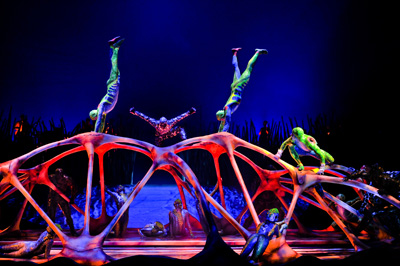
The journey begins with "Crystal Man" (an artist beautifully covered head to toe by thousands of tiny mirrors) descending from the heavens, unveiling turtle shell-inspired staging around which colorful amphibians gaze upon the audience. As these sequin-clad reptiles warm up the crowd, they reveal the carapace as their playground for gymnastic leaps and trampoline bounds. Welcome to Cirque du Soleil!

I loved that the first act quickly moved to a First Nations feature (that's Canadian for Native American). The Hoop Dancer -- U.S. born Eric Hernandez -- delivered an elaborate performance showcasing many skills with five rings (the closest "TOTEM" gets to the Olympics -- though there are Olympians who are part of Cirque du Soleil's other tours, none are part of this tour). Beautiful. And the live band and musicians' many talents really started to shine in support of Hernandez.

The rest of the first act included a blur of amazing: more gymnastics via the Ring Trio (two males and one female dangling from way, way up); five Chinese-born performers who earned a standing ovation for their brass bowl and teapot tossing -- and catching -- on elongated unicycles; and two "Crystal Ladies" (a duo of Belarus beauties with the same surname, Tsodikova) who seemed to arrive from the future to showcase fine foot juggling skills (I made note of their costumes' similarity to outfits donned by Zhora at Taffeys Bar in "Blade Runner" and now feel I have an answer to what Harrison Ford watched in the film's fictional night club scene).

Cirque du Soleil also brought in the clowns -- this time in the form of Italy's answer to Elvis (with horse jockey physique) and a playful introvert with the morose eyes of The Cure's Robert Smith. They each take center stage several times throughout the show, twice in boats which "float" atop a well-executed stage configuration that blends video projection to create water.

A scene in which the evolution of man from monkey to modern office worker played out nicely and with good cheer.

"TOTEM" also included a few scenes that left me, and more than a few fellow audience members, scratching our heads.

I was not sure what to make of the Robert Goulet lookalike and his teammates in the "Perches" performance (their act includes plenty of daring feats, mind you, but it was the least connected scene for the evolution theme). A character named "The Tracker" also was a non-sequitur, as was the Spanish dancer and the Darwin-like "character" who worked to electrify the audience from within a giant beaker. Each of these fell flat, at least for this blogger.

But "TOTEM" included a lovely couple on the Fixed Duo Trapeze (breathtaking and beautiful -- I now have a crush du soleil on the Canadian performer Sarah Tessier) and a welcomed return of the Hoop Dancer with his female partner. And at this point in the second act, when the woman behind me exclaimed, "roller skates!?!" I must admit to some initial apprehension about wheel-clad Native Americans setting up for a spinning dance on an enormous drum -- but they brought down the house (it was spectacular; something I'll tell to my grand kids at a future Cirque du Soleil show).

It was during this latter pair of First Nations performances when I realized the "turtle shell" staging resembled an enormous Dream Catcher aloft in the big top. A lot of good dreams captured in "TOTEM."

I won't write much here about the final act, Russian Bars, which brought the evening's second "from the future" (???) moments. Were they supposed to be amphibians from outer space? Or going to outer space? Still not sure. But then, part of the beauty of Cirque du Soleil is the wiggle room for audience interpretation.

And with that in mind, my take was that this Russkiye act (with the help of Kym Barrett, costume designer extraordinaire) gave us a mini-preview of the Sochi 2014 Winter Olympic "Look of the Games," if only by coincidence (their costumes are similar to the upcoming winter Olympic outerwear and advertising, with an array of vivid colors and complexity). They are bright, glow in the dark, and they are strong.

Is "TOTEM" a great entertainment experience? Absolutely! Is it worthy of the $43.50 to $153.50 ticket price? Well ... I'll leave that to readers to decide (suggestion: though there is not a bad seat in the house, this show may be better experienced in the price level one or premium seating).

For a second take on "TOTEM" check out the AJC review by Wendell Brock, which provides more than a few apt notes on this tour experience (his colleague Howard Pousner also wrote some great reports about the tour, starting with the January 2012 advance story my team secured via P.R. circles last December).

Looking forward to the next Cirque du Soleil and to "TOTEM" talk with friends. Enjoy the show!

Photos via Cirque du Soleil by OSA Images

Friday, August 24, 2012

Celeste & Jesse Forever Includes Olympic Laughs

"Space Olympics" remains one of my all-time favorite Saturday Night Live spoofs. Andy Samburg nailed it as an otherworldly IOC member (that's intergalactic Olympic committee) welcoming Michael Phelps and others to the Games of the future.

Back on earth this weekend, I enjoyed screening the new romantic comedy "Celeste & Jesse Forever" which features Samburg opposite Rashida Jones (of "The Social Network" and "Parks & Recreation" fame), who wrote this clever little picture.

What drew me to view this film: An Atlanta Journal-Constitution-published reprint of a San Francisco Chronicle review, which gave "Celeste & Jesse Forever" an "A" grade. More importantly, the review briefly mentioned that Samburg's slacker character takes a few hits from overachiever Celeste since he spends a lot of his free time watching reruns of the Beijing Olympics -- specifically an emotional weightlifting competition -- in lieu of gainful employment.

Five-ringed connections aside, this film is quirky, fun, funny and touching ... one of the best-written films I've seen of late (though I did enjoy "Frenzy" on the big screen at an Alfred Hitchcock feature screening as part of the Cultural Olympiad in London last week).

Check out the trailer and more details here.

Photo via Sony Picture Classics

Saturday, March 10, 2012

Olympic Level Anticipation for The Hunger Games


Just a few days ago, I had never heard of "The Hunger Games" except via a recent Wall Street Journal photo cut line mentioning Jennifer Lawrence as a key player in this upcoming film.

Last Sunday, thanks to Jennifer Brett and the PeachBuzz feature in the Atlanta Journal-Constitution, I started to familiarize myself with the trilogy of bestselling books by Suzanne Collins, who must be a gazillionaire about now.

A local Atlanta media event for the film, hosted by Allied Integrated Marketing, also enticed me to learn more, and after an hour enduring the screams of a thousand teen fans in a tent at Lenox Mall in Buckhead (on site to see b-list stars of the anticipated film, including Leven Rambin, Liam Hemsworth, Alexander Ludwig, Amandla Stenberg and Dano Okeniyi), I sat in a local Barnes & Noble and read about 60 pages of "The Hunger Games" -- a good read!

Still wondering why the local media event did not include Atlanta hometown actress Isabelle Fuhrman.

A hunch was confirmed via some online searching: Collins cited Greek mythology among the inspirations for "The Hunger Games" -- specifically the story of Theseus, who is tied to Athens (the only threads to any Olympic connections "The Hunger Games" may have, as the other inspirations include Roman gladiators, the antithesis of the Olympic Truce).

Five-ringed ties or not, this blogger has joined the ranks of "The Hunger Games" fans, and the March 23 arrival of the movie will be interesting. Here's hoping the film lives up to the hype and is true to Collins' writing (based on the previews, which mostly portray the first couple of chapters, so far so good).

Photo credits: "The Hunger Games" book cover via Amazon.com; Jennifer Lawrence archery photo via Film-Book.com; Leven Rambin photo by Nicholas Wolaver copyright 2012.

Blog Archive

Powered By Blogger
Web Analytics