Showing posts sorted by relevance for query berlin 36. Sort by date Show all posts

Tuesday, January 12, 2010

Atlanta Jewish Film Festival Scores w/ "Berlin 36"


While on sabbatical in Munich last summer, it was fun to stumble upon a new Olympic film with the title "Berlin 36."

Of course, at the time it seemed there was no hope of screening this film any time soon (trailer here) -- I speak/read no German, and the art-house "look" to the preview did not hint of mainstream release (it was later revealed the film opened in Germany in September 2009).

So it was delightful news to learn the Atlanta Jewish Film Festival (AJFF) landed "Berlin 36" as its premiere showcase film for the 2010 event, the festival's 10th year in Georgia.

With thanks to the P.R. team for AJFF, I viewed "Berlin 36" at home and look forward to viewing the big screen version at the Festival Premiere event tomorrow evening.

The festival's other films, including some sports-themed titles (especially the sumo-scale "A Matter Of Size" regarding the Japanese sport), are on my to-do list for the final days before heading to Vancouver (be sure to check out the AJFF's complete schedule).

But back to a review of "Berlin 36" ...

"Berlin 36" portrays the true story of Gretel Bergmann, a Jewish high jumper from Laupheim, Germany, who was on track to win the gold in the 1936 Berlin Olympic Games until a range of political moves involving the Nazi Party, German track officials, the I.O.C., U.S. Olympic Committee and others led to Bergmann's undeserved dismissal from the German track team only weeks before the XIth Olympiad Opening Ceremony.

The curious twist to the already sad story of Olympic-level anti-Semitism is that the German team replaced Bergmann with a "female" high jumper who was, um, "equiped" for competition.

Contrary to the review by The Sunday Paper in Atlanta, whose critic incorrectly identified the "female" athlete as "transvestite," the real-life competitor named Dora Ratjen was a hermaphrodite (distinctly different from transvestite in that s/he may have had both boy and girl parts under her/his track suit). Ratjen's 4th place finish at the Berlin Games went down in Olympic history among the first cases for the need for gender testing in sport.
UPDATE ADDED Jan. 13, 2010: I stand corrected -- in the previous paragraph I got it wrong. The correction: The Sunday Paper correctly reported that Dora Ratjen was transvestite, not hermaphrodite, according to comments made by Kaspar Heidelbach, the director of "Berlin 36," during the Q&A session on opening night of the AJFF. "I have seen the [Ratjen's] medical file," said Heidelbach, when responding to audience questions. At an AJFF post-premiere dessert event, Heidelbach further clarified that he tracked down Ratjen's medical records [confirming transvestite status, rather than hermaphrodite] via a former East German official who located the files in Moscow. Therefore, Ratjen apparently had boy parts under his track suit.

"Berlin 36" does a fairly good job at showcasing the behind-the-scenes workings of Germany's preparation for the 1936 Olympics. It was interesting to view the film maker's take of the Olympic City in the opening scenes and during the climactic buildup to the actual competition in the Berlin Olympic Stadium (these scenes were reminiscent of pre-Games/during-Games of Paris 1924 as portrayed in "Chariots Of Fire" and in the classic Olympic caper "Charlie Chan at the Olympics").

The special effects addition of airships to some outdoor scenes are intriguing, too, though almost but not quite on par with the works of George Lucas. The real story on Hindenburg at the 1936 Olympics is worth a look.

Where "Berlin 36" left me hanging was some of the obviously "made up facts" that turned the real-life drama faced by Bergmann into "historic fiction" and farce.

In a phone interview tonight with Ms. Bergmann -- a New York resident of more than 70 years, for decades using the name Margaret Lambert (now age 95) -- I asked her to clarify a few things in "Berlin 36" and learned a lot from the conversation.

"I first learned they were planning a film [about my life] about three years ago," said Lambert. She explained that the filmmakers asked for her input during the production, and she met several members of the "Berlin 36" cast and crew, including Karoline Herfurth, the actress who portrays Bergmann (some might recognize Herfurth from her part in "The Reader").

"There were some things [about "Berlin 36"] I felt should be changed," she added. "But we came to an agreement."

The elements Lambert mentioned for change included the recommendation that the filmmakers use a pseudonym for Ratjen, which they did. But in spite of Lambert's input, the script was not altered from fiction to fact when it came to the "friendship" between the Jew and she-male athlete.

"We were roommates -- that was fact," said Lambert. "But we were never that friendly [as portrayed later in the film]. We only ever talked about sports and high jump, but nothing personal whatsoever."

Certainly, by the conclusion of "Berlin 36" the Bergmann-Lambert story was completely off the tracks.

"We did think it was odd that she [Ratjen] was shy and would not shower with the other girls," said Lambert of the film's portrayal of her teammate and bathing. "But I did not learn that he, or she, was a man until I read about it in a magazine at the dentist office ... in 1968!

"I laughed out loud and thought 'oh, there she is, my roommate' and everyone else in the dentist's waiting room thought I was crazy!"

Lambert went on to state that overall she is very happy about how "Berlin 36" turned out, but she thought some of the made-for-big-screen drama was "stupid" or "silly" but she understood why the filmmakers had to do what they did "for effect" and she was "O.K. with it" because, Lambert said with a chuckle, "no one would watch an hour-and-a-half movie only about high jumping."

Lambert also mentioned she was impressed with Herfurth's preparation for the role of the Olympian-in-training Bergmann.
"That girl trained for three months," said Lambert.

I do recommend that anyone should see "Berlin 36" at its multiple screenings during the Atlanta Jewish Film Festival or when it comes to a theatre near you. Though off-track from fact in later scenes, it does do justice to Lambert-Bergmann's place in Olympic track and field history while offering insight and answers to that often-asked question, "why do they have gender testing in the Olympics?"
Update Jan. 13, 2010: For another interview with Ms. Lambert, read the Atlanta Journal-Constitution's conversation written by Howard Pousner.

---------------------------------------------------
It's not every day one gets to interview a 1936 should-have-been Olympian, so in addition to discussing "Berlin 36" I also asked Lambert her perspective on other Olympic topics.

I had seen in biographies of Lambert that she moved to the U.S. in 1937, and she proclaimed she would never return to Germany but later did. So I asked for some more specifics on her decision to go home in recent years.

"The first time I went back it was to Frankfurt, and then a couple of days in my hometown," said Lambert. "I was very nervous. But I'm glad I went. I learned that people there still feel very guilty about what happened, and you could not blame them for what their parents and grandparents did."
When asked her perspective on the tragic events at the Munich 1972 Olympics, and the extent to which she may have drawn a connection to Berlin 1936, Lambert said, "I was very upset during Munich and thought they should have immediately closed the Games. But I don't think I drew any connection between Berlin and Munich -- what happened in Munich was just horrible."

I also asked Lambert about her trek to the USA in 1937, and whether she made the journey in an era when Zeppelins were the common Germany-to-North America Trans-Atlantic option.

"I came over on a ship later in 1937, after the Hindenburg," said Lambert, correctly noting that lighter-than-air travel quickly ended after the May 1937 explosion in New Jersey ended the Zeppelin travel era. Of the Hindenburg tragedy, Lambert added, "I was sorry people died but very happy the Nazi symbol [the Hindenburg] was destroyed."

On the topic of "did you go on to compete in other sports after the high jump?" Lambert explained, that when she left Germany, she was only allowed to take $4 with her to America, so it was a tough start upon arriving in the USA.

"I played tennis and golf working at a summer camp," Lambert said. "And I hit a home run the first time I was up to bat in baseball."

Of the Fosbury Flop that now dominates high jump, Lambert said, "I would never have learned to do that."

Our conversation also touched on the South African woman who won gold at the 2009 World Championships in Athletics, which took place at the Berlin Olympic Stadium. Though neither Lambert nor I could recall Ms. Caster Semenya's name, we both remembered the gender issues brought up during the Berlin track event.

Both Lambert and I wondered the extent to which Semenya's future competitions may inspire interest in "Berlin 36" and the extent to which the film might inspire further conversation about Semenya.

"When I saw her [Semenya] on TV, I instantly thought she was a man," said Lambert (and so did I, frankly). But Lambert did not draw parallels to the 1936 gender issues. Instead, Lambert noted her take on modern Olympians.

"I don't think the Olympics are what they used to be," said Lambert. "We did it for the love of sport, and now they do it for the money."
Photos via AJFF and Berlin 36 official site

Wednesday, January 10, 2024

Shallow Writing Sinks "The Boys In The Boat"

Following a recent press screening for "The Boys In The Boat," the host asked my thoughts of the five-ring-related film. 

With thanks to Allied Global Marketing for the pre-Christmas media ticket, my response to their rep was that I really wanted to love this movie -- based on a great book by Daniel James Brown -- but didn't as there were too many issues, starting with writing as shallow as the eight-man sculls on screen.

In the weeks since the Dec. 18 screening in Atlanta, an online search yielded that at least one film critic deemed the George Clooney 2023 picture comparable to the 1981 Oscar-winning best picture directed by Hugh Hudson with a screenplay by Colin Welland (who also earned an Academy Award, among four wins from seven nominations for the outstanding earlier film).  

"'The Boys In The Boat' is like 'Chariots of Fire' on the water," wrote James Verniere of the Boston Herald.  

With all due respect to Mr. Verniere, it's not. 

Not even close. 

Looking for the good, the costume team led by veteran designer Jenny Eagan nailed it. 

It's impressive on the big screen that "The Boys in the Boat" Olympic attire -- from Team USA's uniforms to the athlete and official Berlin Olympic pins -- all pops with authenticity, right down to the colored ribbons that served as the era's Olympian accreditation. 

In a publicity video, Eagan describes some of her team's creative process:

While drafting this post, I sent a LinkedIn message to Eagan requesting an interview as her press clip above did not answer my key questions on her team's research of the Berlin uniforms, pins and other 1936 attire (when she responds, a follow up post or update in this one may follow).

Paraphrasing the night-of-screening remarks by my guest for the viewing event, the film's production design team also deserves a shout-out for what seemed to be a mostly accurate depiction of the 1936 Games on the waters of Berlin's Langer See, the river-filled lake which served as the rowing venue. From the credits, it's my understanding a Canadian reservoir was the crew's home and set for many takes. 

But back to the issues that sunk the film for this blogger. 

As noted, strike one was the writing as I found Mark L. Smith's screenplay flat, predictable and, more than once, annoying for its missed opportunities. 

Too many times I felt like turning to my seatmates and stating, "and now [insert character name] is going to state [fill in the blank with aptly anticipated often monosyllabic retort]." Did the head coach reject his wife's late-night flirtations because he was tired or because they were written so silly? Tough call. But worse, who cared? As evidenced with a mid-film popcorn and pee break, I stopped paying attention an hour earlier! 

In another example, viewers meet the wise old longboat craftsman who spouts wisdom and the lore of rowing from a lifetime of experience, but the writing is so dumbed down, my thoughts drifted to fresh lyrics for the popular nursery rhyme, "Row, row, row your boat, gently on the screen, wearily, wearily, wearily, wearily, weaker than a meme!"

The second strike was shallow character development. While Brown sank the oars deep into history and his Olympian (and coaching) characters on the pages of his book, Smith's screenplay only skimmed the surface floating too many stories with no depth while failing to tie up numerous loose ends by the final scenes. 

The audience meets, for instance, the main protagonist and his love interest, who clearly supports his athletic interests across two continents and an ocean. But by the time the closing credits roll, the audience exits wondering what happened to her once a flashback device lifted directly from "Saving Private Ryan" returns viewers from Berlin '36 to modern times. Did the main character marry her? Who knows? Who cares? Not Smith, and the screenplay instead called for rolling the credits. 

Squandering Joel Edgerton's talent -- on the heels of his memorable lead role in "Master Gardener" -- also left me scratching and shaking my head. The scenes of the coach he portrayed, and his wife, were just weird, or too PG, and their relationship status proved another unresolved cliffhanger by the film's conclusion. Worse still, he's never given the words nor actions to equal coach Sam Mussabini as portrayed by Sir Ian Holm

Strike three: Non sequitur micro-dramas also abound, such as the awkward introduction of a dining car social class showdown aboard the New England-bound train to the Olympic trials, or a square-pegged moment with Jesse Owens that omits mention of Team USA's other Black athletes in Berlin. Then, after this nod to history, the screenplay has the audacity to suggest the FΓΌhrer himself became more exasperated by Team USA rowers than Owens' track and field feats. Nein.

Auch Nein for portraying the international rowing judge in Nazi attire. But thanks to Eagan's team, at least the uniform looked right. 

Mega NEIN the protagonist's love interest could find a radio broadcast of Olympic rowing ... live ... from Berlin ... with a nine-hour time difference that assumes the race on a lake half-way across the globe had an afternoon start time. Even if you were in love, as a 1936 Seattle resident, would you be awake before dawn rapturously tuned-in to rowing commentary live from Germany? Would you be tuned in from the East Coast, or anywhere? 

The most nervig, er, annoying scene of all arrived when a key character finds himself kicked off the team only to have his Olympian status restored thanks to poor man's version of Richard Gere's "I got nowhere else to go!" speech to Louis Gossett Jr. in "An Officer and a Gentleman." Sadly, the rowing version is not at all quotable. 

Also missing from "The Boys in the Boat" is a memorable soundtrack. For all of Alexandre Desplat's strengths and skills as a composer, it was disappointing that even the film's score seemed to be trying too hard. The only time it worked was in support of the final race. No Vangelis here. 

For a comparison, you can hear the Greek composer's Oscar-winning score just by its mention here, yes? No one's gonna by humming nor jogging, nor rowing, to "The Boys in the Boat" soundtrack. 

I'm not pulling solo, single skull-style with some of my perspectives, according to the AP's review by Jocelyn Noveck. Though she's a bit kinder and more professional in her remarks, her notes on the screenplay are apt. Silver Screen Capture's writer also catches my drift. 

To his credit, Clooney mentioned one point of the film was to bring people together to cheer a common cause. He must be onto something because, curiously, there were a lot of cheers when Team USA won gold in the Dec. 18 screening auditorium. A crowd pleaser? Perhaps. (Our screening was packed with high school and college rowers.)

Only time will tell whether ticket sales leave MGM cheering as well (as of this Jan. 11 post, the film is still $4.9 million shy of recouping its $40 million budget). According to online sources, "Chariots of Fire" banked $59 million atop a $5.5 million budget. 

Someday when I'm afforded an opportunity to speak with Herr Director George, just like Sister Nancy Usselman (see photo), my first question will be the extent to which the final Olympic race and its clunky camera angles took inspiration from SCTV 3-D Theatre. In the early 1980s, was Clooney tuned in to John Candy, too (at the :45 and 1:20 marks in this clip)?

The bottom line is that too often it felt "The Boys in the Boat" tried too hard (und scheiterte) to accomplish too much, and audiences can do themselves a favor by instead watching "Chariots of Fire" for inspiration.

Image credits: Penguin Random House book cover, Calum Turner image via the X account @CTurnerUpdates on which no photo credit was shared, stills by Laurie Sparham/MGM, Clooney red carpet premiere photo via the Pauline Center for Media Studies blog on which no photo credit was given to Sister Usselman's camera operator. 

Wednesday, February 19, 2025

With Its Silver Jubilee, Atlanta Jewish Film Festival Includes Olympic History and International Treats

The Atlanta Jewish Film Festival's 2025 edition is underway. 

Celebrating 25 years, AJFF presents 50 films including 28 narrative works and 22 documentaries. 

"This year's lineup not only highlights stories that resonate deeply with Jewish life but also redefines what it means to be a 'Jewish' film," said AJFF Executive and Artistic Director Kenny Blank in the festival's announcement press release. "It's all about the intersection of Jewish experiences with the broader world, creating space for meaningful dialogue and connection between communities."

A small army of AJFF Evaluation Committee volunteers screened hundreds of submissions (600+) to create this year's schedule of competing and special screening films. 

I was inspired to volunteer with AJFF many years ago after the organization hosted multiple five-ringed titles including "Berlin 36" during the 2011 festival, the same year as the 30th anniversary screening of "Chariots of Fire" which enabled a sit-down interview with director Hugh Hudson

Here's what caught my eye as "must experience" titles and subjects for AJFF 2025 (with venues and dates/times in parenthesis for ticketing -- the titles are hyperlinked to available trailers):

"Riefenstahl" (Springs Cinema & Taphouse on 23 Feb.) joins the cannon of documentary films on the famed German actor-turned-director Leni R, whose propaganda epic "Olympia" -- capturing the first torch relay and most of the 1936 Berlin venues and athletes -- premiered on Hitler's 49th birthday and set the gold standard for Games-related filmmaking. 

But for the first time, director Andres Veiel enjoyed access to the entire Riefenstahl archive, including an array of Leni-censored footage she hid while spending decades trying to build her own legacy while attempting to distance herself from obvious Nazi sympathies of her early career. 

This new doc presents original and outstanding visuals, such as first-to-my-eyes use of R's original reels, to present that archive while exposing new info enabling all to edit their own Leni POV.

"Come Closer" (Springs Cinema & Taphouse on 22 Feb.) is among the best films I've seen since the Covid pandemic. 

At its core is Eden, a troubled/co-dependent Tel Aviv twentysomething grieving the sudden loss of her closest confidant/brother. When his unmentioned girlfriend Maya attends the funeral, both young women embark on a journey of remembrance and love, heartbreak and healing. 

Their shared beach getaway filled me with wanderlust for eventually visiting the sea-meets-mountains Israeli coast, which closely resembles a previously visited Mediterranean favorite, Antalya, Turkey. Bring tissues to view this film which earned 12 Israeli Academy Award nominations, winning best director (Tom Nesher, who will attend the AJFF event) and best picture. 

"Charles Grodin: Rebel with a Cause" (Tara Theatre on 2 March) details the comedian-actor's filmography while spotlighting his run as CNBC talk show host who championed an array of important causes. I loved this film for its mix of laughs and touching, new-to-me notes from Grodin's storied career (his bit for "The Woman In Red" still cracks me up). 

Other films I have yet to see but piqued my interest for a media ticket (thanks, AJFF Media Relations team) include:

"Diane Warren: Relentless" (Sandy Springs Performing Arts Center on 2 March) regarding the Grammy, Emmy, Golden Globe and special Academy Award winning songwriter hits including "Because You Loved Me" with Celine Dion and David Foster from "Up Close and Personal" and Starship's "Mannequin" hit "Nothing's Gonna Stop Us Now." 

The trailer includes everyone from Cher and Aerosmith to Common, Leann Rimes and Gloria Estefan, with whom she wrote the Atlanta Olympic anthem "Reach."
  • "Art Spiegelman: Disaster Is My Muse" (Plaza Theatre on 22 Feb.)
  • "Tatami" (Plaza Theatre on 23 Feb.)
  • "ADA - My Mother the Architect" (Springs Cinema & Taphouse on 23 Feb.)
  • "Plunderer: The Life and Times of a Nazi Art Thief" (Tara Theatre on 4 March)
  • "The Spoils" (Springs Cinema & Taphouse on 24 Feb.)
  • "Full Support (Springs Cinema & Taphouse on 23 Feb.)
For those outside Atlanta, AJFF offers streaming ticket options for most titles on March 7-16. Check out AJFF.org for rates, dates and other details. 

Image credits: AJFF, Lothar Ruebelt/Getty Images, United King Films, Orion Pictures, Drexler Films

Monday, February 15, 2016

Kind Words For 'Race'


Movie buffs and Olympic fans are getting treated to several new five-ringed films this year, and next to hit the big screen is the Jesse Owens biopic "Race."

Focus Features hosted a star-studded Atlanta premiere earlier this month, and there are plenty of good reasons to experience this portrayal of an American and worldwide Olympic hero, and those forming his inner and outer circles of influence, on the road and boat to the Berlin 1936 Olympiad.

Ambassador Andrew Young, Chris Bridges (a.k.a. Ludacris), Regina Belle, Anthony David and Kim Fields were among the honored guests on site.

Rising track star and Rio Olympic hopeful Candace Hill also attended to enjoy what she called her first real red carpet experience. I was hoping to spot other Georgia Olympians, or the team from the upcoming documentary "Olympic Pride, American Prejudice" (a work in progress also featuring Owens) during the festivities.

Addressing the audience before the special screening, the actor in the title role, Stephan James, explained how he drew inspiration from the Olympic champion.

"Jesse Owens was a humanitarian," said James. "Of all things I learned about him, nothing [compared] to that aspect of his life."

James described Owens' courage to travel to Berlin as one of the first black Team USA Olympians also running against strong headwinds of Nazism in Germany and racism at home in the USA.

"I took it as a responsibility to bring a level of humanity to him and bring that to the screen," said James. "I hope [audiences] enjoy the film and they learn something from it, but most importantly I hope [they're] inspired the same way I was."

Through a red carpet interview informed by an Atlanta Journal-Constitution report, I asked James about his training for the film on the tracks at Georgia Tech during his time away from filming "Selma" (in which he portrayed a young Congressman John Lewis).

While responding, James also described how his study of "Olympia" -- the original Olympic film and award winning documentary by Leni Riefenstahl -- factored into his Owens performance. James seemed humbled by the opportunity to portray the gold medalist, and the actor's responses may be viewed here:


I liked "Race" not only for its attention to small Olympic details but also its script directly addressing race relations, leaving no doubt about the title's double entendre while subtly proving the premise of the "Avenue Q" song "Everyone's A Little Bit Racist Sometimes." Just about all of key characters in "Race" had strong though inappropriate words about their fellow man. 

Prepare to wriggle in your seat if you're uncomfortable with epithets like coon, cracker, darkie, eight ball, Kraut, the n-word or peckerwood. They're all in there, though not in succession as in the dugout confrontation of "42."

Some of the most honest conversations in "Race" are between Owens and his coach Larry Snyder (Jason Sudeikis). As the arc of their relationship evolves from coach:athlete to mentor:mentee then close friendship, their "tell it like it is" comfort levels increase, eventually shining as they defend each other to narrow-minded peers. This crescendos with the film's most direct statement on race (for a spoiler, see 1:35 to 1:45 of the trailer).

I think both characters grew from their open and direct conversations, and perhaps moviegoers may also. And, by the way, the second nod to a previous sports film comes through a few Sudeikis coaching scenes akin to Ian Holm in "Chariots of Fire."

If a goal of "Race" is to get audiences talking frankly about the topic race, the filmmakers succeeded -- the diverse premiere audience definitely shared conversations upon exiting the theatre. This writer sort of anticipated mention of Richard Pryor's response to Chevy Chase on "SNL" to creep into the post-screening banter.

I spoke with Ambassador Young, Fields and Belle about their observations.

Young described "Race" as "probably his favorite" Olympic movie because it took him back to his first lessons in race relations at age four. Conversing with me as the credits rolled, Young said his boyhood home street included some pre-WWII German neighbors who publicly saluted Hitler, and early newsreels of Jesse Owens' victory provided fodder for some father-son conversations.

"It taught me 'don't get mad, get smart!" said Young, who added that he never met Owens or his family members, but he did serve in Congress with Owens' teammate/Olympic gold medalist Ralph Metcalfe.

Fields, who was emcee for a brief in-theatre presentation for James, said she enjoyed the film. The "Facts of Life" star who now resides in Atlanta thought it would be an inspiration for many, as did Belle, who answered a few questions on camera, specifically citing one of the film's best lines about freedom and sport relevant to anyone's chosen passion.


Returning to attention to detail in "Race," a few other finer points are notable.

For the second or third time in recent film history (following "Unbroken" and "Berlin 36"), the German Olympiastadion is vividly brought to life through rich, modern animation.

An over-the-shoulder lens follows Owens through the vomitory and onto the field with 100,000 seated fans. This long take seamlessly presents an on-screen Owens transformation from national track star to international icon. This I liked, and many in the audience gasped at the stadium views inclusive of the 1936 Olympic cauldron.

I also enjoyed how everything from Riefenstahl's camera angles and lipstick to the long jump judges' correct Olympic pin and ribbon colors really popped. Earlier, during the opening scenes, there's an homage to "Rocky" with Owens taking a training run through depression era Cleveland. Everyone's got the right pinstripe suit, hat and rumble seat sedan, proving the costume and set decoration teams did their homework.

They even put an Olympic oak seedling in Jesse's hands during his medal ceremony, accurately depicting the special takeaway gift presented to each winner of gold, silver and bronze (the fate of many Olympic oaks was documented by an International Association of Olympic Historians member, with at least one Owens oak still possibly alive at his his high school or college alma mater, Ohio State University).

The hand-held seedlings got a lot of surprised responses from the audience: "A tree?!?" and "What's Jesse going to do with a tree?"

Where I took issue with "Race" is through the broad and purely fictional liberties taken by the writers to showcase the politicking of Team USA and Third Reich. If the filmmakers went out of their way to get the right lapel pins on the actors, why create such preposterous scenes on other Olympic fronts?

The most outlandish set up features multiple conversations during which Riefenstahl, the documentary filmmaker, personally translates conversations between Joseph Goebbels and Avery Brundage, the German propaganda minister and the U.S. Olympic Committee delegate, respectively. Ridiculous!

These scenes seemed false on a level akin to another purely fictional Olympic film character, the so-called "Olympic shooter from Syria" written into "American Sniper" for distracting-to-this-blogger dramatic effect (more on that fiction here). More forgivable but perhaps just as fictional are post-race scenes during which Hitler snubbed Owens (facts still debated my many historians).

Two casting choices -- specifically regarding Jeremy Irons and William Hurt -- struck me funny as well.

While Irons' CV is chock-full of douche bag villain roles (his love to hate them characters in "Lolita," "Reversal of Fortune," "Damage" and "Margin Call" among my favorites), and I get it that Irons as Brundage is a new addition to the list, it seemed to me the balding William Hurt, who also played some jerks (see "Broadcast News," "Mr. Brooks" and "A History of Violence") had a better hair line match to Brundage.

Instead, Irons dons the spectacles and Hurt carries his tail between his legs as Jeremiah Mahoney, the U.S. athletics official who -- at least in the script for "Race" -- failed to sway votes for a 1936 Olympic boycott (more creative writing liberties, I suspect -- though the boycott vote did take place it's doubtful such speeches were uttered by those in attendance).

Two German performers shine as Riefenstahl and Goebbels, who share some verbal fencing just as directy as Owens and Snyder.

Barnaby Metschurat filled his S.S. costume with stern angst, and Carise van Houten dished out some clever schadenfreude for Hitler's closest minion.

"This is my Olympics," said Goebbels, to which Riefenstahl aptly retorted, "This is my film; without it, your Olympics will be forgotten in one year!"

Other brief notes: Though the exact duration of the film is not yet published, audiences may wish to pace themselves for a marathon not a sprint to the finish.

Also, the soundtrack to "Race" leaves a bit to be desired -- seemed like a missed opportunity for the filmmakers to engage Vangelis, John Williams or one of several talented African American composers for a stronger score (the team at Back Lot Music just didn't come through on this one).

I was very impressed by Stefan James filling some big Olympian shoes** in "Race." This was his second five-ringed film (he previously appeared in the made for television movie "The Gabby Douglas Story") and it hopefully will be the first of many major roles for James' career.

One key scene in the rain, during which Owens stares with optimism at the woman he hopes to marry, resembled the Pulitzer Prize winning photo of President Obama gazing into a challenging future, and down the road I think James could fill the shoes of our commander-in-chief on film.

Might also be fun to see James again in the eventual "Carl Lewis Story" or "Bolt -- Usain's Journey" down the road. Until then, my suggestion is to run, don't walk, to see "Race."

Premiere event photos and videos by Nicholas Wolaver. Hurt-Brundage-Irons images via IMDB. Stills and posters from "Race" via Focus Features.

**A pair of Jesse Owens' shoes may be on view in the upcoming High Museum of Art exhibition "Out of the Box: The Rise of Sneaker Culture" opening June 11; the exhibition catalog features images of a pair of Owens' spikes. "Race" includes a curious reference to these shoes via Coach Snyder clumsily trying to locate Adidas founder one night in Berlin -- another fictionalized, albeit interesting, Olympic trivia element in the film.


Thursday, February 16, 2012

Vote For Greatest Sports Films

While searching the LA Times for coverage of the IOC's Fifth World Conference on Women and Sport (underway through Saturday), stumbled upon a sports film competition inviting readers to submit their top 10 lists of greatest sports films.
There are some excellent nominations posted by readers, and here's my list submitted for consideration:
1. Chariots of Fire
2. One Day In September
3. Bull Durham
4. Olympia
5. Breaking Away
6. Any Given Sunday
7. 16 Days of Glory
8. The Natural
9. Rocky
10. Personal Best
Of course, could have gone with a few more outstanding Olympic-themed films including Berlin '36, Munich (which is a Spielberg REMAKE of Sword of Gideon), Ice Castles, The Cutting Edge, Prefontaine, Downhill Racer or Cool Runnings. Also considered more documentaries such as Tokyo Olympiad, and comedies including Jerry Maguire, Caddyshack, Happy Gilmore or Major League.
I always enjoyed the winter Olympic venues in the James Bond films On Her Majesty's Secret Service and For Your Eyes Only.
What are your favorites? Be sure to cast your votes via the LA Times. Happy voting!
Photo via Barnes & Noble

Sunday, March 12, 2023

Blockbuster Vermeer Exhibition Yields Surprise Olympic Find in Amsterdam's Rijksmuseum

Just one line of an October news article inspired a February jaunt to Amsterdam.  

"Vermeer retrospective to be held in 2023 at the Rijksmuseum" was all it took. 

In recent years (though we could not pinpoint exactly when), a close friend, his wife and I began an informal competition, each vying for the title of s/he "who has seen the most Vermeer paintings."

With a reported "record number" (28) of the artist's canvases under one roof, it made sense to go Dutch post-haste, not only for the sake of advancement in our playful contest but also for the joy brought with each Vermeer viewing. 

Of the artist's 37 known works (down to 36 if one discounts a canvas still missing from a 1990 burglary, reduced further to 35 given recent study), each of us had experienced some of the "easy access" Vermeer portraits on view at the National Gallery in Washington, in the Manhattan-based galleries of The Met and neighboring Frick Collection, or in The Louvre, while neither of us yet journeyed to the more elusive Vermeer paintings further afield in museums of Germany, Ireland and Tokyo. The exhibition also promised, and delivered, a look at some works held in private collections. 

My own introduction to Vermeer was through client publicity work when "The Girl with the Pearl Earring" made its world tour summer stop at Atlanta's High Museum of Art in 2013. It was love at first uncrating, setting in motion my quest to experience her siblings. 

Landing at Schipol was characteristically easy, and after short rail rides by train to Centraal and tram to the Leonardo Hotel, which faces the same canal as Rijksmuseum, it was just a short stroll to engage with Vermeer's masterpieces. In fact, the public transport commute was shorter than the three-hour exploration of the special galleries. 

With some intention, it's now my habit (when museum security does not intervene) to first walk through art exhibitions in reverse, starting at the exit and slowly studying each work sans mobile phone and without reading wall texts. It's all about the art and just the works, not the organizer's narrative nor "expert" perspectives, though often there are informative notes to absorb during the second pass. 

Since most special exhibitions of late have a gift shop near the end, crossing this retail space usually teases the "must see" and "nice to see" highlights arranged by the curators. This proved especially true with Vermeer's retail opportunities, including a Rijksmuseum-specific batch of Playmobil sets. 

I learned Vermeer painted from the mid-1650s to 1672, sometimes investing two or three years on one creation, and occasionally working on more than one painting simultaneously. Paraphrasing Rijksmuseum General Director Taco Dibbits' foreword to the exhibition catalogue, 'Closer to Vermeer' could be the exhibition's motto, which rings true in than I got my face right up within a half-meter of almost everything hanging on the dark blue or taupe walls. 

The first visual feast was "Woman with a Pearl Necklace" in town from Berlin, one of four or five Vermeers in which his model dons a yellow fur with what may be snow leopard cuffs and collars. 

Not far from her, "The Geographer" which travelled from Frankfurt, gazed out the artist's studio window that graces the left side in many other works. 

The galleries did not seem overcrowded from my 7 p.m. entry to closing time at 10. More than once I overheard English speaking guests referencing the outstanding Penn & Teller feature documentary film "Tim's Vermeer" regarding a businessman who invested in study of the artist's technique. Other languages overheard include Dutch, French, Mandarin, Japanese, Spanish or Portuguese and at least one indecipherable conversation from Eastern Europe (possibly Russian or Polish). 

With an exception or two, each gallery included five-to-seven works, with Vermeer's two known hometown street or landscapes, assorted character study tronies and more monumental works generally grouped together. 

While I spent about five to seven minutes with each work -- about 2.5 hours plus a Nescafe/waffle break and exit through the gift shop -- certain canvases really popped or resonated:


From Tokyo's National Museum of Western Art, "Saint Praxedis" was entirely new to me and one of the boldest surprises, not only for its subject's vivid rouge attire but also the drama -- a decapitated martyr and another woman approaching his corpse -- looming in the background. The squeezing of blood from her foreground cloth or sponge into an elaborate urn is reminiscent of another fluid-spilling work displayed around the corner (and painted three years later), "The Milkmaid" in a temporary new space of her home museum. 


"Girl Reading a Letter at an Open Window" in town from Dresden. This canvas enjoyed a bit of its own, well-deserved international press in recent years for the museum discovery and restoration of a painted-over Cupid portrait aloft in the artist's studio.


"Young Woman Standing at a Virginal" which had fellow attendees or docents and me pointing out "there's that Cupid again." The youthful musician breaks the fourth wall with a sly smirk while fingering the instrument's keys, as if to state, "Here's another ditty from Delft!"


"Girl Interrupted at Her Music" with another Vermeer model breaking the fourth wall, this time with less mirth and more of a melancholic or j'accuse! gaze. This painting inspired the title and themes of the early 1990s memoir and later film starring Winona Ryder, Angelina Jolie and Elisabeth Moss. This was my second encounter, a follow up to a 2015 intro at The Frick.


"The Glass of Wine" featuring a young woman polishing off a serving of vino while a Dutchman motions as though to refill her glass. My eyes kept shifting to the brightly backlit stained-glass window, which I later learned depicts Temperance. 

But the piΓ¨ce de rΓ©sistance painting that brought a tear of joy was another new-to-me Vermeer titled "The Procuress" featuring a mix of favorite elements framed by the artist elsewhere. 

The tapestry, for instance, is so detailed you could almost count individual threads. Or the light reflecting from the Dutch porcelain, drinking glass and hand-held guilder also pops delicately from the grin of Vermeer's self-portrait (far left). This canvas made me beam from ear to ear -- I would happily book future passage to experience it again in its Dresden museum home.

Of course, it was fun to reacquaint with "Girl with a Pearl Earring" after all these years (paraphrasing Bobby Brown's late 80s single, "my heart belongs to this tronie"), and also to again experience The Frick's "Officer and Laughing Girl" which, like "The Astronomer" in Paris (regrettably absent for unknown Louvre reasons) is a longtime favorite. 

Observation of "The Love Letter" from the Rijksmuseum collection inspired remarks to a friendly museum guard in that the paper missive might instead be handed over from a neighbor imploring the featured young musician to "put down that lute!"

The same guard explained that for the Vermeer exhibition -- which sold out tens of thousands* of tickets during the early days of availability -- the museum assigned about one guard per canvas, perhaps in response to recent protest-centered vandalism that literally brought ruin within only a glass pane's width of a Vermeer in The Hague (a dreadfully misguided and overly risky PR stunt I and other professional communicators have deplored via direct messages to the protesters' media counsel). 

* I was not yet able to verify numbers, but another guard estimated "over 200,000" tickets including thousands of stretch timeslots added in response to overwhelming demand. 

Though my ticket purchase went through with ease on Feb. 4, a day or two after my friend's wife purchased her passage to Holland for mid-March, within a few days of their on-sale and the opening week blitzkrieg of publicity for the show, the museum website now states "The Vermeer exhibition is definitively sold out" with a link provided to view the entire experience virtually. 

Here's hoping those who secured tickets enjoy the experience as much as I did through my reverse-course, the start-to-finish sequence and back again to gather photos for this post. 

The race to discover the next and remaining, unseen Vermeers ... is on!

Since my special exhibition ticket was for an after-hours Saturday evening, the press office at Rijksmuseum was kind enough to help me purchase a media ticket to view the main collection the next day. 

While I will eventually craft a separate post about Rijksmuseum's outstanding treasures, as noted in the headline to this Vermeer summary, a five-ringed discovery was revealed in close proximity to the special exhibition galleries. 

Peering in on Suday, around the corner from the Vermeer entrance, signage prompted a peek inside an Asian Collection gallery in which one of the museum's newest acquisitions -- a donated assemblage of Japanese prints spanning several decades -- yielded a gorgeous platform diving image that, according to the wall text, was a color woodblock print by Onchi Koshiro. 

"According to collector Elise Wessels, this is one of the most beautiful prints in the donation ... Onchi made it for the exhibition at the Los Angeles Museum of History, Science and Art organized for the 1932 Summer Olympics."

Bravo, Koshiro!

Photos by Nicholas Wolaver

Friday, January 22, 2016

Guest Column: J. Brian Carberry’s 20:16 in Texas

My good friend and fellow International Society of Olympic Historians member J. Brian Carberry recently trekked to the capitol of Texas from his home near Bossier City, La. What follows is an "Austin Postcard" guest column Carberry wrote about the experience.

Though his colleagues and friends don't typically think of Brian as a "clock watcher," readers will see and appreciate that Carberry kept an eye on his timepiece during these experiences. Enjoy!

GUEST COLUMN: J. Brian Carberry's 20:16 in Austin, Texas

The Martin Luther King, Jr. weekend dates of Jan. 16-17, 2016, in Austin offered a unique opportunity for viewing an Olympic-caliber sporting event, exploring local ties to Olympic history, taking in a commemorative statue of a local Blues legend, and learning about one of Brazil’s most beloved sportsmen and athlete ambassadors via a world-class exhibit.

With 2016 upon us, and the Rio Olympics on the horizon (along with my family being out of town on school and family business), a driving journey to Austin from Shreveport, La., offered the perfect getaway to set the Olympic/Brazilian mood for the year.  

My 20 hours and 16 minutes (20:16) in the Texas capitol -- built around attending the Arena Pro Swim Series at Austin (a FINA-approved competition for athletes to log qualifying times for Rio) -- accomplished this goal.

Departing at noon on Jan. 16, I arrived in Austin at 5:30 p.m. after a pleasant drive through eastern Texas’ pinewood-laden geography.   

Following a rapid check-in at the Courtyard Marriott (Official Partner of USA Swimming), I quickly navigated my way to the Lee and Joe Jamail Texas Swimming Center on the main campus of the University of Texas where the finals session of Day 2 of the Arena Pro Swim Series commenced at 6 p.m.

With 10 minutes to spare, I paused to take in the Olympians Plaza right outside the venue (modeled after the 1972 Munich Olympic pool, according to this page on the UT website), which features a fenced-in tree with a band of round medallions inscribed with the name of every UT swimmer or diver who competed in the Olympics. The name, discipline, and (where appropriate) medals won, are denoted. 

I was pleasantly surprised to learn that Illinois native and current oldest living U.S Olympic gold medalist Adolph Kiefer (USA) attended and swam at the University of Texas in the wake of his inspiring gold medal-winning swim (at age 17) during the 1936 Berlin Olympic Games in the 100-meters backstroke.

Given Kiefer’s Jewish heritage, it was a nice reminder of the overall climate at the ’36 Games, and an affirmative testament for the MLK Jr. Holiday.  

The final medallions denoted Kathleen Hersey (USA), who is a two-time Olympian through 2012 in the women’s 200-meter butterfly and James Feigen (USA), who won a silver medal at the 2012 London Olympics in the men’s 4 x 100-meters relay and whom I would see swim later that evening.  A long and rich Olympic swimming and diving tradition indeed!

After viewing the plaza and medallions, I made my way into the venue and to my seat with moments to spare before the first “A” final of the night in the women’s 400-meters individual medley. 

As veteran Olympic attendees know, you travel the swiftest when alone and focused on your destination. My fast-tracked entry was also assisted by the lack of multiple layers of security to process through prior to entering, and no line at on-site ticketing where $15 afforded me the equivalent of an Olympic “A” level vantage point for the evening session.

In year four of their exclusive sponsorship with USA Swimming, aquatic gear manufacturer Arena’s logo was ubiquitously presented at the venue with a full array of branded training and casual wear products available for purchase.

Eight finals were on the slate for the evening, and the performances did not disappoint. Over 35 Olympic medalists from around the world were on the program to swim, along with many noted up-and-comers set to make an impression as they worked to make their first Olympic team this year.  

Some swimmers at this meet were clearly in the process of rounding into shape or focusing on rarely swam distances/events as part of their training towards a peak in Brazil later this year.  

Others were there to serve notice as world class times were swam over the course of the night.

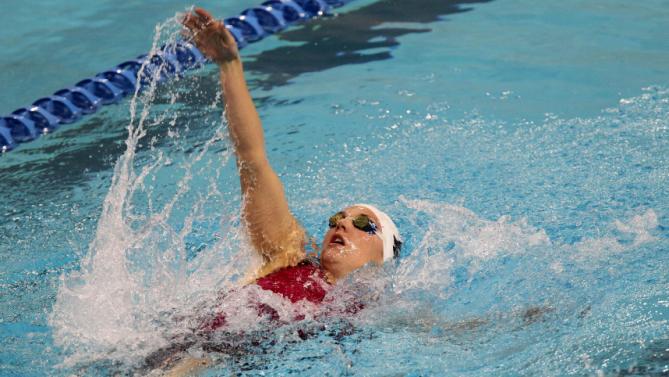
For the women’s 400 IM final, a notably partisan section of the crowd was on hand waving Hungarian flags as the 2015 World Champion and Olympic hopeful in this event, Katinka Hooszu (HUN), pulled away in 4:37.50 to win a final that included Olympic IM medalists Caitlyn Leverentz (USA) finishing sixth and Elizabeth Biesel (USA) seventh.

AP Photo/Stephen Spillman
Next up was what would turn out to be arguably the marquee performance of the evening as Olympic veteran Ryan Lochte (USA) took to the pool against a final field that included two other Olympic gold medalists, though in different disciplines.  

Backstroke Olympian Tyler Clary (USA) would finish fourth and long distance freestyle specialist Oussama Mellouli (TUN) would take eighth as Lochte, who at 31 was eight-plus years older than the average age of the field, set a UT Pool record of 4:12.66 in winning the event outright by 1.98 seconds over second place finisher Chase Kalisz (USA).

Not to be outdone, the women’s 200-meters freestyle final featured three Olympic gold medalists from the 2012 London Olympic Games. Missy Franklin (USA) came in third in her first of two finals for the evening, while her 2012 4 x 200 teammate Shannon Vreeland (USA) took eighth.  

Neither were a match for 2012 women’s 800-meters gold medalist and 2015 World Champion in this event, teenager Katie Ledecky (USA), who won in 1:54.43 to record the all-time sixth-fastest time in the event, beating out Sarah Sjostrom (SWE). This time by Ledecky was also a UT pool record.

AP Photo/Stephen Spillman
The men’s 200-meters freestyle final brought the crowd to its feet as Olympic legend Michael Phelps (USA) stepped to the blocks. Also in the field was Olympic gold medalist Jeremy Stravius (FRA); a perennial member of the French Olympic men’s relay teams that rival Phelps and others in the USA men’s relay units.  

On this night, Stravius prevailed in a time of 1:47.56. Phelps finished fourth behind Townley Haas (USA) and Jordan Pothain (FRA), foreshadowing the 2016 Olympic men’s freestyle relays should be as competitive as ever.

The women’s 200-meters backstroke final included the 2012 Olympic gold medalist Franklin and the 2015 World Championship bronze medalist Hosszu both contesting their second final of the evening.  Kirsty Coventry (ZIM), the 2004 and 2008 Olympic gold medalist in this event, was also in the field.  Perhaps due to fatigue from the attempt to double, Hosszu, with the aforementioned Hungarian crowd contingency rooting her on was beat at the touch by .34 seconds by up and comer Maya DiRado (USA).  Franklin was third and Coventry was sixth.

The men’s 200-meters backstroke final included 2012 Men’s 100-meters backstroke and men’s medley relay Olympic gold medalist Matt Grevers (USA) stepping up to the longer distance. With 2012 Olympic gold and bronze medalists (Clary and Lochte, respectively) absent from the field after the men’s 400 IM earlier in the evening, the event was a showcase for aspiring Olympians.  

Ryan Murphy (USA) who swam on the 2015 World Championship men’s 4 x100 medley relay gold medal team won easily in 1:55.99 with Grevers finishing fourth.

The penultimate final of the evening was the women’s 50-meters freestyle. Winner Sjostrom in a time of 24.17 and Arianna Vanderpool-Wallace (BAH), who placed third, were semi-finalist and finalist, respectively, in this event at the 2012 Olympic Games, indicating a strong progression. 

Olympians Natalie Coughlin (USA), Dana Vollmer (USA) and Theresa Alshammer (SWE) swept the B Final in that order. The former two Olympic gold medalists were moving down in distance for this tune up, and the 2000 Sydney Olympics silver medalist in this event, Alshammer, is still going strong at the age of 38 after a sixth place finish at the 2012 Olympics.

The last Final event was the men’s 50-meters freestyle, which included 2012 Olympic gold medalist in the 100-meters freestyle, Nathan Adrian (USA), who finished first in 21.85. Olympic silver medalist and UT alumnus Jimmy Feigen (USA) finished third and the 2012 Olympic silver medalist in the event Cullen Jones (USA) finished sixth.  The 2000 Sydney Olympics gold medalist in this event, Anthony Ervin (USA) recorded the 10th fastest time of the night with a third place finish in the B Final.

After the competition, Arena provided an autograph and photo area with their sponsored athletes including 2015 World Championships silver medalist Connor Jaeger (USA), and 2012 Olympic gold medalist Breeja Larson (USA).

Hosszu, Cullen Jones (USA), and Rowdy Gaines (USA), who was there as media, all made time to mingle with the crowd outside of the venue.

Jones was born on Leap Year Day in 1984 so good luck and birthday wishes for the Olympiad year were offered as I secured an autograph before returning to my hotel to watch the last half of the NFL Divisional Round playoff game between the Arizona Cardinals and Green Bay Packers. Folks interested in the upcoming Arena Pro Swim Series events in Orlando, Charlotte, Indianapolis and other cities will find ticket information via this link

The next morning, I grabbed a hearty breakfast at the International House of Pancakes (a nod to the weekend’s global theme), and headed to the Circuit of the Americas (COTA) Downtown Paddock to take in the Hall of Fame Collection of memorabilia documenting and commemorating the career of Brazilian F1 legend Ayrton Senna (BRA).

The exhibit, which is described as having been “meticulously gathered over a period of 20 years by private collectors Howard Jacobs and Darren Jack,” consists of photo authenticated race worn clothing, steering wheels, autographed pieces, and original F1 car parts. 

The exhibit does an excellent job of documenting and including an array of items from each phase of Senna’s F1 career with an array of impressive items, many of which are signed by the late Senna. 

Of note is the inclusion of items from periods at the beginning and end of his career when he served very short stints with the teams of Toleman and Williams. 

The exhibit showcases some very interesting and appropriate items without overwhelming the viewer with clutter.

In an 11 year career in motor racing’s highest echelon, Senna won 41 Grand Prixs and three Driver Championships before his tragic death at the Imola Raceway in San Marino on May 1, 1994. In death, Senna remains a national hero in Brazil as I had learned more about in a preparatory viewing of the 2010 film Senna that documents his life.

A frequently used freeway in Rio de Janeiro, Avenida Ayrton Senna, has been named in his honor and many Olympic visitors this year will find themselves traveling this thoroughfare. Fans might also enjoy a listen to the CD A Tribute to Ayrton Senna: A Music Documentary, which features a collection of affirmational songs from noted artists including Queen, Tina Turner, Pink Floyd, Phil Collins, Enya, and others interspersed with recorded statements by Senna himself, and notable audio race calls from key moments in his career.  (The exhibit continues through March 2016, and it is advised to call ahead at 512-655-6400 to confirm dates and times.)

My final stop before departing Austin was a visit the commemorative statue of Texas native and
Blues guitarist extraordinaire Stevie Ray Vaughn. 

Unveiled in 1993 and installed along the Riverside Drive’s Bike Trail, the statue was executed by Ralph Helmick, and on this day small roses had been placed upon his sculpted hands by prior visitors.

Vaughn’s Blues guitar, which I first heard on MTV in 1984 while watching the video to his hit song Cold Shot, was distinctive and electrifying even among other guitar greats.

I was thankful for the morning walk along the bike trail, and the time to reflect on the musical genius of another legend whose time on Earth was short but made a global impact.

With the clock approaching 1:20 p.m., and with a long drive ahead of me, I pulled onto the northbound on ramp to I-35, and as I exited the Southern metropolis I noted it was 1:46 p.m., and my 20:16 in Austin had come to an end to the minute.


It was a weekend to reflect on the past, celebrate the present, and look forward to a great Olympic year in Brazil and beyond.

Non-AP photos by J. Brian Carberry; image of UT Olympians Plaza via fd2s; Greetings from Austin vintage postcard via this blog.

Blog Archive

Powered By Blogger
Web Analytics